The Congo’s fifty-foot crocodile
Sometime in early 1888, a small government steamer was making four miles an hour up the Congo River when she ran aground. There’s nothing remarkable in that — Africa’s second longest river and the world’s deepest is a maze of shifting sandbanks, and any pilot expects to feel his hull kiss the bottom now and again. What was remarkable was that this sandbank began to heave. The water around the bow churned in a way no sandbank has any business doing, and the steamer’s engineer, leaning over to find the cause, watched the bank itself detach from the riverbed and bolt. It was a crocodile. One longer, he was certain, than his forty-two-foot boat, and it crossed the bar and tumbled into deep water before he could reach for a rifle. They had run the steamer clean into a living animal at speed, jammed it into the sand, and it had shrugged them off and left without a mark on it.
The engineer was John Reinhardt Werner, and the animal, if the Congo’s rivermen were to be believed, was the Mahamba.
A witness in the wrong century
Werner is an unusually good witness for a monster, which is precisely what makes him a problem. He was not a folklorist collecting tales around a fire, nor a Victorian showman selling a story. He was a working engineer keeping the boilers running on a colonial waterway, and he wrote his account up plainly in A Visit to Stanley’s Rear-Guard (Blackwood, 1889) as one observation among many practical ones. His steamer, the A.I.A., took her name from the Association Internationale Africaine — the “philanthropic” society, dedicated on paper to lighting the darkness of Africa and ending the slave trade, that served as Leopold II’s cover story while he assembled the private empire that would become one of the most murderous colonial regimes in history. I wanted to make that clear, because the romance of the Victorian riverboat curdles the moment you remember what the riverboat was for. Werner was part of the apparatus. His crocodile sightings come to us stamped with the flag of a project built on forced labour and mass death.
That grim provenance aside, Werner’s testimony is specific. He described these giant crocodiles as almost common on the river, and he did not hedge on size. On a low sand-spit beyond the grasses, he wrote, one might see a monster of perhaps fifty feet; he claimed to have seen several considerably longer than the A.I.A. On one occasion, stalking ducks across a sandbank with only a shotgun, he found the largest crocodile he had ever seen lying between him and his supper. Measuring it by eye against the steamer moored three hundred yards off, he reckoned it a full fifty feet long, with the ridged crest of its back standing four feet clear of the sand. He sent a boy for his rifle, thought better of the whole enterprise, and in retreating spooked the ducks — whereupon he took a shot at them, missed, and startled the crocodile into the water. It is a very funny, very human anecdote, and it has the ring of a man reporting exactly what he saw rather than embroidering a legend.
The scale problem
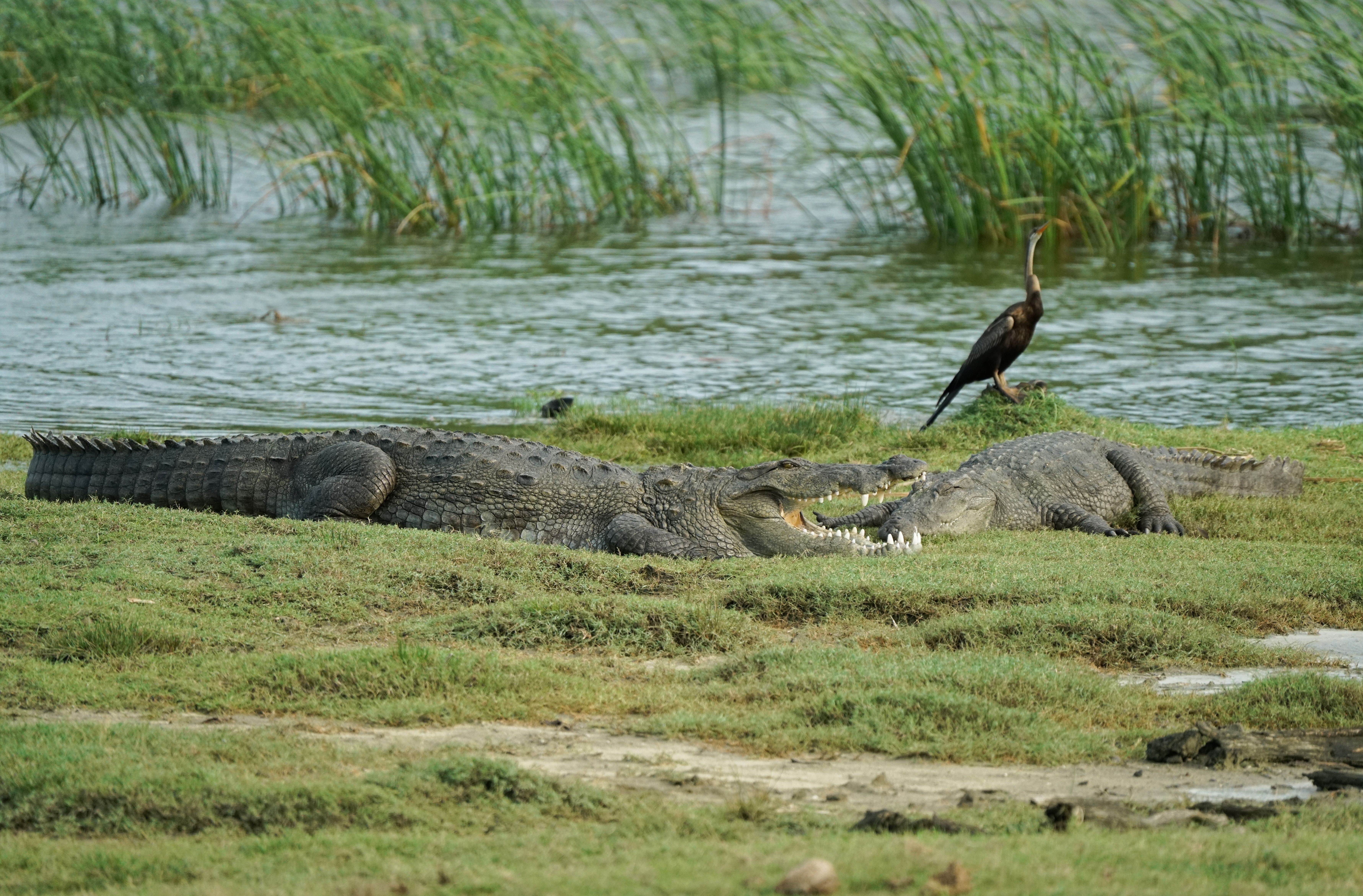
The Nile crocodile, the largest predator these waters officially hold, is a genuinely formidable animal that tops out at roughly twenty feet. A big saltwater crocodile — the largest living reptile on Earth — reaches perhaps twenty-one. Werner was describing something more than twice that length: a creature outside the entire range of any crocodile known to science, living or dead.
And that last phrase is where the Mahamba does something most cryptids cannot. It out-measures the fossil record.
The usual yardstick reached for here is Sarcosuchus imperator, the Cretaceous giant nicknamed the “SuperCroc.” When Paul Sereno’s team described it for a rapt public in 2001, the headline figure was around forty feet — a crocodile-shaped monster that shared the rivers of what is now Niger with dinosaurs and, on the strength of a five-and-a-half-foot skull, may occasionally have eaten them. Forty feet. Even by that generous early estimate, Werner’s fifty-foot animal is the larger beast.
But the comparison has sharpened since. A 2019 reassessment pulled Sarcosuchus back to a more conservative maximum of about thirty-one feet — and the other contenders for largest-ever crocodilian, Deinosuchus and the giant caiman Purussaurus, cluster in the same thirty-three-to-forty-foot bracket, all of them reconstructed from fragmentary bone. In other words, the best-supported estimate for the largest crocodyliforms that ever lived now sits comfortably below what Werner claimed to have watched sunbathing on a sandbar. The Mahamba is not merely bigger than any living crocodile. It is bigger than the biggest crocodile the earth has ever produced a fossil of.
That should give even a sympathetic and optimistic reader pause.
The second stream
The easy move would be to file Werner under Victorian exaggeration and close the book. What complicates that is a second, entirely independent line of testimony arriving nearly a century later.
In the 1980s the biologist Roy Mackal travelled the Congo basin chasing Mokele-mbembe, the region’s more famous “living dinosaur.” Along the way he collected the vocabulary the Bobangi people used for the animals of their river, and it was more precise than an outsider might expect. There was the ordinary crocodile. There was the Nguma-monene, a long, ridge-backed thing that was something else again. And then there was the Mahamba: not a separate kind of animal but a crocodile in every way that matters — same shape, same habits — only monstrously, impossibly large, forty to fifty feet and more, said to lie up in long tunnels dug into the riverbanks. The people describing it were not confusing it with anything. They were insisting, from direct familiarity with the real crocodiles all around them, that this was one of those and simply far too big.
So we have two witnesses who never met, separated by a hundred years and by every difference of language, purpose and worldview, describing the same specific impossibility in the same specific water. That is a genuinely uncomfortable coincidence, and it is the strongest thing the Mahamba has going for it.
What could it be?
The serious hypothesis is a relic: a surviving or simply undescribed giant crocodilian, a lineage that kept the old Cretaceous dimensions going in the vastness of the Congo swamps where no one has ever managed a proper survey. It is not absurd on its face — the region is enormous, poorly mapped, and has surrendered new large vertebrates within living memory.
The less serious end of the shelf holds the idea, which surfaces now and then in the cryptid literature, that the Mahamba is no crocodile at all but some freshwater relative of the mosasaurs. A 1954 sighting in the Maika marshes is sometimes pressed into service here — a large reptile that reportedly lifted an abnormally long neck from the water before diving. But that long neck pulls in the opposite direction from everything else on record; it describes a different animal from Werner’s flat-backed, short-legged, unmistakably crocodilian giant, and folding the two together muddies rather than strengthens the case.
Then there is the explanation that requires nothing new at all. A single, genuinely enormous Nile crocodile — an old, exceptional individual pushing the upper limit of its kind — glimpsed across open water, with no fixed reference for scale and a rifle conspicuously absent, is exactly the raw material from which fifty-foot estimates are honestly made. Water flatters length. Distance deceives. Fear does the rest. Werner measured his monster against a steamer three hundred yards away, and even a careful man measuring by eye across that gap can be handsomely wrong.
I remember being on the banks of the Chobe River in Botswana, and just happening to look up. At some distance – my estimation was not dissimilar to Werner’s three hundred yard steamer – I saw what I thought was a large tree floating in the centre of the river. It took me a few moments to realised it was of course, a huge crocodile. The size really threw me off and at that distance, I almost certainly over estimated it. But I did think it was every inch of twenty feet, if not more. And I made the comparison to what was in front of me – a tour boat.
So, I have some sympathy for anyone matching boat sizes to unusually large crocodilians. But I think we can accept it’s not an exact science.
Where are the bones?

Which brings us to the question that closes the file on the Mahamba, as it closes the file on most of its kind.
We know Sarcosuchus was real because it left us a skull the length of a man and enough skeleton to argue over. We know the outer limits of crocodilian size because the fossil record, patchy as it is, has physically produced the animals. The Mahamba has produced witnesses — good ones, independent ones, a century apart — and not one confirmed bone. No skull, no skeleton, no shed tooth the size of a hand, nothing hauled from a bank or found bleaching on a sandbar. For an animal supposedly common enough that a working engineer saw several in the course of doing his job, that absence is very loud.
Sarcosuchus outgrew the living world and left us its remains. The Mahamba outgrew even Sarcosuchus, and left us only the water it disappeared into.