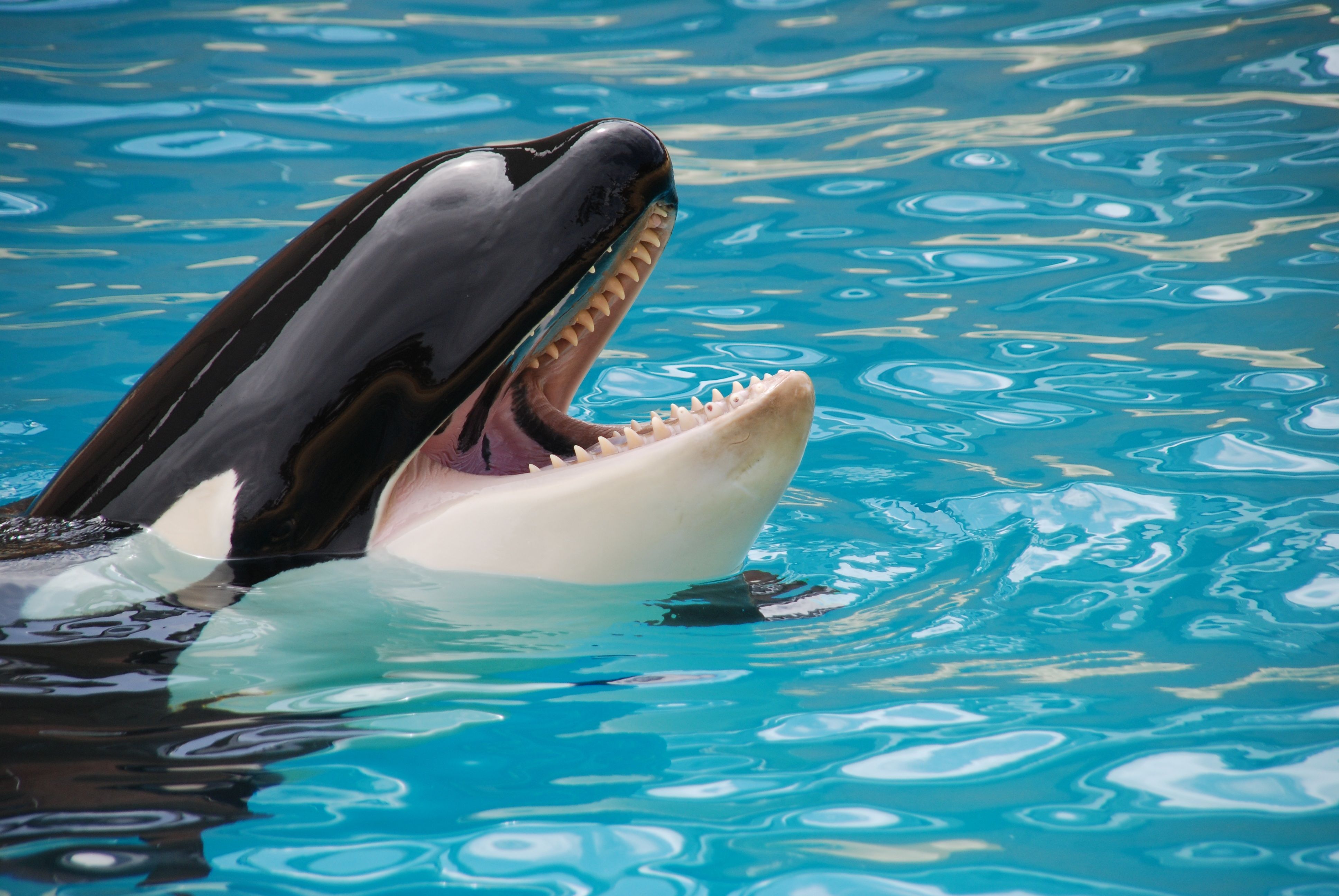
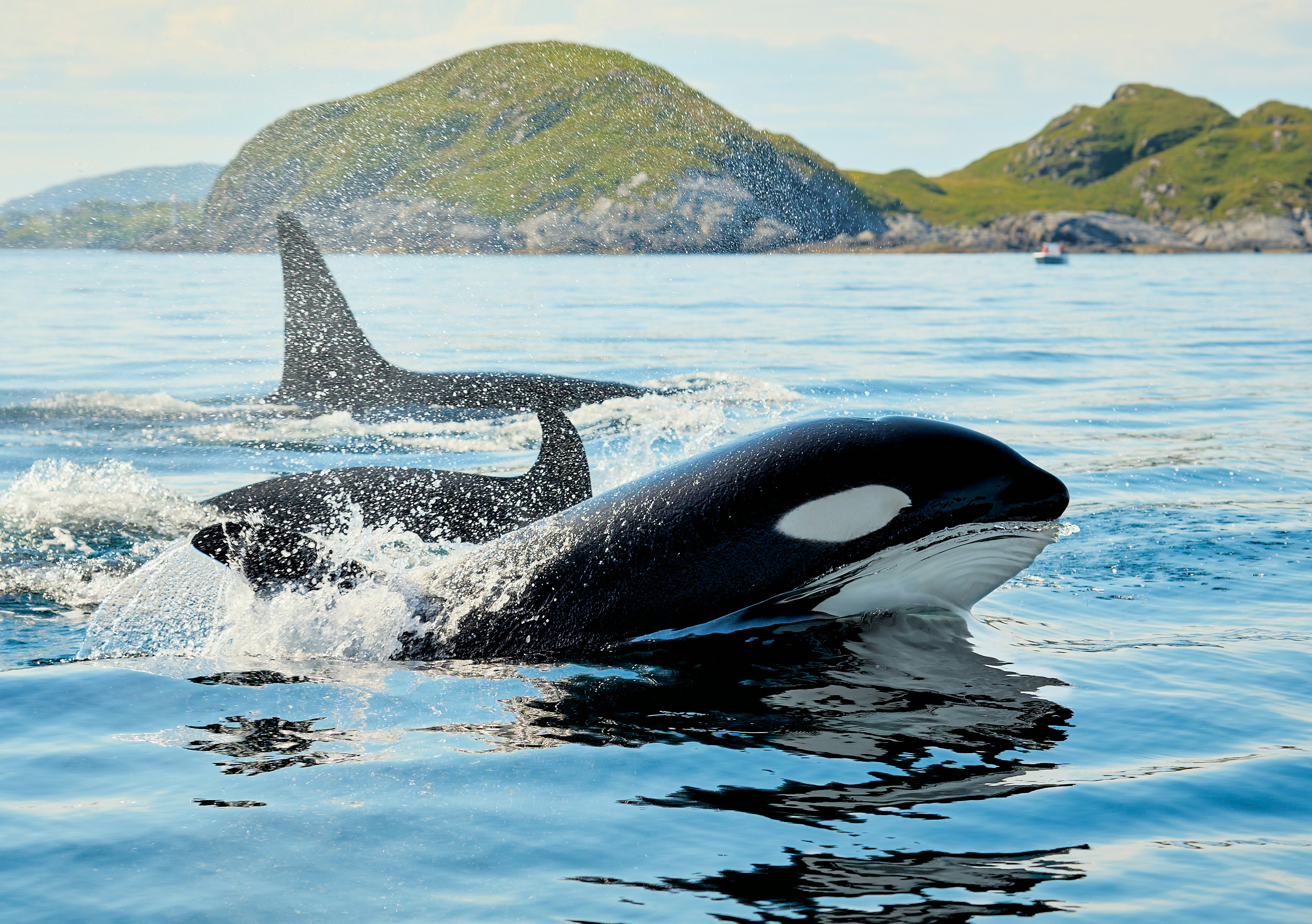
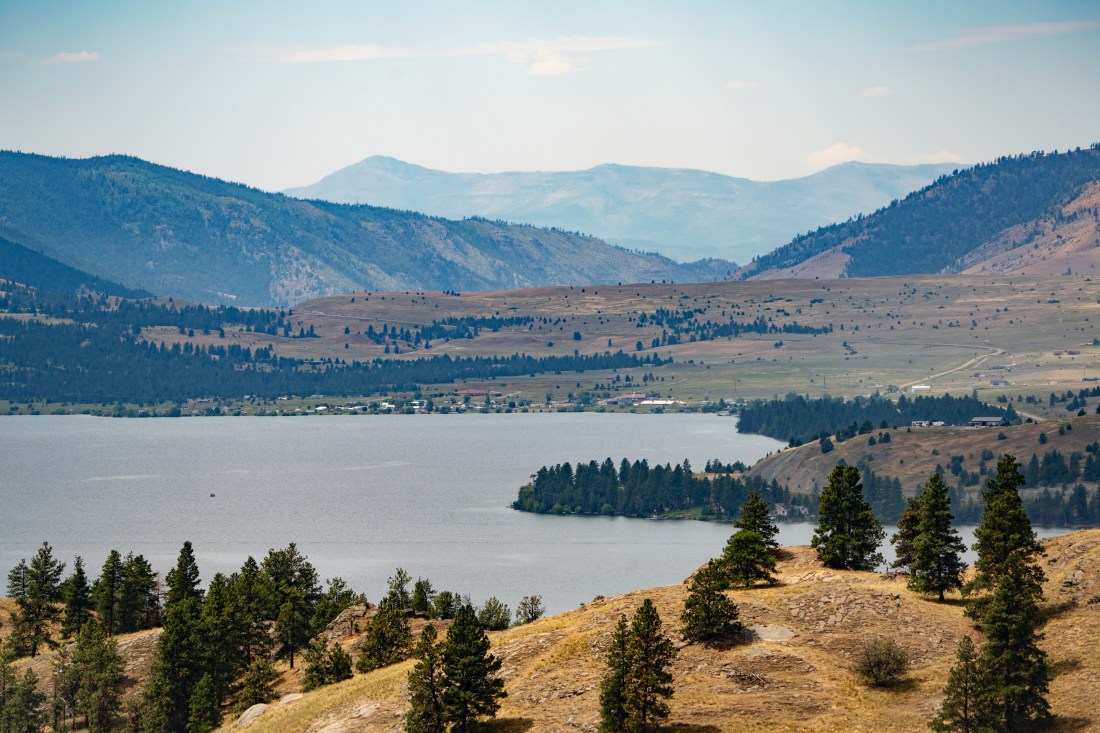
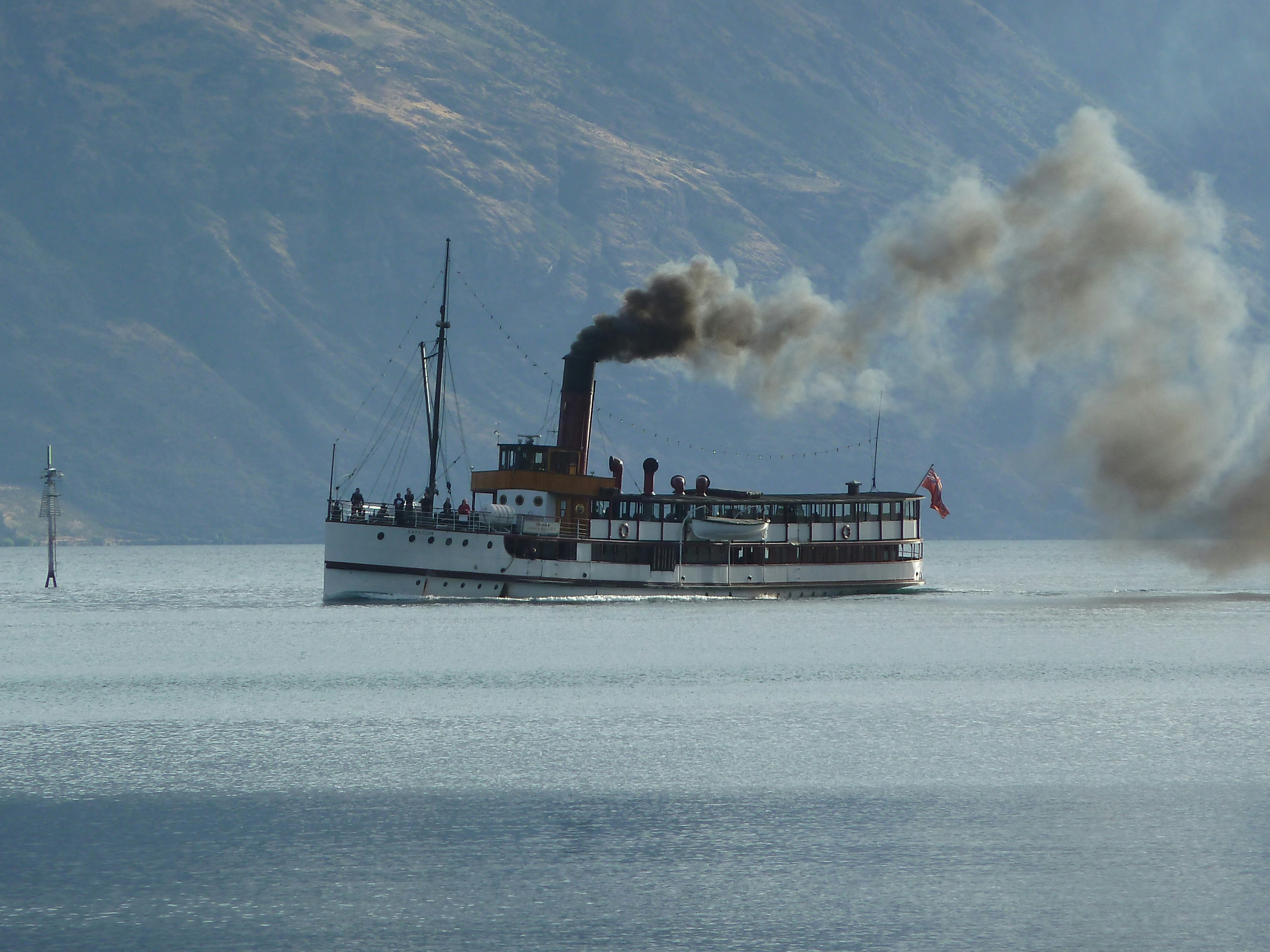
For a while now I’ve been keeping two houses and doing neither of them justice. That ends today.
From here on, my writing lives at Field Notes by Luke on Substack. The nature essays, the conservation arguments, the pieces on craft and independent publishing, and yes — the cryptids and the folklore and the things people swear they saw on a back road at dusk. All of it, in one place, arriving in your inbox the moment it’s finished.
This blog isn’t being deleted. The archive stays exactly where it is, and I’ll still post here when something genuinely suits the format. But if you want the work — the real work, as it appears — Substack is where to find me.
Why
Partly it’s the reason any writer eventually chooses one desk over two. Split your output across platforms and you don’t get twice the readership; you get half the writing.
But mostly it’s this: readers have been telling me for months that emails they signed up for never arrived, that comments disappeared, that they’d assumed I’d stopped writing altogether. That’s a poor arrangement for everybody, and no amount of tinkering has fixed it. Substack does one thing and does it plainly. I write, and it lands with you. There is no feed deciding whether you’ve earned it this week.
What’s waiting
Most of it is free. Sign up, pay nothing, and you’ll get the essays and field pieces as they publish — more of them than you’ve been getting here, and more ambitious. Substack is where I’ve decided to stop playing safe. The research goes deeper, the arguments have edges, and I’m rather less interested in being agreeable than I used to be.
There’s also a paid side, and it’s worth explaining what it actually is, because it isn’t a tip jar.
The Reyes Files is a monthly serialised novel-in-episodes. Marcus “Red” Reyes is a former Army combat tracker who works the cases nobody files properly — the animal that shouldn’t be in that county, the death that got written up as an accident because the alternative was unwriteable. There is nothing supernatural in it. Everything is treated as a biological problem, tracked and solved with real fieldcraft, because that’s the only version of this I have any interest in writing.
The pilot episode is free to read in full. Go and see whether it’s for you before you spend a penny.
Paid subscribers get every episode, the full back catalogue, and the run of the archive. Founding members also get the year’s episodes as a printed paperback, which I post out myself.
What I’m asking
Just this: come with me.
If you’ve been reading here for years, you’re the reason any of this works, and I’d rather not lose you to a platform’s bad plumbing. It takes about fifteen seconds and costs nothing.
At a quarter past twelve on 9 March 1976, some 560 miles north of the equator and a very long way from anyone, something hit the bow of the yacht Guia III hard enough to shift it three metres sideways.
Claudio Cuoghi was at the helm and had felt nothing coming. By the time Giorgio Di Mola got below, the forward compartment was already full. The breach was well beneath the waterline and far too large to plug; two spinnaker bags stuffed into it were sucked straight back out, taking a crewman’s arm most of the way with them. Sails passed under the hull were torn away. The batteries went under before a proper mayday could get out. Jérôme Poncet, skippering that leg of the Atlantic Triangle, said afterwards that not even God could have saved her.
She sank bow-first. The crew got into an inflatable with fourteen litres of water between them and were picked up around midnight the following day, having fired flares at a passing ship. Within the week they were at the Waldorf Astoria as guests of Whitbread, which was rather the point of the race in the first place.
There were five orcas around the boat while she went down. One of them lay against the hull, entirely still, in a posture that Francesco Longanesi Cattani could only describe as the animal trying to work out what sort of creature Guia was. On deck, another crewman was shouting that the whale had come to murder them. When the yacht finally went under, the orcas left.
Two readings of the same animal, in the same four minutes, from men standing five feet apart. One of them describes an intelligent predator investigating an unfamiliar object. The other describes a monster. Fifty years on we are still choosing between them, and the record of which one we picked, and when, and why, is largely a record of what was showing at the cinema.
The killer, dismissed
Before the orca could be a monster, it had to be worth noticing, and for most of the written record it was not.
The sixteenth-century naturalists were happy enough with sea monsters in the abstract — Konrad von Gesner and Ulisse Aldrovandi both produced cetaceans of extravagant proportions, ship-devouring things with fountains erupting from their skulls — but these were whales in general, monstrous by category rather than by species. The orca had no particular billing.
Melville, three centuries later, gives it a paragraph and a shrug. In the Cetology chapter of Moby-Dick, Ishmael admits that the Nantucketer knows little of this whale and the naturalist nothing at all. He allows that it is savage, that it will fasten onto the lip of a larger whale and hang there like a leech until the bigger animal is worried to death. Then he loses interest. The killer is never hunted, he notes, and he has no idea what sort of oil it yields. He objects to the name on grounds of imprecision, and delivers the line that has outlived the rest of the passage by a comfortable margin: For we are all killers, on land and on sea; Bonapartes and sharks included.
There is something almost funny about this. The monster slot in the greatest whaling novel ever written goes to the sperm whale — an animal that mostly wants to be left alone in the dark eating squid — while the actual apex predator of the world ocean gets four sentences and a note that nobody bothers with it.
What did exist was testimony, and the testimony has always been more interesting than the fiction.
Two Inuit elders in the Foxe Basin passed on an account of a young man in 1955 who ignored advice about the thinness of the ice over Grand Suttie Bay, walked out over a polynya where orcas were trapped, and was taken when the whales deliberately broke the ice beneath him. It is oral history, it cannot be verified, and it is entirely possible that it is a cautionary tale about listening to your elders wearing a whale as a costume. But it should not be waved away either. It comes from people who lived and hunted alongside these animals in conditions no marine biologist has ever worked in, and it describes something behaviourally coherent — orcas breaking ice from below is documented hunting behaviour, not invention.
We have a photograph of very nearly the same thing. In the early 1910s, during the Terra Nova expedition, a pod of Antarctic pack-ice orcas made a determined attempt to wave-wash a photographer and a team of sledge dogs off an ice floe. Pack-ice orcas specialise in washing seals off floes. The dogs were barking. Nobody was hurt, and the modern reading is that the whales were doing exactly what they always do, to what they reasonably believed were seals.
And then, in the space of four months in 1972, the two incidents that ought to have given anyone writing a killer whale film all the material they needed.
In June, Dougal Robertson’s forty-three-foot schooner Lucette was struck by orcas 200 miles west of the Galápagos and sank in about a minute, putting his family into a raft and a dinghy for thirty-seven days before a Japanese fishing boat found them. In September, an eighteen-year-old surfer named Hans Kretschmer was bitten on the leg at Point Sur in California, taking something close to a hundred stitches. His doctor reportedly said it looked as though somebody had gone at his thigh with an axe.
Kretschmer’s case is the only documented instance of a wild orca injuring a human being. It is also, on inspection, the case for the defence. There were sea lions in the water. He punched the animal’s head, and it let go. He then bodysurfed to shore expecting a second strike that never came. The pattern — a single investigative bite followed by immediate release — is far more legible now than it was in 1972. The one time an orca ever laid teeth on a human in the wild, it appears to have realised its mistake and spat him out.
That is the whole evidentiary record, more or less, as it stood in the mid-1970s. A sunken schooner. A bitten surfer. Some Edwardians on an ice floe. An unverifiable story from the Canadian Arctic. Against it: an animal that had, by then, been netted, sold, towed, penned and taught to jump through hoops for the better part of a decade, and had done almost nothing about it.
Hollywood was about to fix that.
The gentle giant, and what he built
In June 1965, a young male orca drifted into a salmon net near the village of Namu in British Columbia. The fisherman who found him rang Ted Griffin, who owned the Seattle Marine Aquarium, and Griffin bought the whale for eight thousand dollars, which turned out to be the cheapest part of the exercise. Namu was towed 450 miles south in a floating pen. Crowds lined the Seattle waterfront. Aircraft circled.
Namu became the first captive orca to perform in the water with a person, and Griffin — riding him in front of paying audiences — became a local hero. There was a film, Namu, the Killer Whale, made by United Artists in 1966, in which a marine biologist befriends a misunderstood whale and must persuade frightened fishermen that the animal is gentle. There was a theme song. There was, in the space of about eighteen months, a wholesale reversal of the killer whale’s public reputation from oceanic vermin to enormous friendly dog.
Namu died on 9 July 1966, having survived just over a year. He had picked up a bacterial infection from the polluted water of his pen; weakened, he became entangled in the cables of his enclosure and drowned. Griffin later said he wished the whale had succeeded in what he chose to describe as a break for freedom.
Here is the fact around which everything else in this essay orbits. The film that taught the world to love orcas is the film that built the industry that killed them. Demand for a Namu of one’s own was immediate and enormous. Griffin founded a whale-catching company to supply the marine parks; his best customer was SeaWorld. He took the calf who became the original Shamu, having harpooned her mother. By 1970 the Penn Cove captures were using boats, aircraft and explosives to round up young whales in Puget Sound, and four calves drowned in the nets. The bodies were weighted and sunk. They were found the next day.
None of this was a betrayal of the gentle-giant story. It was the direct commercial consequence of it. You cannot sell tickets to see a monster up close. You can sell an enormous number of tickets to see a friend.
Find me a fish
In the middle of the night in 1975, Dino De Laurentiis telephoned the screenwriter Luciano Vincenzoni. Vincenzoni admitted to having seen Jaws. De Laurentiis instructed him to go and find a fish tougher and more terrible than the great white.
Vincenzoni, by his own account, had no interest in marine life whatsoever. His brother Adriano, who did, pointed him towards killer whales. The orca is not a fish, but that has never been the sort of objection that slows a producer down.
What emerged was Orca, directed by Michael Anderson, shot largely around Petty Harbour in Newfoundland, released by Paramount in July 1977 on a budget of six or seven and a half million dollars, depending on whose accounting you trust, and taking $14.7 million. Ennio Morricone wrote the score, which is far better than the film deserves. Richard Harris plays the fisherman with the full-throated commitment of a man who has decided that if he is going to be in this, he is going to be in this. Charlotte Rampling is the marine biologist. Will Sampson, two years on from One Flew Over the Cuckoo’s Nest, is the Indigenous man who understands what the whale is doing. Bo Derek loses a leg, in case anyone had failed to spot which film was being remade.
The plot: Harris’s character harpoons a pregnant female orca. She miscarries on his deck, in a sequence still capable of clearing a room. Her mate then works through his boat, his livelihood and his town until the two of them can settle it on open water.
It is, of course, Moby-Dick turned inside out. Melville’s whale is a blank onto which Ahab projects everything; the horror is that we cannot know whether there is anything behind it. Vincenzoni’s whale has motive, grief, a plan, and something close to a legal case. The animal Melville could not be bothered to describe has become the only character in the film with a coherent inner life.
The phone call
Which brings us back to Guia III, and to the strangest document in this whole story.
In the weeks after the sinking, Giorgio Falck received a telephone call from Los Angeles. The caller introduced himself as a friend of Falck’s brother-in-law. He gave his name as Vincenzoni. He said he had been studying killer whales for three years and was writing a book about them.
He then told Falck a story. In New Zealand, a fishing boat had injured a female orca with its propeller. The male had sunk the boat — and he was careful with the detail, noting the vessel’s seventy-millimetre planking against Guia‘s thirty-five. A month later, in the same place, the same animal had killed a crew of six.
That is the plot of Orca, related as established fact, to a man who had just lost his boat, sixteen months before Paramount put it in cinemas.
I cannot prove that this was Luciano Vincenzoni, and I am not going to pretend otherwise. The claim of three years’ study sits awkwardly against a brief handed down in 1975, and it is at least possible that the caller was his brother Adriano, the one with the zoological interest. But the call came from Los Angeles. The surname is not common. The timing lands precisely inside the film’s development. And the anecdote is not merely similar to Orca‘s premise; it is Orca‘s premise, with the numbers filed off. On the balance of everything we know, this is the film being written, out loud, down a transatlantic line, to a survivor.
It is worth pausing on what that story actually asserts. Six people killed by a single orca would be, by a wide margin, the worst loss of human life to a killer whale ever recorded anywhere. It appears in no register, no report, no scientific literature. Somebody in Los Angeles in 1976 was collecting atrocity stories about killer whales, and either could not tell or did not care which of them were true.
And then Falck — who had every reason on earth to want a monster, who had just watched a boat he loved go down and who describes the orca as a hateful animal — refuses the story flat. He tells the caller he is perfectly aware sea monsters are in vogue since Jaws. He is aware that Guia‘s sinking is of interest chiefly because it happens to involve a topical one. But he is interested in boats and in racing, not in orcas and not in violence.
The man with the strongest possible claim on the revenge narrative would not take it. It was offered to him by a screenwriter, and he handed it back.
Yaka, Nepo, and the whales in the lorries
Orca was made with real whales, and this is where the film stops being merely silly and becomes something closer to evidence.
The two animals identified as the film’s leads are Yaka and Nepo. They were captured together on 11 December 1969 at Pender Harbour in British Columbia, when a group of twelve orcas — Northern Residents, a fish-eating population — was surrounded in a storm and six young animals taken. Yaka was around a year old. Nepo was around two. They were podmates. They were sold together, moved to Marine World in California on 28 December, and put in a tank with an older female called Kianu.
For a few years the three of them did well enough. Kianu grew possessive of Nepo and aggressive towards Yaka, and was sold to Japan in April 1978, which left the two survivors of the Pender Harbour capture alone together. The park hoped Yaka would breed. She never did.
Nepo died on 10 July 1980, of acute bronchopneumonia and kidney disease, at roughly twelve or thirteen years old. Yaka was beside his body and reportedly would not leave it, and afterwards stopped eating and stopped engaging with her trainers. A companion was brought in, an Icelandic female called Vigga, and the two of them performed together for over a decade. Yaka died on 29 October 1997 of a respiratory infection, having spent nearly twenty-eight years in tanks. She had been taken from the sea before she was old enough to have learned to hunt in it.
Marineland of the Pacific also supplied whales to the production, and the likeliest candidate there is Corky II, taken in the same 1969 round-up, though the crediting on this has been muddled for decades and I would not swear to the detail.
They are, by any reasonable measure, wonderful in the film. They are also, by any reasonable measure, giving away the entire game, because their dorsal fins have collapsed. It is a condition essentially unknown in wild males and rare in wild females, and near-universal in animals held long-term in tanks. It is on screen. In a film about a wild orca’s stolen family. In 1977. Nobody in the production appears to have thought it worth a comment.
Because the whales could obviously not be made to bite off Bo Derek’s leg or carry a corpse across a harbour, the effects team also built animatronic orcas out of rubber. These were good. They were good enough that when they were driven to set, animal rights activists blocked the lorries, believing there were live whales inside.
Sit with the shape of that for a moment. Protestors on a road in the mid-seventies, correctly identifying the crime, correctly identifying that whales were being trucked about for entertainment, and stopping entirely the wrong vehicle. The animals they were trying to save were not in the lorries. They were already at the park, already performing twice a day, and had been for six years. They would go on doing it for another twenty.
The door closes
Free Willy arrived in 1993 with a plot about a boy liberating a captive orca, and had the singular distinction of generating a real liberation campaign for its own star. Keiko had been captured off Iceland and was living in a small tank in Mexico City. Public pressure moved him to Oregon, then to Iceland, then to a sea pen; he eventually swam to Norway, where he died in 2003. Whether it worked depends entirely on what you thought it was for. He never rejoined a pod. He also spent his last years in the sea.
Then 2013, and Blackfish, and the argument was effectively over. What the film did was not reveal that captivity was cruel — people had been saying so since Namu — but connect the cruelty to the deaths of specific named human beings, and make the connection impossible to un-see. Every human being ever killed by an orca has been killed by a captive one. There is no confirmed fatal attack by a wild killer whale anywhere in the record, ever. The animal only becomes a man-killer inside a tank.
That is a devastating fact for a monster movie. It means the horror cannot be located in the animal. It can only be located in us.
The film that argues itself out of existence
Killer Whale arrived in January 2026, directed by Jo-Anne Brechin and co-written with Katharine E. McPhee, distributed by Lionsgate. Ceto is an orca held in a Thai marine park; after she kills a janitor, the management dumps her into the open sea. Two friends on holiday end up trapped in a lagoon with her.
On paper this should work. The premise carries genuine moral charge, the animal has a real grievance, and the audience arrives pre-loaded with everything Blackfish taught them. The film reviewed catastrophically — twenty per cent on the Tomatometer, and, more tellingly, twenty-one per cent with audiences.
The reviews are unusually consistent about why. Screen Rant found it succeeded as a sombre meditation on captivity and failed as a survival film, and concluded that the director was less interested in making something vicious than in condemning what had been done to the whale. Rue Morgue put its finger on the structural problem: the film cannot decide whether Ceto is an object of fear or of sympathy, and so makes the woman who cares most about her into her principal victim. The film even puts the argument for the defence into its own dialogue, noting that the only recorded fatalities have involved captive animals — a point one reviewer observed, drily, that nobody watching was going to care about.
So the received wisdom is that the captivity angle should have given the film an edge, and the evidence is that it did precisely the opposite. It disarmed it. You cannot frighten an audience with an animal they have already acquitted. The moment you explain why she is angry, you have converted your monster into a plaintiff, and the remaining eighty minutes become a courtroom drama in which everybody has already agreed on the verdict.
The orca is, I think, the only screen monster we have successfully talked ourselves out of. We know perfectly well that sharks are misrepresented and ecologically vital, and The Meg still took a billion dollars. We know bears are not malevolent and we still watch films about them eating people. But the orca’s rehabilitation was so recent, so total, and so specifically bound up in the story of its captivity that the monster no longer fits inside the animal. There is nowhere left to put it.
The revenge was always ours
And then, in May 2020, the whales started sinking boats.
Off the Iberian Peninsula, orcas began ramming vessels and biting the rudders off sailing yachts. By the middle of 2025 there had been more than 750 recorded encounters, over 250 boats damaged, and at least six sunk. The behaviour spread. The press adored it. The animals were assigned the collective designation “Gladis”, after Orcinus gladiator — whale-fighter — and the internet did what the internet does. They were called comrades by a labour organiser and by a newspaper columnist. Merriam-Webster announced that it welcomed its new Delphinidae overlords. A revenge fantasy that Paramount could not sell in 1977 was, in 2023, the most popular story in the world.
Except that it is not a revenge fantasy. It is fifteen animals.
The Iberian orcas are a genetically and culturally distinct subpopulation, listed by the IUCN as Critically Endangered since 2019, numbering fewer than forty individuals in total, and dependent on Atlantic bluefin tuna, which has its own problems. Around fifteen of them have taken part in the boat interactions: eleven juveniles and four adult females, with no identifiable ringleader. The rate is falling — 207 interactions in 2023, 136 in 2024, 125 the year after. Nobody has been hurt. Not once, in over 750 encounters. As GTOA’s Alfredo López has pointed out, they do not come in hard and sink the boat, which they could do easily if that were the objective.
Fifteen adolescent whales from a population smaller than a decent pub quiz turnout, most of them apparently playing, against which we have constructed an international narrative of maritime vengeance.
And here is the fact that ought to end the argument. Through the 1960s and 1970s, while Pacific orcas were being chased by aircraft, herded with explosives, netted, and stripped of their young — while Yaka and Nepo were being taken, sold, and put to work — those whales did not attack boats. Not one. There is almost no evidence that wild killer whales seek revenge at all. A chimpanzee robbed of food will retaliate. An aggrieved macaque will settle the score, sometimes against a relative of the offender. Orcas do not do this. The trainers killed in the parks were killed by animals that researchers believe were psychologically wrecked by the conditions they were kept in, which is not revenge either. It is something worse and much sadder.
The revenge was never theirs. We wrote it. We filmed it, using the actual victims as extras, in a park, for money. And half a century later, when a handful of bored teenagers off Cádiz started snapping rudders for reasons no one can establish, we recognised our own script and gave it a standing ovation.
The coda is uglier. Sailors are now carrying illegal firecrackers to throw at a critically endangered species. Some play death metal through speakers. Others bang steel bars against the hull. Marine mammal biologists are openly braced for someone to shoot one. The single population that has ever cost us anything is the one we are arming against, while the whales who genuinely had cause never lifted a fluke.
One of the six young orcas taken at Pender Harbour on that December night in 1969 is still alive. Corky II went to Marineland of the Pacific rather than Marine World, and to SeaWorld San Diego in 1987 when Marineland was bought and closed. She is around sixty-one. She has been in tanks for fifty-six years, longer than any orca in history. She was pregnant seven times and none of her calves lived past seven weeks. She has cataracts. She still performs.
Her siblings are alive in the water off British Columbia. When researchers played her family’s calls to her in 1993, after twenty-four years of captivity, she reacted so strongly that she was seen to shudder.
Melville thought the killer whale was hardly worth the ink. Namu made it loveable, and the loveliness built the tanks. De Laurentiis wanted a fish tougher and more terrible than the great white, and got a mammal that has never knowingly killed anybody. Killer Whale discovered in 2026 that you cannot run a monster movie on an animal the audience has already forgiven.
And a whale who is very probably in Orca is still swimming in circles in San Diego, forty-nine years after the film came out, having been cast as the monster in a story about her own abduction, and having never in fifty-six years done a single thing to deserve the part.
In 1889, the year Montana became a state, a steamboat called the U.S. Grant was working its way down Flathead Lake with something over a hundred passengers aboard. Her captain, James C. Kerr, saw a log in the water ahead.
Then the log started moving.
What Kerr and his passengers reported was an object of perhaps twenty feet, whale-like, coming towards the boat. One passenger — and here the nineteenth century announces itself — produced a rifle and fired at it. The thing went down. Everybody got home. And the Flathead Lake Monster, in the form we still argue about, was born on that afternoon.
It has been argued about ever since. More than a hundred sightings have been logged in the years since Kerr, most of them between April and September, which is either evidence of a creature’s seasonal habits or evidence of when people are on the water with a drink in their hand. Locals call it Flessie, in tribute to a more famous Scottish resident. Two explanations dominate: a sturgeon, or a giant eel.
Both of those explanations are worth taking seriously. Neither of them, it turns out, came from the lake.
The lake’s case for itself
Flathead is not a pond. It covers close to two hundred square miles, runs to a maximum depth of 370 feet, and is the largest natural freshwater lake west of the Mississippi. Tom Bansak of the Flathead Lake Biological Station describes it as a geological remnant of Glacial Lake Missoula, that vast ice-dammed body whose repeated collapses scoured the Pacific Northwest.
So the concealment argument has legs. There is genuinely a great deal of cold, dark water here, and a fish with any sense would spend most of its life at the bottom of it.
The sturgeon, taken seriously
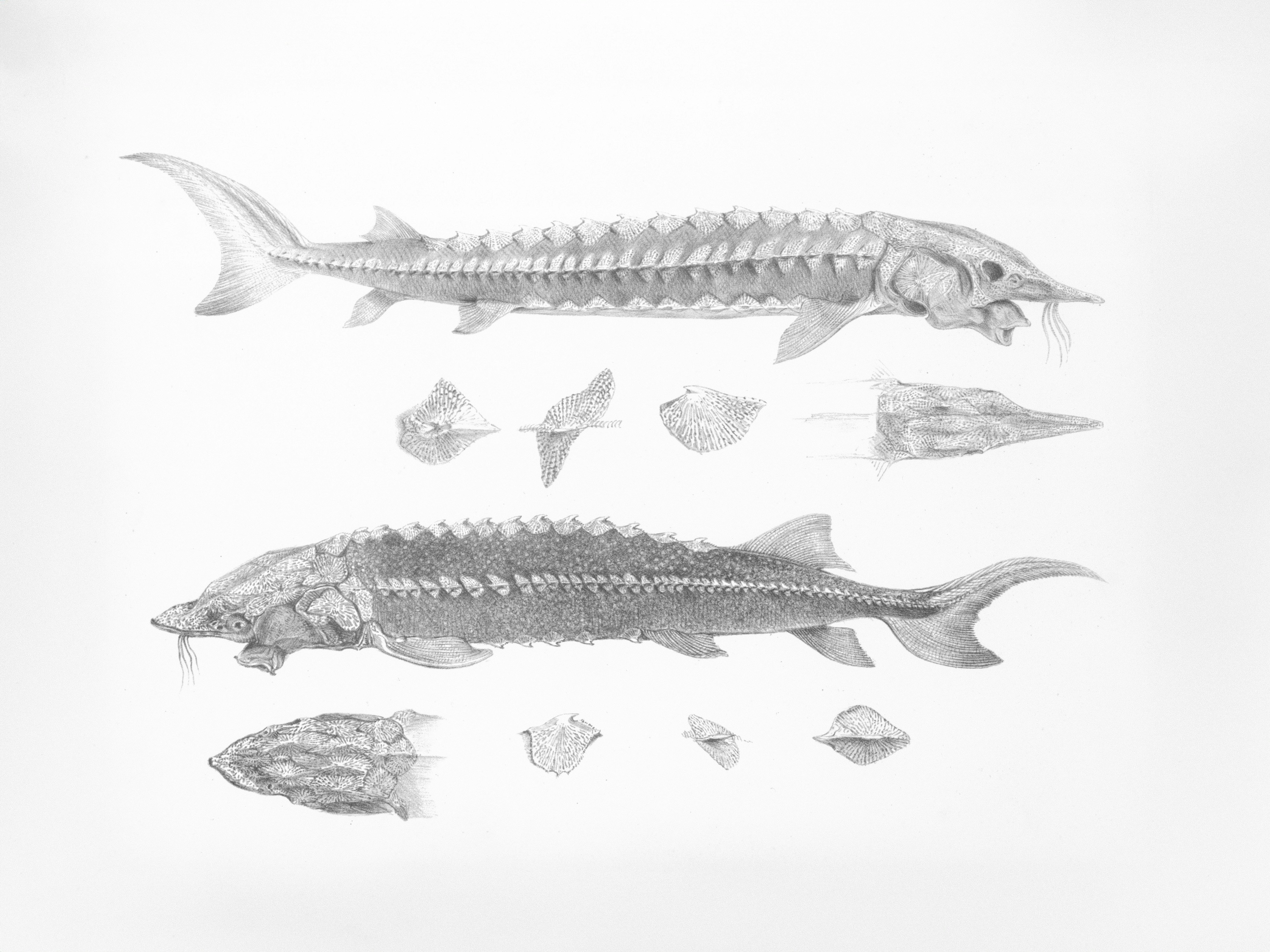
The white sturgeon is the largest freshwater fish in North America, can live the better part of a century, and looks — with its ridged back and long tapering snout — convincingly prehistoric. It is not a mad suggestion. Flathead drains into the Clark Fork, the Clark Fork into the Pend Oreille, and onwards into the Columbia system, so we are at least in the right plumbing.
Bansak is admirably straight about it: he thinks it highly likely that sturgeon lived in Flathead Lake or its predecessors, and says the real question is whether they persist and whether anyone can prove it. That is the honest scientific position, which I have little ability or interest in discrediting.
The difficulty is everything after that. The nearest white sturgeon are in a different drainage — the Kootenai River below Kootenai Falls, and Kootenay Lake up in British Columbia — and biologists cite waterfalls, and later dams, are precisely what fixed those limits. Flathead has been netted, electro-shocked, and visited by small submarines. Nothing out of the ordinary or monstrous has been officially recorded. Brian Marotz, then of Montana Fish, Wildlife and Parks, made the point that with a popular deep-water lake trout fishery operating year after year, somebody should long ago have pulled up at least a small or juvenile monster by accident.
And there is an arithmetic problem nobody likes to dwell on. The creature of the sighting record is thirty to forty feet long, undulates like a snake, and has black eyes. Even the most magnificent of sturgeons does not match that description.
The sturgeon, and where it actually came from
Here is the part that reframes the whole business.
In the 1950s, a group of Polson residents formed an organisation called Big Fish Unlimited. Its stated purpose was not zoological. It existed to generate publicity of the economically beneficial kind for the town at the south end of the lake. To that end it offered money: five hundred dollars for a sturgeon over nine feet, a thousand for one over fourteen.
Enter C. Leslie Griffith, aged sixty-three, described as a freelance fisherman, and who had reportedly taken a 300-pound white sturgeon out of Idaho’s Snake River. He moved to the lakeshore near Dayton and fished for the best part of three months. On a Friday evening in late May 1955, off Cromwell Island, something took his line and — by his account — towed his sixteen-foot cedar boat around the lake for five hours before he gaffed it.
The fish was seven feet six inches long and weighed 181 pounds. Within hours it was on ice in the Salish Hotel building and views could be had at twenty-five cents a look, ten cents for children, with a competition to guess its weight thrown in. Promotional posters billed it as “our baby monster”. Some seven thousand people came. The Great Falls Tribune put it on the front page under a headline about a fisherman hooking the Flathead Lake Monster, while noting, drily, that nobody had ever caught a sturgeon in that lake before or produced good evidence there were any. The Tribune also observed that the fish subsequently swelled to 350 pounds in newsprint.
When people began asking the obvious question — had it actually come out of the lake — the promoters responded with a masterpiece of logic. They offered a thousand dollars to anyone who could prove it hadn’t. Griffith and the group’s leading light both signed notarised statements swearing it had. Two university zoologists opened the fish up and found the situation no clearer, though one of them noted a fish backbone inside it that didn’t appear to belong to anything known to live in Flathead.
Then, as these things do, it went to law. Griffith sued over ownership and money. It took until late 1959 for the Montana Supreme Court to settle it, and the court offered no opinion whatsoever on where the fish had come from.
And the fish is not in the state records. Not then, not now.
That absence deserves emphasis, because it cannot be explained away as paperwork nobody filed. The official Montana record for white sturgeon is a 96-pound fish caught in the Kootenai River in 1968. Griffith’s was 181 pounds. Had it been accepted, it would have taken the state record by nearly double and held it comfortably for the next sixty years. Fish of that size do not slip quietly past the record-keepers.
To be scrupulous: record books have eligibility rules about method of capture, witnesses and certified scales, and a man who gaffs a fish alone after a five-hour fight may simply fall outside them. Absence from the books is not proof of fraud. But it is not an oversight either, and the state of Montana has now spent seventy years declining to write down the most famous fish ever taken from its most famous lake.
The sturgeon theory, in other words, does not rest on a fish. It rests on a bounty.
The eel, and the map
The eel is the other favourite, and it dies faster.
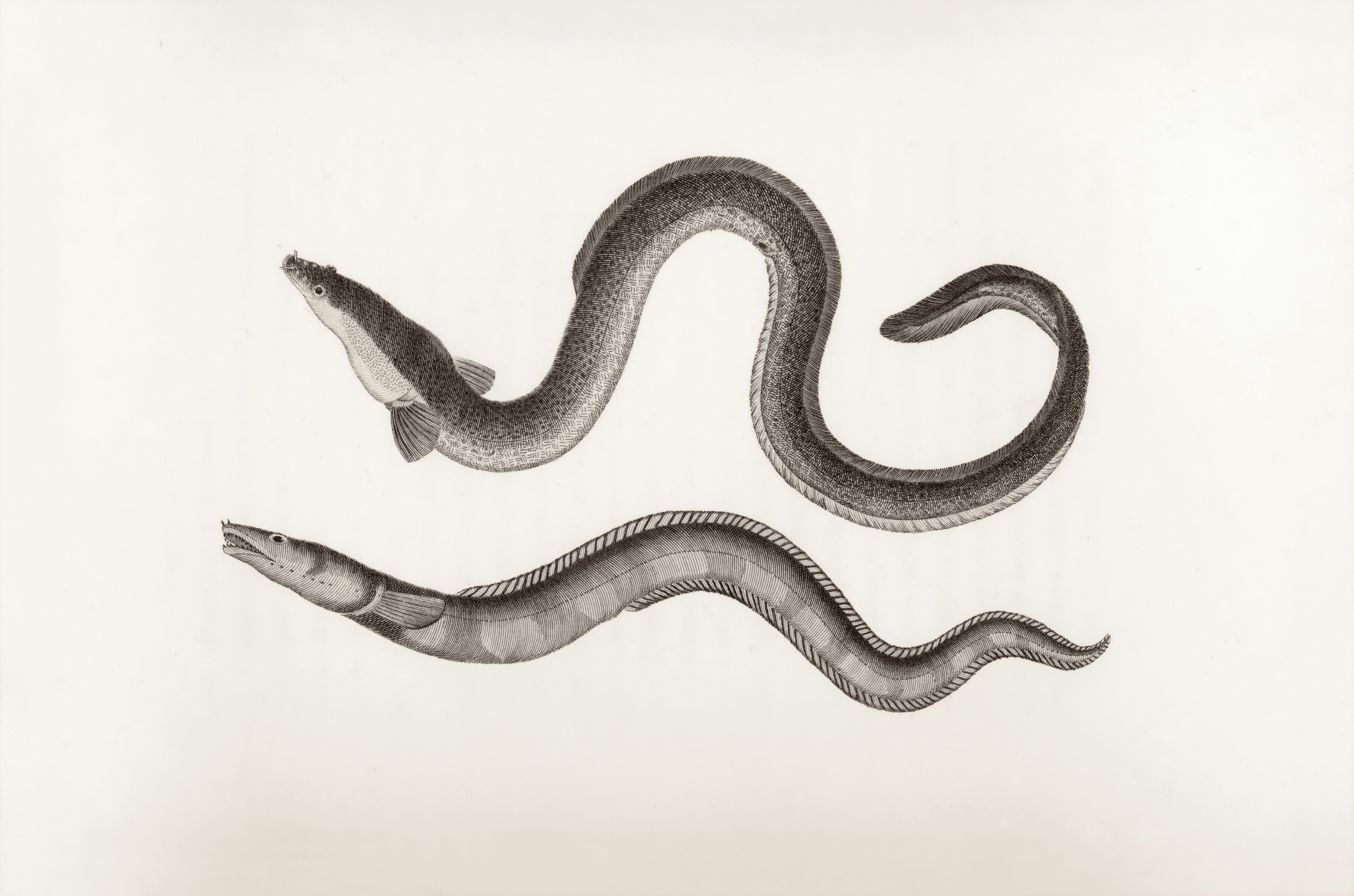
There are no freshwater eels in any Pacific drainage of North America. None. The American eel is an Atlantic animal that spawns in the Sargasso Sea, and there is no route from there to a lake in western Montana that does not involve a lorry, or truck in American parlance. The nearest eel-shaped candidate is the burbot — a freshwater cod, elongate, nocturnal, deep-dwelling — and even the burbot is native to the Kootenai drainage rather than the Flathead, turning up in the lower Clark Fork only as an introduction. Wrong system, wrong size, wrong animal.
Which tells us what “eel” is doing in these accounts. It isn’t a taxonomic proposal. It is a word people reach for when they have seen something long moving through water, because English does not offer them a better one. Well, other than monster.
The thing under the ice
Long before any of this, the Ktunaxa told a story about the lake.
In the version recorded by Ella E. Clark in Indian Legends from the Northern Rockies, the people once lived on an island in the middle of Flathead. Crossing the frozen lake one winter, two girls found antlers about two feet long standing up through the ice. Taking them for a dead animal’s, the girls set about cutting them free with sharp stones. The antlers began to shake. The ice split open, and a head came up through it. The girls escaped by transforming themselves, but half the people drowned — which is why, the story holds, there are so few Ktunaxa, and why afterwards they did not stray far from the shore.
Modern write-ups routinely cite this as proof that the monster has been seen for centuries. It is worth noticing how badly that fails.
The creature in the story is antlered. It is not a sturgeon and it is not an eel. And the story is not a sighting report — it explains why the world is as it is and warns against a particular kind of greed. Conscripting it as corroboration for Flessie is precisely the move Big Fish Unlimited made with the sturgeon: taking something that existed on its own terms and repurposing it as evidence for a claim it never made.
There is a further point, and it matters. Sturgeon fishing was part of Ktunaxa life in the Kootenay basin, where the fish genuinely occur. These were people who knew what a sturgeon was, caught them and ate them. When their tradition describes an antlered thing shaking apart the ice, it is not a confused account of a big fish. It is a different kind of statement about the world, and it earns the right to be read as one.
And no, it isn’t a wendigo
Some of you got to “antlered creature” and thought it. Or, at least I did. So, let’s deal with it, because the answer is more interesting than a connection would have been.
The wendigo belongs to Algonquian-speaking peoples of the Great Lakes and the subarctic — Cree, Ojibwe, Saulteaux, Innu. Flathead’s peoples are Salishan and Ktunaxa, the latter speaking an isolated language with no accepted relation to Algonquian or anything else. Different culture area, different language family, and a very great distance between them.
More to the point, the traditional wendigo has no antlers. It is a gaunt, ash-skinned figure with sunken eyes and a heart of ice, whose hunger grows with everything it eats, and its horror is that it still looks like a person. The antlered deer-skull creature is a twentieth-century invention, assembled out of horror fiction and finished off by video games and internet art.
So the wendigo acquired its antlers exactly the way Flessie acquired its sturgeon. Retrofitted from outside, by people telling the story for their own purposes, until the new version buried the old one. If like me you made that connection a moment ago, you weren’t making a mistake. You were demonstrating the thesis.
The trade in monsters
None of this was new in 1889, and Kerr’s generation had form.
In July 1855, fishermen on Silver Lake in western New York saw a floating log that turned out to move. The local paper reported it. More sightings followed. Visitors poured into the town of Perry, watchtowers went up, vigilance committees patrolled the water, and the Walker Hotel filled up well outside the season. In 1857 the hotel burned down, and in the wreckage somebody found a wire-and-canvas serpent with a set of bellows. The hotelier had built his monster on the bones of a Seneca story about a creature in the lake. Out-of-town papers had called it nonsense from the start, and had been right.
A log that turns out to move was, by 1889, very nearly a genre convention.
Nobody has found bellows in Flathead, and I am not accusing Captain Kerr of anything. But a lake steamer full of paying passengers in a brand-new state on the edge of a tourist boom is a particular kind of setting, and the local paper, the Flathead Courier at Polson, spent decades as the monster’s newspaper of record.
Its long-serving editor, Paul Fugleberg, kept an inventory of what sightings turned out to be. Wave action, shadows, odd light, logs. Bears, horses, deer, elk, and even dogs. There was also a dead monkey, an escaped buffalo, and a circus seal that had gotten loose. There is a whole social history of Montana in that list.
The part that should give us pause
It would be easy to finish there, and it would be too easy.
Fugleberg himself never dismissed the possibility outright. In 1962 the writer Dorothy M. Johnson, then secretary of the Montana Press Association, wrote to warn him against treating the reports with his tongue in his cheek: the witnesses had been frightened, and hadn’t found it funny. She added that she had heard of something in Flathead Lake forty years earlier, so the Polson Chamber of Commerce could not claim the credit.
Then there is Laney Hanzel, who worked the lake as a fisheries biologist for Montana Fish, Wildlife and Parks from 1960 until 1993 and became the closest thing the phenomenon had to a scholar. He compiled the sightings, interviewed the witnesses, mapped them all. He disliked the word monster and refused to use it. He called it a creature, and by every account he told the stories in a way that left you genuinely unsure what he thought, and free to decide for yourself.
Thirty years on the water, night and day, and Hanzel never saw a thing himself.
What is actually in the lake
In truth? Probably nothing out of place. A very large lake trout, a floating log at the wrong angle, an elk swimming a bay, a wind seam running across still water at dusk. The occasional person telling a story, and rather more people believing one.
But the more revealing question isn’t what’s down there. It’s what each generation put there. The Ktunaxa placed an antlered being beneath the ice and drew a hard warning from it. A steamboat captain in statehood year saw a whale. A chamber of commerce saw a sturgeon, and priced it at twenty-five cents a look. The twentieth century, once Loch Ness supplied the template, saw a long neck and an undulating body.
Flathead is 370 feet deep and takes three and a half years to change its water. It is very good at holding things. It just tends to give back exactly what was brought to it.
In July 1974 an elderly Swiss baron walked into the hills of Komodo and did not come out. What we chose to believe about his death says more about us than about the dragons.
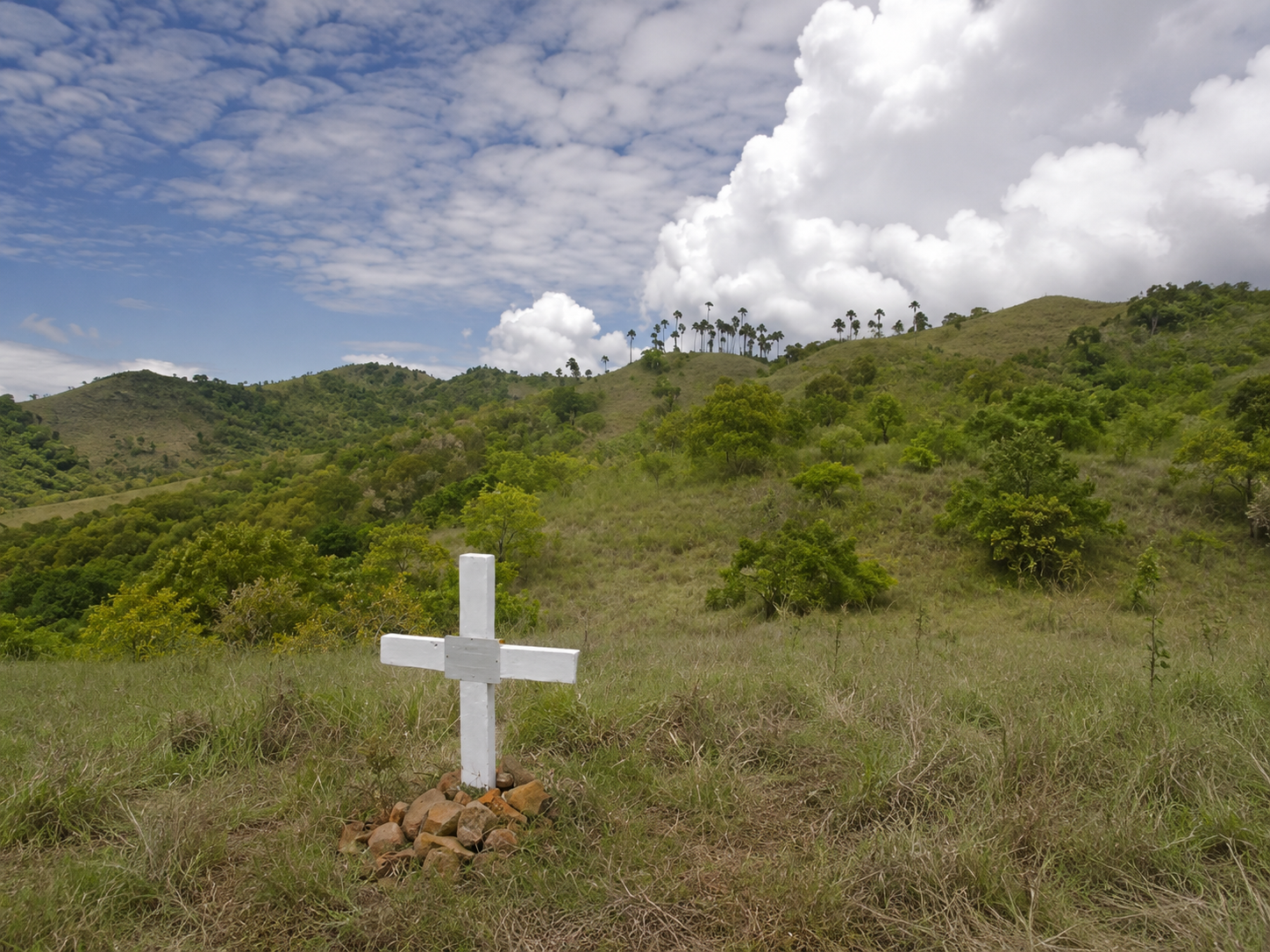
High on a ridge on the island of Komodo there stands a small cross. The inscription is plain enough — he loved Nature throughout his life — and it marks the last known whereabouts of Baron Rudolf Reding von Biberegg, a Swiss aristocrat in his seventies who, on a July morning in 1974, went walking among the largest lizards on Earth and was never seen again.
The bones of the story are these. Von Reding was part of a small tourist party that had sailed across from Flores to see the dragons in the flesh. By one account the group had spent the morning enticing the animals with a goat carcass, the better to watch them feed, before the baron peeled away to make his own way back to the boat. By another, he stumbled and hurt his knee on the trail, and his guide left him where he sat to go and fetch help. The two versions agree on what mattered. When the party returned, the baron was gone. More than a hundred people combed the island over the following day. Miles from the path, high in the hills, they found his glasses and his smashed camera. Nothing else — no baron, no body, not a scrap. He is remembered as the first European ever devoured by a Komodo dragon.
It’s that word European that ought to catch in the throat.
The counted and the uncounted
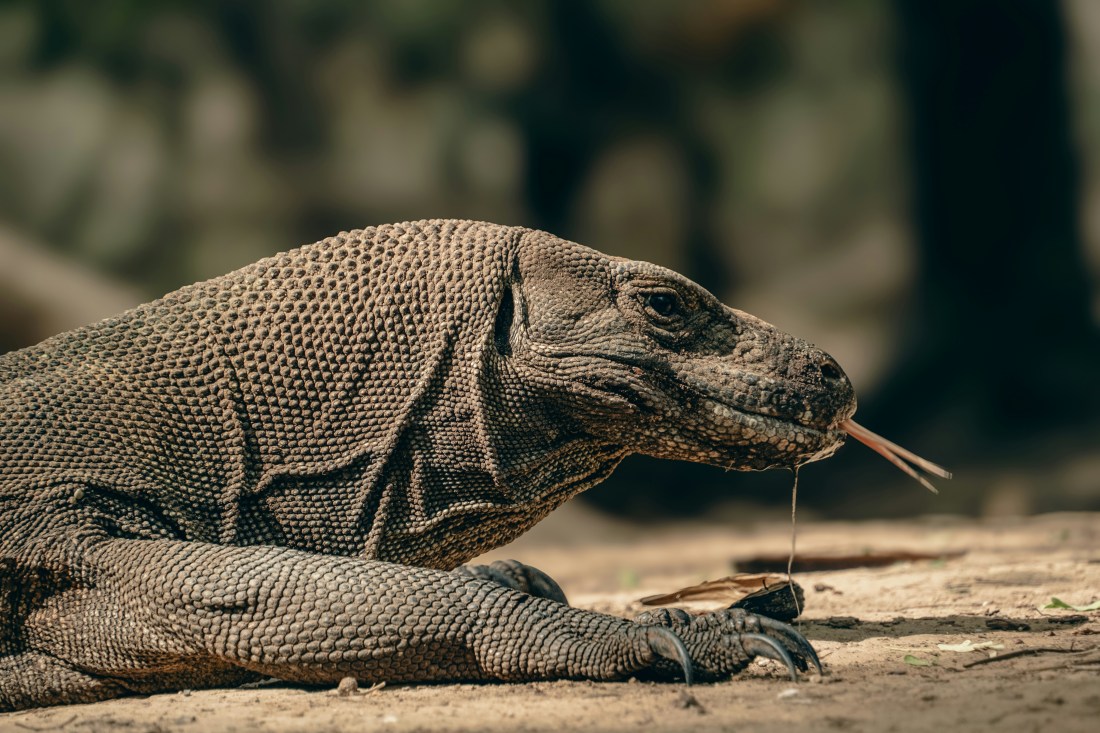
Von Reding was not the first person taken by a dragon on Komodo. He could not possibly have been. People have lived alongside these animals for as long as there have been people on these islands, and the accommodations they make tell you everything. Villagers on Komodo and Rinca do not wander into the grasslands alone. For generations they threw the old, toothless dragons the heads and hides of butchered deer — a kind of tribute, a peace kept by feeding the very thing that might otherwise feed on them. You do not build those habits around an animal you consider harmless. You build them around one that has, within living memory and long before it, killed people you knew.
None of those people got a cross on a ridge. None of them got a line in the Washington Post. They died, if they died, uncounted and unrecorded, and the tally that Western readers know — the handful of tourist-era deaths and maulings logged since 1974 — begins precisely at the moment a titled European joined the list. Von Reding is famous not because his death was the worst or the first, but because his was the death that got written down. The dragons had been man-eaters all along. We simply hadn’t been paying attention to the funerals that came before, and most of the ones that came after.
We thought we could pet them
To understand how a whole hemisphere managed to overlook this, you have to go back to a photograph.
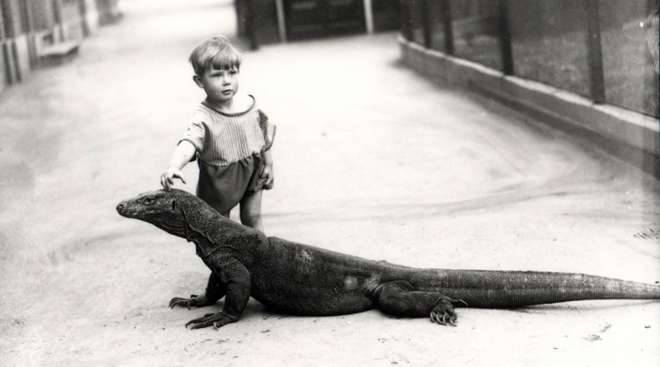
In 1927 the first two live Komodo dragons in Europe arrived at London Zoo, into a purpose-built Reptile House designed by Joan Beauchamp Procter — the zoo’s first female Curator of Reptiles, a woman of formidable talent and fragile health who would be dead within four years, at thirty-four. Procter took one of the dragons, Sumbawa, entirely to heart. She walked it around the grounds like a dog, occasionally steering the two-metre lizard by its tail, and in 1928 she scandalised a Scientific Meeting by bringing it along to eat chicken and eggs from her hand while she stroked its head, all to prove the beast was no monster. There is a photograph, published in one of her own papers, of Sumbawa beside a small child who is patting it on the head as one might a Labrador.
This was the settled Western picture of the Komodo dragon for the better part of the twentieth century: a torpid, obliging curiosity, slow and rather lazy, safely behind glass or, if you were Joan Procter, on the end of a lead. It was a picture built almost entirely from captives — sick, sluggish, half the size they reach in the wild — and from the theatrical mythmaking that had named them in the first place. The very phrase “Komodo dragon” was a piece of showmanship coined by an American expedition in the twenties whose specimens helped inspire King Kong. We invented a dragon for the cinema and then, having got a good look at the real thing dozing in a zoo, decided it wasn’t so fearsome after all. Both pictures were wrong. Neither had much to do with the animal that hunted the hills of Komodo.
Everything we didn’t know we didn’t know
Here is the genuinely humbling part. The most basic facts about how this animal makes more of itself, and how it kills, are more recent than most of the people reading this.
Take reproduction. In 2006 keepers at Chester Zoo watched a female called Flora — who had never so much as met a male — lay a clutch of fertile eggs. The same year, a London dragon named Sungai did the same, and the two cases were written up together in Nature. Female Komodo dragons, it turns out, can reproduce alone, through parthenogenesis, and the offspring they produce this way are all male, which means a single female washed up on an empty island could in principle lay eggs, raise mates from her own hatchlings, and found a whole population from scratch. Chester’s Kevin Buley reached, almost word for word, for the line Ian Malcolm delivers in Jurassic Park: it is, he said, nature finding a way. A film about resurrected reptiles breeding when they were never supposed to had beaten reality to the punch by thirteen years.
Then there’s the bite. For decades the received wisdom held that a Komodo dragon’s mouth was simply so thick with septic bacteria that a single bite doomed its victim to die of blood poisoning days later, the dragon ambling along behind to collect the body. It’s a wonderfully grim story, and it’s largely wrong. In 2009 a team led by Bryan Fry identified genuine venom glands in the lower jaw — the toxins drop blood pressure and prevent clotting, so the prey bleeds and slides toward shock. Later work went further and questioned whether the mouth was even especially dirty to begin with. So the science of how this animal actually reproduces, and how it actually kills, is younger than a blockbuster from 1993. We were letting toddlers pat them on the head decades before we had the first clue what we were looking at.
And we did not even know, until relatively recently, that they can swim — strongly, between islands, diving several metres down.
Back to the ridge
Which brings us back to the baron, and to the theory, still politely offered, that no dragon was involved at all. He was old, the argument runs, and unwell; perhaps he simply died out there, or met with more ordinary human misfortune, and the reptiles are merely convenient.
I don’t buy it, and I don’t think the evidence asks us to. That theory is a fossil of 1974 — a relic of exactly the misjudgement this whole story is about. It comes from a decade that thought these animals were slow, lazy zoo-pieces; that had never heard of their venom; that did not know a startled clutch of tree-dwelling juveniles, bolting for the branches to avoid being eaten by their own elders, might send a nervous old man stumbling off the path and straight into the territory of the larger, patient, opportunistic adults; that did not even credit the beasts with the ability to swim. Set the dismissal against what we now know, and it is the dismissal, not the dragon, that looks like the wild assumption.
An elderly man, injured or frightened, alone and immobile in the hills — that is not a puzzle to a Komodo dragon. That is an invitation. His glasses and his broken camera, and nothing else at all, is not the scene of a quiet natural death. It is the signature of an animal that eats bone, hide and hoof and leaves almost nothing behind. We will never be certain, because there was nothing left to be certain with. But on the balance of everything we have learned in the fifty years since — most of which the men who shrugged at his disappearance did not know — the baron who loved Nature throughout his life was very likely taken by it.
The cross on the ridge gets that much right. It just doesn’t say by what.
Two weeks ago I sat in the front row of the BFI IMAX and watched a palaeontologist go weak at the knees over a brachiosaur. The film was Jurassic Park, screened for London Climate Week by The Wildlife Trusts, and before the lights dropped, Craig Bennett – Chief Executive of The Wildlife Trusts – made the point that we perhaps could never have imagined at its inception: the film is thirty-three years old, and its science fiction has quietly become science. De-extinction is no longer a plot device. It is a funding round.
I did not expect, a fortnight later, to be writing about the man who played that palaeontologist because he had gone.
Sam Neill died on Monday in Sydney, aged 78. His family called it sudden and unexpected, and were careful to say he remained cancer free — he had beaten the rare blood cancer he was diagnosed with in 2022, and announced as much only that spring. That is the cruelty of it. Many of us had let ourselves believe we would be seeing a great deal more of him.
I’d like to pay my respects the way this blog knows how: by noting that Sam Neill spent an extraordinary amount of his career standing next to monsters, and that almost nobody did it better.
Dr Alan Grant, and the wonder that curdles
Let’s start where most of us did. Every kid who grew up in the eighties had a dinosaur phase; Alan Grant showed up and quietly extended ours by another thirty-odd years. He was Indiana Jones with a rock hammer — a palaeontologist who would rather be knee-deep in a Montana dig than anywhere near people, least of all children. One can sympathise. What Neill understood about the part was that the wonder and the wariness are the same muscle. Watch the sauropod scene: the open-mouthed awe of a man who has spent his life with the dead and is suddenly handed the living. He recaptures this beautifully, despite all the danger via dinosaurs his character has been exposed to by then, when he spots the dreadnoughtus in Jurassic World: Dominion. But also watch how quickly that awe learns to be afraid. By the end he will not endorse the park, and he has become, almost against his will, the fierce protector of two frightened children.
The film’s explicit sermon on hubris belongs to Ian Malcolm — the line about scientists being so preoccupied with whether they could that they never stopped to ask whether they should, which I have leaned on myself when writing about resurrected wolves. But Grant is its conscience in a quieter register: the scientist who looks at the miracle and says, gently, that some things are not ours to command. Neill played that not as a lecture but as a kind of grief.
It’s been a while since I drew anything, but this image has been in my head all morning. Farewell Dr. Alan Grant.
When the fiction walked out of the cinema
Which brings us back to that IMAX introduction. In 2025 a Texas company, Colossal Biosciences, announced it had “brought back” the dire wolf — a claim I picked apart at length elsewhere, because what they had actually made was a gene-edited grey wolf in a very good marketing coat. The dodo, the thylacine and the mammoth are all on their stated to-do list. Grant’s fictional dilemma has become a real one, and we are all extras in it now.
The Hunter, and a guide you cannot trust
Here is where I had meant to cast Neill as the wise voice steering a hunter towards mercy — and where the film politely refuses to let me.
In The Hunter (2011), Willem Dafoe plays a mercenary sent to Tasmania by a biotech firm to find the last thylacine and take its DNA, killing any others so that no rival can have them. Neill plays Jack Mindy, the local who meets him off the plane and shows him the country — and who turns out to be a man with rather too many secrets and divided loyalties, closer to the fire that guts the film’s grieving family than to its conscience. It is Dafoe’s hunter, not Neill’s guide, who finds the moral centre, and he finds it the hard way.
I think that is the better note anyway. Mindy is a wonderfully compromised piece of work — friendly, helpful, and quietly on the wrong side — and the film’s real argument is that when the last of a kind is at stake, nobody’s hands stay clean. The thylacine Dafoe hunts was formally declared extinct in 1986; it is now, uncannily, a resurrection candidate. The monster and the man have swapped places, and Neill is right there in the middle of it.
The wider bestiary
Grant may be the headline, but Neill kept unlikely company for decades. He was the grown Antichrist in Omen III: The Final Conflict. He lost his mind aboard a very haunted spaceship in Event Horizon and inside a Lovecraftian small town in In the Mouth of Madness. He shared the sea with a killer in Dead Calm and something far worse in Possession. Time and again he was cast as the sane, civilised man at the threshold of the unspeakable — and he lent those films a gravity they had no right to expect, never once looking down his nose at the genre paying his wages.
The man himself
Neill was born in Northern Ireland in 1947 and raised in New Zealand from the age of seven, and for all the Hollywood years he never really left the land. He kept a Central Otago vineyard and a farm full of ducks, pigs and cattle that he introduced to the internet, by name, during lockdown, to the delight of several million strangers. Offered a knighthood, he waved the title away as far too grand, though he quietly accepted the honour in 2022.
And he was, by every account, a deeply kind man. In 2024 he appeared on the ABC series The Assembly, interviewed by a room of autistic journalism students, and a young woman named Abby asked him the best lesson his parents had taught him. He stopped. He teared up, admitting he could not quite say why the question had floored him, before landing on his mother’s very undramatic wisdom: that sometimes you simply have to pull yourself together. It went round the world because it was so plainly unperformed.
He spoke about his illness the same way — without self-pity, and with a line I keep coming back to. He was not frightened of dying, he said; he would just find it “very irritating”, because there were things he still wanted to do.
There were. There would have been more. Thirty-three years on from that first sauropod, the beautiful, terrible animals he stood beside are climbing out of the past and into our laboratories — and it feels right that the man who taught a generation to look at them with equal parts hunger and caution should get the last, quiet word.
Sometime in early 1888, a small government steamer was making four miles an hour up the Congo River when she ran aground. There’s nothing remarkable in that — Africa’s second longest river and the world’s deepest is a maze of shifting sandbanks, and any pilot expects to feel his hull kiss the bottom now and again. What was remarkable was that this sandbank began to heave. The water around the bow churned in a way no sandbank has any business doing, and the steamer’s engineer, leaning over to find the cause, watched the bank itself detach from the riverbed and bolt. It was a crocodile. One longer, he was certain, than his forty-two-foot boat, and it crossed the bar and tumbled into deep water before he could reach for a rifle. They had run the steamer clean into a living animal at speed, jammed it into the sand, and it had shrugged them off and left without a mark on it.
The engineer was John Reinhardt Werner, and the animal, if the Congo’s rivermen were to be believed, was the Mahamba.
A witness in the wrong century
Werner is an unusually good witness for a monster, which is precisely what makes him a problem. He was not a folklorist collecting tales around a fire, nor a Victorian showman selling a story. He was a working engineer keeping the boilers running on a colonial waterway, and he wrote his account up plainly in A Visit to Stanley’s Rear-Guard (Blackwood, 1889) as one observation among many practical ones. His steamer, the A.I.A., took her name from the Association Internationale Africaine — the “philanthropic” society, dedicated on paper to lighting the darkness of Africa and ending the slave trade, that served as Leopold II’s cover story while he assembled the private empire that would become one of the most murderous colonial regimes in history. I wanted to make that clear, because the romance of the Victorian riverboat curdles the moment you remember what the riverboat was for. Werner was part of the apparatus. His crocodile sightings come to us stamped with the flag of a project built on forced labour and mass death.
That grim provenance aside, Werner’s testimony is specific. He described these giant crocodiles as almost common on the river, and he did not hedge on size. On a low sand-spit beyond the grasses, he wrote, one might see a monster of perhaps fifty feet; he claimed to have seen several considerably longer than the A.I.A. On one occasion, stalking ducks across a sandbank with only a shotgun, he found the largest crocodile he had ever seen lying between him and his supper. Measuring it by eye against the steamer moored three hundred yards off, he reckoned it a full fifty feet long, with the ridged crest of its back standing four feet clear of the sand. He sent a boy for his rifle, thought better of the whole enterprise, and in retreating spooked the ducks — whereupon he took a shot at them, missed, and startled the crocodile into the water. It is a very funny, very human anecdote, and it has the ring of a man reporting exactly what he saw rather than embroidering a legend.
The scale problem
The Nile crocodile, the largest predator these waters officially hold, is a genuinely formidable animal that tops out at roughly twenty feet. A big saltwater crocodile — the largest living reptile on Earth — reaches perhaps twenty-one. Werner was describing something more than twice that length: a creature outside the entire range of any crocodile known to science, living or dead.
And that last phrase is where the Mahamba does something most cryptids cannot. It out-measures the fossil record.
The usual yardstick reached for here is Sarcosuchus imperator, the Cretaceous giant nicknamed the “SuperCroc.” When Paul Sereno’s team described it for a rapt public in 2001, the headline figure was around forty feet — a crocodile-shaped monster that shared the rivers of what is now Niger with dinosaurs and, on the strength of a five-and-a-half-foot skull, may occasionally have eaten them. Forty feet. Even by that generous early estimate, Werner’s fifty-foot animal is the larger beast.
But the comparison has sharpened since. A 2019 reassessment pulled Sarcosuchus back to a more conservative maximum of about thirty-one feet — and the other contenders for largest-ever crocodilian, Deinosuchus and the giant caiman Purussaurus, cluster in the same thirty-three-to-forty-foot bracket, all of them reconstructed from fragmentary bone. In other words, the best-supported estimate for the largest crocodyliforms that ever lived now sits comfortably below what Werner claimed to have watched sunbathing on a sandbar. The Mahamba is not merely bigger than any living crocodile. It is bigger than the biggest crocodile the earth has ever produced a fossil of.
That should give even a sympathetic and optimistic reader pause.
The second stream
The easy move would be to file Werner under Victorian exaggeration and close the book. What complicates that is a second, entirely independent line of testimony arriving nearly a century later.
In the 1980s the biologist Roy Mackal travelled the Congo basin chasing Mokele-mbembe, the region’s more famous “living dinosaur.” Along the way he collected the vocabulary the Bobangi people used for the animals of their river, and it was more precise than an outsider might expect. There was the ordinary crocodile. There was the Nguma-monene, a long, ridge-backed thing that was something else again. And then there was the Mahamba: not a separate kind of animal but a crocodile in every way that matters — same shape, same habits — only monstrously, impossibly large, forty to fifty feet and more, said to lie up in long tunnels dug into the riverbanks. The people describing it were not confusing it with anything. They were insisting, from direct familiarity with the real crocodiles all around them, that this was one of those and simply far too big.
So we have two witnesses who never met, separated by a hundred years and by every difference of language, purpose and worldview, describing the same specific impossibility in the same specific water. That is a genuinely uncomfortable coincidence, and it is the strongest thing the Mahamba has going for it.
What could it be?
The serious hypothesis is a relic: a surviving or simply undescribed giant crocodilian, a lineage that kept the old Cretaceous dimensions going in the vastness of the Congo swamps where no one has ever managed a proper survey. It is not absurd on its face — the region is enormous, poorly mapped, and has surrendered new large vertebrates within living memory.
The less serious end of the shelf holds the idea, which surfaces now and then in the cryptid literature, that the Mahamba is no crocodile at all but some freshwater relative of the mosasaurs. A 1954 sighting in the Maika marshes is sometimes pressed into service here — a large reptile that reportedly lifted an abnormally long neck from the water before diving. But that long neck pulls in the opposite direction from everything else on record; it describes a different animal from Werner’s flat-backed, short-legged, unmistakably crocodilian giant, and folding the two together muddies rather than strengthens the case.
Then there is the explanation that requires nothing new at all. A single, genuinely enormous Nile crocodile — an old, exceptional individual pushing the upper limit of its kind — glimpsed across open water, with no fixed reference for scale and a rifle conspicuously absent, is exactly the raw material from which fifty-foot estimates are honestly made. Water flatters length. Distance deceives. Fear does the rest. Werner measured his monster against a steamer three hundred yards away, and even a careful man measuring by eye across that gap can be handsomely wrong.
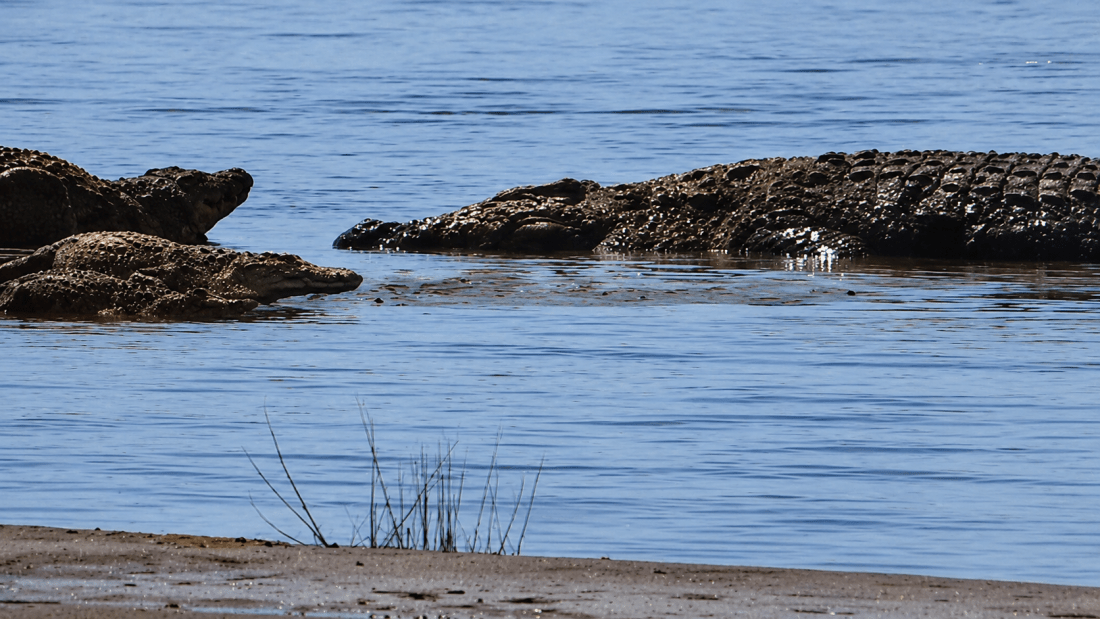
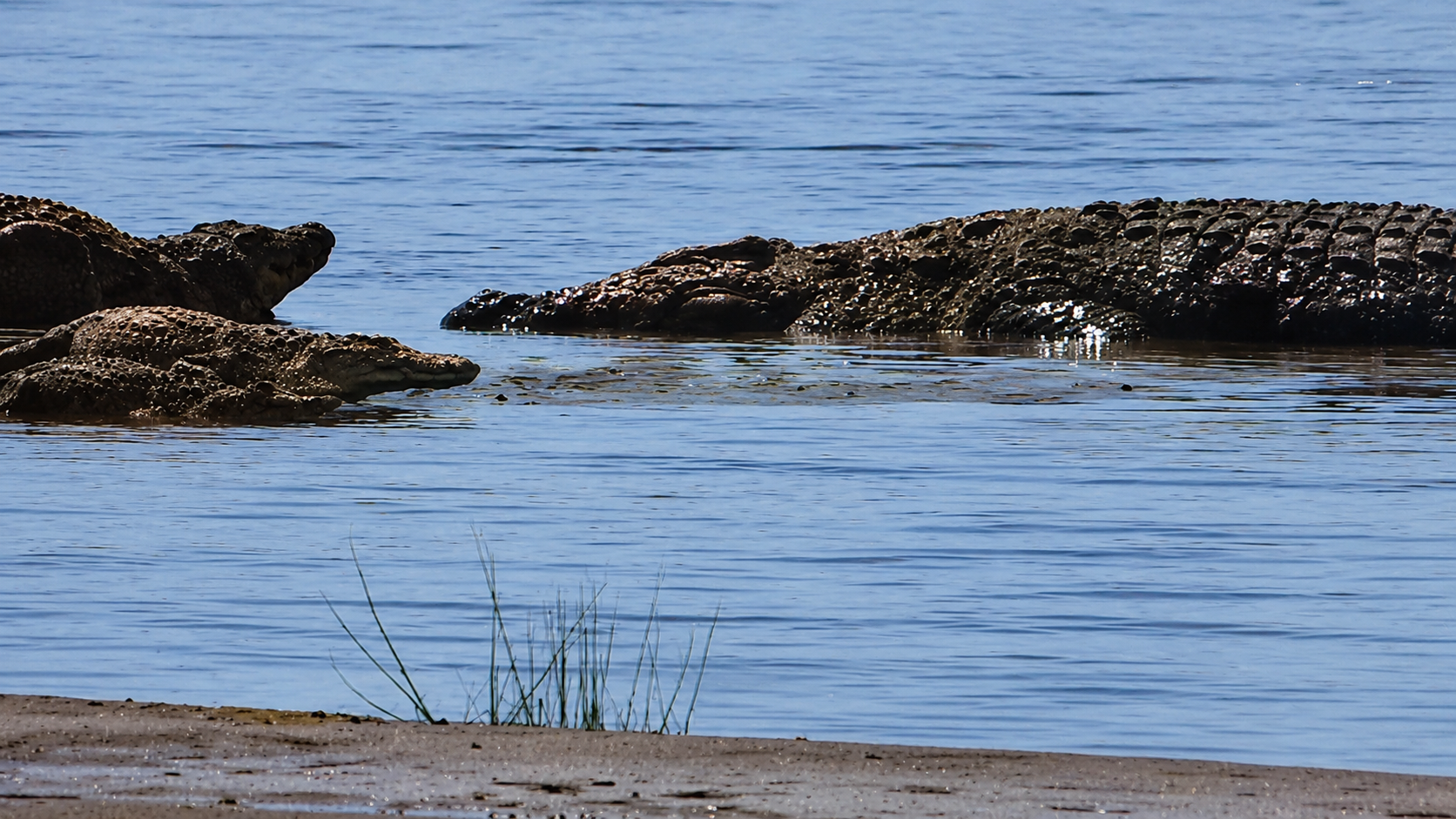
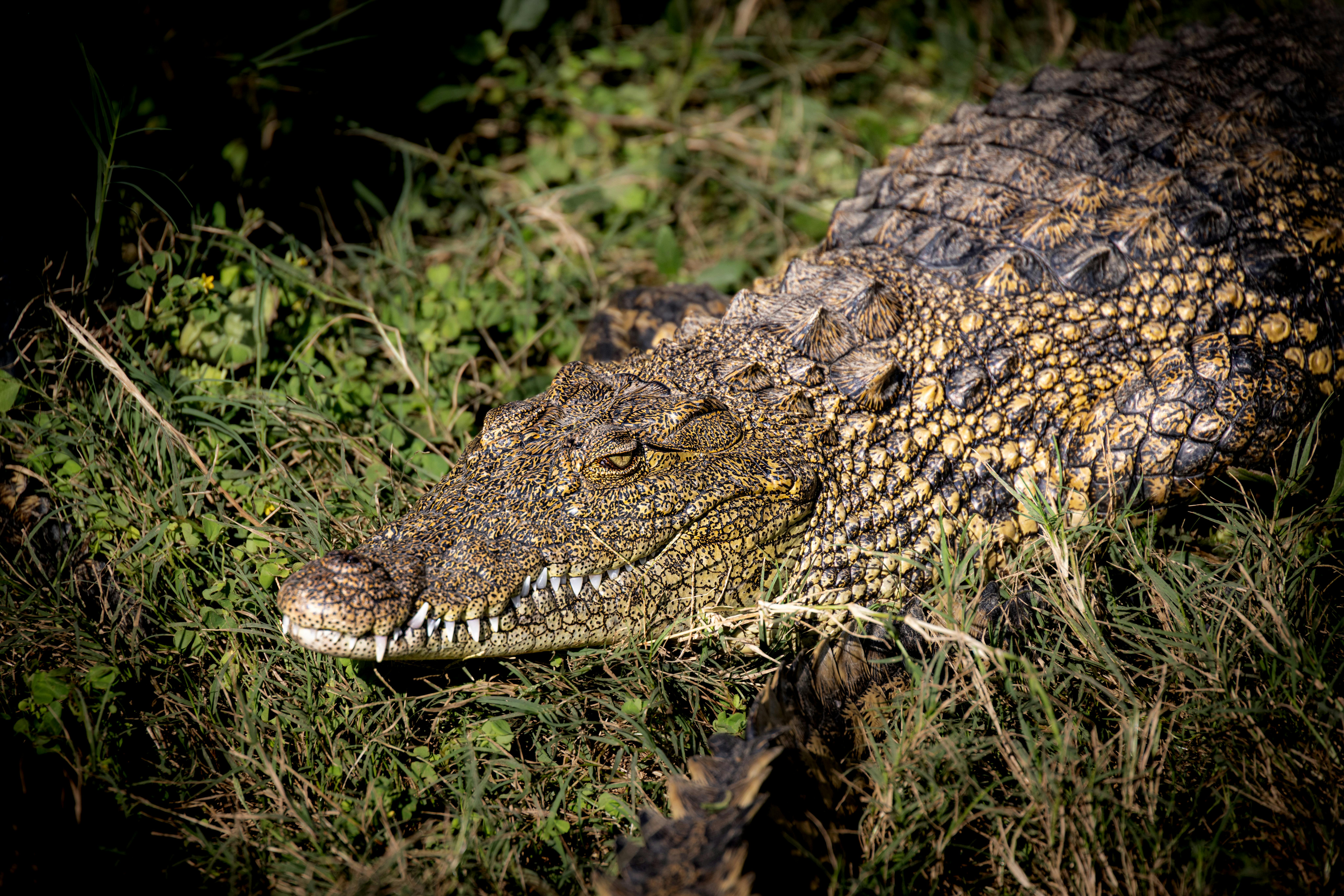
I remember being on the banks of the Chobe River in Botswana, and just happening to look up. At some distance – my estimation was not dissimilar to Werner’s three hundred yard steamer – I saw what I thought was a large tree floating in the centre of the river. It took me a few moments to realised it was of course, a huge crocodile. The size really threw me off and at that distance, I almost certainly over estimated it. But I did think it was every inch of twenty feet, if not more. And I made the comparison to what was in front of me – a tour boat.
So, I have some sympathy for anyone matching boat sizes to unusually large crocodilians. But I think we can accept it’s not an exact science.
Where are the bones?
Sarcosuchus skull at the Museum d’Histoire Naturelle. No children were harmed in the taking of this photo 🙂
Which brings us to the question that closes the file on the Mahamba, as it closes the file on most of its kind.
We know Sarcosuchus was real because it left us a skull the length of a man and enough skeleton to argue over. We know the outer limits of crocodilian size because the fossil record, patchy as it is, has physically produced the animals. The Mahamba has produced witnesses — good ones, independent ones, a century apart — and not one confirmed bone. No skull, no skeleton, no shed tooth the size of a hand, nothing hauled from a bank or found bleaching on a sandbar. For an animal supposedly common enough that a working engineer saw several in the course of doing his job, that absence is very loud.
Sarcosuchus outgrew the living world and left us its remains. The Mahamba outgrew even Sarcosuchus, and left us only the water it disappeared into.
Every man-eater this blog has covered so far has arrived with an explanation. The Champawat tigress had her canines shattered and could no longer take her natural prey. The lions of Njombe, the Leopard of Panar, Gustave brooding in his stretch of river — each was a creature bent by circumstance into something that fed on us, and the horror always came braided with a thread of pity. You could follow the line from cause to consequence and, if not forgive the animal, at least understand it.
Avni breaks the pattern. Not because she was more monstrous than the rest — if anything the reverse — but because by the time her story ends, the tiger is only part of the story.
She was officially labelled T-1, a six-year-old tigress in the Pandharkawada forests of Maharashtra’s Yavatmal district, and she was given the name Avni, meaning “Earth”, by the conservationists who would later fight to keep her breathing. She had two cubs, roughly ten months old, still dependent on her. From 2016 and across two years, she was linked to thirteen human deaths, a figure that hardened into received fact and was repeated in every headline. It should be stated that the forensic case was thinner than the number suggests: thermal-camera evidence and tests on the recovered bodies put the toll closer to six. Either way, the fear was real and the cost was real. Some twenty villages lived under advisories to come in early and never walk alone as fields went untended, and daily life buckled. People had died horribly. None of what follows is meant to pretend otherwise.
What happened was a mangled and corrupted series of events. And it is these, not the predator, that should keep you up at night.
The legal machinery did its work first. In September 2018 the Nagpur bench of the Bombay High Court sanctioned an order to tranquillise or, failing that, shoot her; days later the Supreme Court declined to interfere. But the permission came fenced with conditions. Killing was to be a last resort, attempted only if capture failed. The cubs were to be darted and moved to a rescue centre. On paper, this was a state behaving responsibly toward a protected national animal it had decided, reluctantly, it might have to destroy.
But there’s significant detail the official narrative preferred to walk past. Avni was young, and she was healthy. The textbook man-eating tiger is usually a broken animal — old, injured, or starved of its proper prey, like the Champawat tigress and her ruined teeth. Avni had no such alibi, and that is precisely the point. A fit young tigress turning to human prey is not a freak of nature; she is a symptom of something we built. Shrinking forest, advancing settlement, prey squeezed out, predator and people pressed into the same narrowing ground. She was not the disease. She was the fever telling you the disease was beginning to show physical symtoms.
Enter the hunter. The forest department engaged Nawab Shafath Ali Khan, a Hyderabad-based marksman with a long and contested record — a man the Union minister Maneka Gandhi would publicly brand a criminal. The gun, when it finally went off, was not even fired by him. It was fired by his son, Asghar Ali Khan, who had no authorisation to kill anything.
Before that, though, came the circus, and I use the word advisedly. To draw Avni in, the team deployed a live goat, the urine of another tigress, and — this is not a joke — bottles of Calvin Klein’s Obsession for Men, on the strength of a Bronx Zoo experiment suggesting its civetone pheromone attracted big cats. There were Italian Cane Corso sniffer dogs sourced from a champion golfer. There were drones, too noisy to be useful, and paragliders, defeated by the terrain. And there was the elephant, brought in from Tadoba to track her, which one night tore free of its chains and trampled two villagers to death. In tragic irony, a hunt mounted to stop a killer had begun manufacturing its own corpses.
Then, on the night of 2 November 2018, they found her. The department’s account was clean and self-justifying: a dart was fired, the tigress charged the open vehicle, and Asghar shot her in self-defence from eight to ten metres. It is a tidy story. The postmortem tore it apart, line by line.
Avni was facing away from the shooter. A charging animal does not present its back. The fatal round was a textbook lung-and-shoulder shot, the kind a trained hunter delivers with intent, and there were no signs of a struggle on the body — no thrashing, no scramble, nothing to suggest a frightened animal fighting for its life. As for the tranquilliser dart that was supposed to have come first: it appeared to have been pushed into her flank after she was already dead, with no haematoma around the wound, no bruising, none of the bleeding a living body produces when struck. It had been staged. Someone knelt beside a dead tigress and inserted a dart into cold muscle to make a killing look like a mercy that failed.
The rest only deepens it. The rifle was widely alleged to be a .458 Winchester Magnum, heavier than the calibre floor the National Tiger Conservation Authority required, and it was never surrendered for verification. No veterinarian was present, in breach of protocol. The shooting happened at night, also in breach. The team took over an hour to reach the body, from a base camp fifteen kilometres away. A later authority inquiry noted the dart had been prepared days earlier and would have been all but useless — the kind of detail that again suggests the darting was theatre from the start.
So, the question that organises this whole squalid affair is not whether Avni was a man-eater. It is whether anyone holding authority over her ever intended to find out. A Supreme Court ruling, a national protocol, a last-resort clause, an order signed and countersigned — the entire apparatus of a modern conservation state appears to have arranged itself neatly around a foregone bullet, and then dressed the result to pass inspection. We also can’t rule out that some very frightened villagers urged or possibly paid Khan to kill Avni regardless. Or, that he perhaps acted in what he thought was their best interests, regardless of the authorities.
Maneka Gandhi called it a ghastly murder, a straight case of crime. The forest minister called it self-defence and a last resort. Out in the villages, where the dead had been real, some people set off firecrackers. All of that is true at once, and a story this graceless does not resolve into a side. But again, corruption, conflict, and conservation often go hand in hand in the field, and especially across modern India and Africa.
And then there are the cubs. The press release announcing Avni’s death did not mention them. In the hours afterward they were simply gone — orphaned, somewhere out in the forest she had hunted, the same forest the order had promised would deliver them safely to a rescue centre. Whether that promise was honoured any more faithfully than the one about taking their mother alive is a question the dart in her flank had probably already answered.
There is a tidy version of this story that gets told every summer, usually around the time someone re-airs Jaws on a bank holiday. It goes: Spielberg made a film about a shark, the film made an obscene amount of money, and every producer with a chequebook and a rubber animal spent the next decade trying to do it again. Tidy, and not exactly wrong. But it skips the most interesting part, which is that Jaws lit the fuse on a genre it didn’t actually belong to.
Look closely at the 1975 original and you’ll notice something the imitators all felt obliged to fix: the shark has no reason. It isn’t avenging anything (we’re ignoring the fourth instalment at this moment in time). It hasn’t been mutated, provoked, or wronged. It is simply a large apex predator doing what large apex predators occasionally do, and the film is far more interested in the three men in the boat than in any quarrel between humanity and the sea. There’s a lovely irony buried in this. Even the picture’s own origins are slippery — the 1916 Jersey Shore attacks are widely cited as the seed of Peter Benchley’s novel, and Benchley went to the trouble of issuing a correction to The New York Times in 2001 to deny it. The film references 1916 in its own dialogue. Make of that what you will. The point is that Jaws arrived without a thesis about nature, and the films that chased it spent a decade supplying one.
The bloodline before the shark
The idea of nature turning on us was hardly new. Hitchcock had done it in 1963 with The Birds, in which gulls and crows lay siege to a California town for no stated reason at all — arguably the purest expression of the whole notion. The early 1970s kept the thread going: Willard (1971) and its army of rats, Night of the Lepus (1972) and its giant rabbits filmed in slow motion across miniature sets (a sentence that explains the film’s reputation rather efficiently), and Frogs (1972), in which an assortment of swamp life conspires to remove a polluting Florida patriarch from the gene pool. The amphibians mostly sit and watch, which is somehow more unnerving than if they did the work themselves.
So the appetite was there. What Jaws added wasn’t the concept but the commercial proof — that an animal-attack picture could be the biggest thing in the country. The rest was arithmetic.
Silent Spring with teeth
Here’s the engine that the tidy version leaves out. The decade that produced these films was also the decade that produced modern environmentalism. Rachel Carson’s Silent Spring had landed in 1962, the first Earth Day was held in April 1970, and the air was thick with genuine anxiety about pesticides, pollution, the ozone layer and what exactly we were doing to the world. The drive-in took that anxiety and gave it fangs. Where Jaws offered a predator without motive, its descendants offered defendants. The animals weren’t just hungry — they were owed.
You can read the era’s whole guilty conscience in the premises. Day of the Animals (1977) blames a damaged ozone layer for sending wildlife collectively berserk. Prophecy (1979) hands us a bear mutated by mercury from a paper mill, lurching through the Maine woods as a sort of furry environmental impact statement. Kingdom of the Spiders (1977) sics pesticide-starved tarantulas on William Shatner. The monster, increasingly, was us — and the films knew it.
The American core
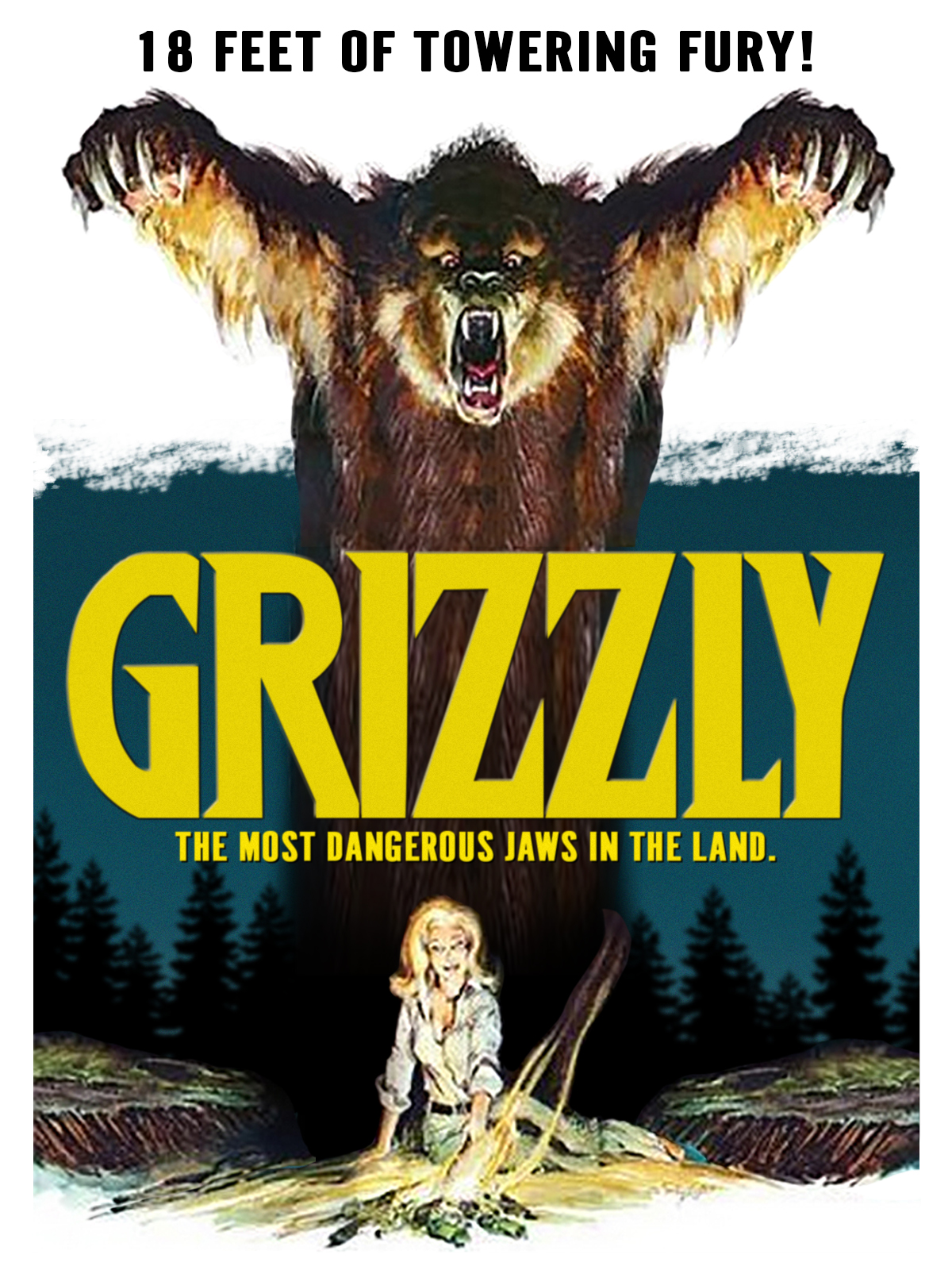
The film that turned the key was Grizzly (1976), directed by the prolific William Girdler and marketed, with admirable honesty, as the most dangerous jaws on land and at least one tagline cited “Jaws with claws“. And it is Jaws transposed to a national park almost beat for beat: the denied threat, the obstructive official, the climactic showdown (here the bear is dispatched with a bazooka, because of course it is). Critics were unkind. Audiences were not — it became the highest-grossing independent film of 1976, earning somewhere near $38 million against a budget under a million, a record it held until Halloween two years later. There is a grim coda to that success: distributor Edward L. Montoro allegedly kept the profits, leaving Girdler and his writers to sue, was later pursued by Universal over a different rip-off entirely, and in 1984 simply vanished with the company’s money, never to be seen again. A man-eating producer to bracket the man-eating bear.
The cycle that followed had range. Piranha (1978), directed by Joe Dante from a John Sayles script, was the clever one — a film that grasped the joke and told it on purpose, which is precisely why it endures. Alligator (1980), Sayles again, took the old urban legend of the flushed pet reptile and fed it discarded growth hormone until it burst out of the sewers; it remains, for my money, one of the era’s genuine guilty pleasures, smarter and funnier than it needed to be. And then Prophecy, which is a real curio — a John Frankenheimer film, properly mounted and beautifully shot, that lapses into pure camp the moment the mutant bear appears. The gap between its ambitions and its monster is where a lot of its charm lives.
The prestige peak: Orca
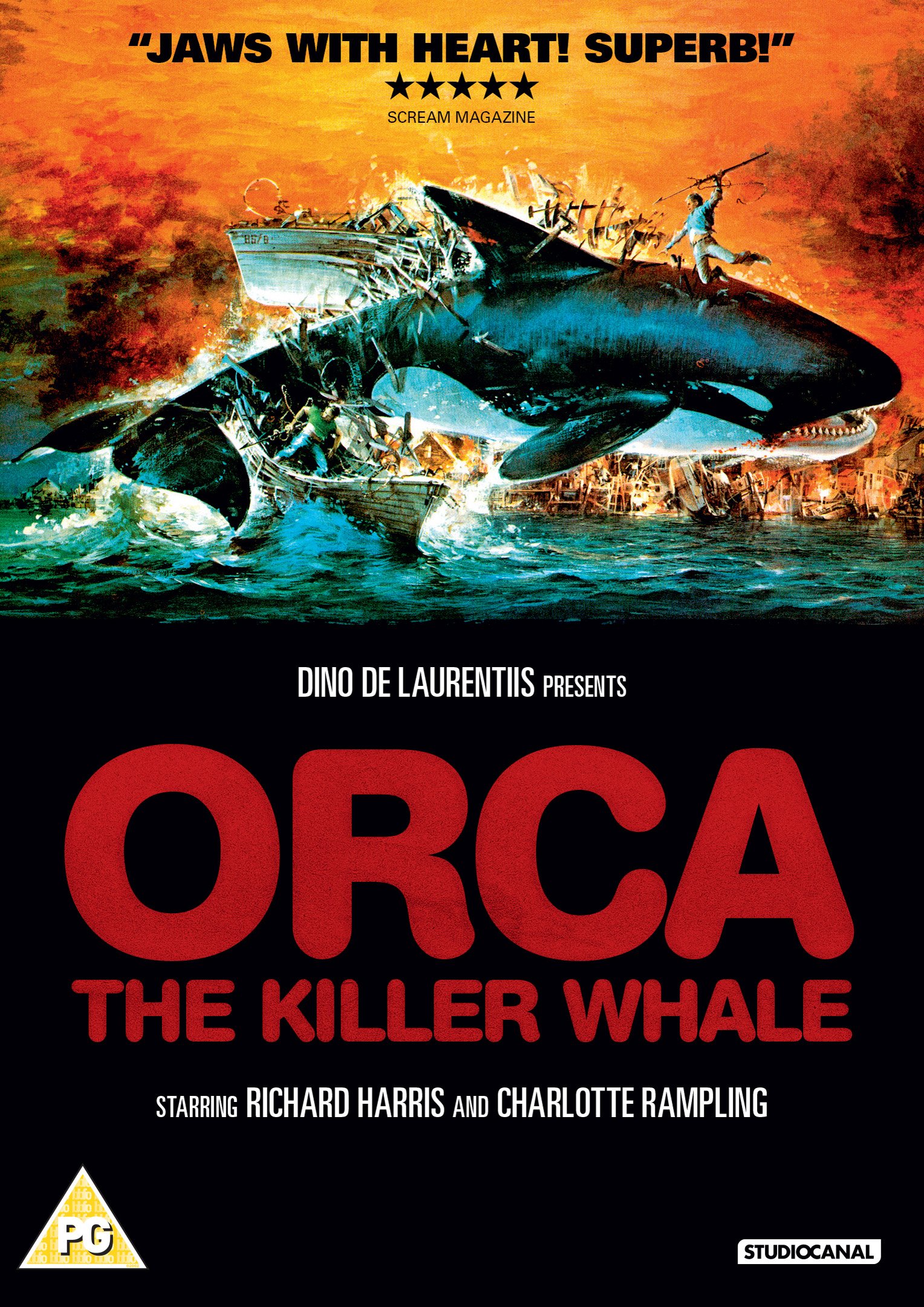
If Grizzly was the cycle’s reliable workhorse, Orca (1977) was its swing for the fences. Dino De Laurentiis commissioned it to outdo Spielberg outright. The legend has him phoning his writer in the night demanding a “fish” tougher and more terrible than the great white, and threw real money at it: Richard Harris, Charlotte Rampling, and a Morricone score. What makes Orca fascinating isn’t its budget but its morality. It flips the polarity completely. The whale isn’t a monster; it’s bereaved, hunting the captain who killed its mate and calf. It’s less Jaws than Moby-Dick reversed, or Death Wish with a dorsal fin — the animal as wronged party, the human as the one with the reckoning coming. That inversion, the audience quietly rooting for the creature, became the cycle’s true signature.
The cash-ins and the artful outliers
Inevitably, the imitation curdled into outright theft. The Italian industry, never shy, produced Cruel Jaws and Enzo Castellari’s The Last Shark (released abroad as Great White) — films so close to the source that Universal had their American releases halted in court. The genre had begun eating itself.
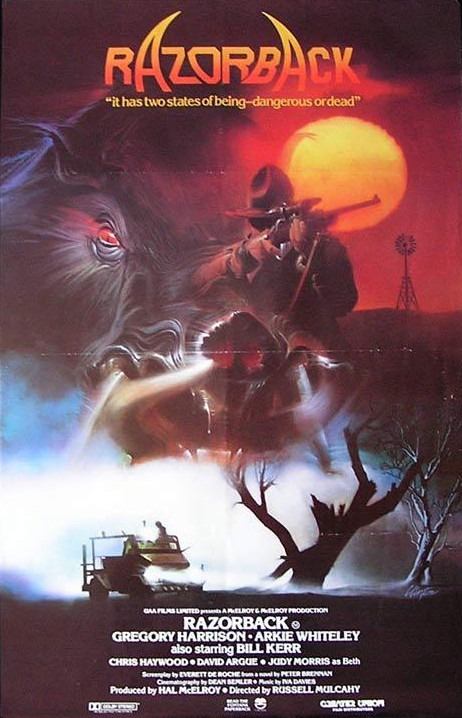
Australia, meanwhile, did something more interesting with the same materials. Long Weekend (1978) is the era’s most artful entry, a slow, dread-soaked story of a bickering couple whose casual cruelties to the bush — litter, a rifle, a smashed egg — are answered by a landscape that turns sentient and patient. And then there’s Razorback (1984), Russell Mulcahy’s giant-feral-boar picture, which has no business looking as good as it does. Mulcahy came from music videos, and it shows in the best way: the outback set-pieces, especially the desert sequences, are extraordinary — bleached, surreal, lit like a nightmare. It’s a B-movie with the visual imagination of something far grander. I also especially liked the tagline: it has two states of being – dangerous or dead. The film also featured a young Arkie Whiteley, the London-born, Sydney-raised daughter of the painter Brett Whiteley, in one of her early roles. She died in 2001 at just 37, of adrenal cancer — a genuine loss, and worth a moment’s pause amid the killer pigs.
The bill comes due again
By the early 1980s the cycle had run its course. Cultural dread migrated to the nuclear and the dystopian — the wasteland replaced the wilderness — and the notion of a vengeful animal started to feel quaint. But it never quite died, and lately it’s been stirring, fed by the same anxieties that powered the original wave, now updated. Shark cinema, frankly, never stopped at all (that will get its own blog). The bear got its absurdist revival in Cocaine Bear (2023). And the moral inversion Orca pioneered has come fully back into fashion: Killer Whale (2026) builds its whole story on an orca driven to kill by twenty years of captivity, with the humans cast firmly as the villains — an animal-welfare parable in a creature-feature costume.
What’s telling is that even a film made to condemn captivity caught flak for doing the one thing the genre always does: turning the species into a monster to sell tickets. Which brings us neatly back to the patriarch. Both Benchley and Spielberg lived to regret what Jaws did to the great white’s reputation — Spielberg has said as much, plainly. Half a century on, the nature-strikes-back film has become self-conscious about the very fear it trades in. The animals are still sending us the bill. We’ve just started to suspect we had it coming.
I’ve just come back from the Lyme Regis Fossil Festival, where I attended a talk by palaeozoologist Darren Naish on sea monsters past and present. Standing in the Etches Collection a few hours beforehand, staring up at the fossilised remains of a pliosaur — one of the genuine, historically verified sea monsters that once ruled the world’s oceans — I found myself doing what I suspect most visitors do: imagining it alive. Imagining the water disturbed.
The sea rex skull at the Etches Collection.
The rational case against lake monsters is well-rehearsed, and Naish is one of its most eloquent advocates. The breeding population problem alone is formidable — a single animal isn’t a species, it’s an anecdote. And Naish has also noted, in published research with Charles Paxton, something fascinating: the rise of fossil plesiosaur discoveries in the 19th century demonstrably changed the shape of sea monster reports. Before plesiosaurs became culturally embedded, people reported sea serpents. Afterwards, they increasingly reported things with long necks, paddles, and large rounded bodies. The monster template updated itself. We see what we’ve been taught to imagine. And that’s before we get to misidentification and everyday animals and objects reported as monsters.
I’m not saying there’s nothing in any lake. I would love there to be. But it’s worth keeping that thought in mind as we travel several thousand miles east to one of the coldest places on earth. And as Naish said in his talk, no argument against potential existence is the same as saying people aren’t having experiences. Furthermore, we should be open to the possibility that science can make the logical argument why something can’t exist, but can’t account for the supernatural or other explanations. And ultimately, absence of evidence is never evidence of absence.
The Pole of Cold
Lake Labynkyr sits in the Oymyakon region of Yakutia, deep in Russia’s Far East — the same district that lays claim to being the coldest permanently inhabited place on the planet. Temperatures here have been recorded as low as -67°C. The lake itself is roughly 9 miles long, 2.5 miles wide, and plunges to around 260 feet at its deepest point. It sits at over 1,000 metres above sea level, and is ordinarily frozen from October to June. Wikipedia
Ordinarily, that is, because here Labynkyr starts to get interesting. Unlike other lakes in the region, which freeze solid during the long Siberian winter, Labynkyr doesn’t — it maintains a near-constant surface temperature of 2°C. One theory is that Labynkyr, where much of the underlying rock is volcanic, is warmed slightly from below by a fissure in the Earth’s crust. Whatever the cause, the result is a body of water sitting open and dark in the middle of one of the most hostile landscapes on the planet, surrounded by ice — and on its surface, according to those who have ventured close enough to look, large holes that locals call “devil windows” appear on the ice, with traces of large animals beside them. Fandom + 2
The nearest settlement is about 150 kilometres away. Local people, the Yakuts and Evenks, have kept their distance from the lake for generations.
What They Say Is in the Water
The creature is described as a huge, aggressive monster with a big mouth full of sharp teeth. Witnesses across different generations and different communities have given strikingly consistent accounts: a large animal with a flattened dark-grey body and a big head with a mouth like a bird’s beak with enormous teeth. Estimates put it at around 30 feet in length. The distance between its eyes, according to some accounts, is no less than the span of a traditional local raft made from ten logs. Russia Beyond + 2
The stories that have accumulated around the creature are the kind that travel. On one occasion, an unknown creature is said to have come ashore and chased a local fisherman until he died of fright. On another, the devil surfaced in front of villagers and swallowed a floating dog in a single movement. Other accounts describe hunters’ dogs leaping into the lake to retrieve shot ducks and simply disappearing. MYSTICAL RUSSIAgoodreads
The accounts predate the Loch Ness Monster — to whom Labynkyr’s creature is inevitably compared — by decades, with the earliest written records reaching back to the late 19th century. Scotland’s monster only became a media sensation in the 1930s. Labynkyr’s devil had been quietly eating dogs for at least fifty years before that. Blogger
A 1964 edition of the Italian magazine Domenica del Corriere depicts the monster.
The Geologist’s Diary
The creature might have remained a piece of remote folklore, absorbed and forgotten, were it not for Viktor Tverdokhlebov. In July 1953, just a few months after Stalin’s death, Tverdokhlebov — a geologist with the East Siberian branch of the Soviet Academy of Sciences, not a man professionally inclined to whimsy — was on expedition with a colleague named Boris Bashkatov near the shore of Lake Vorota, roughly 20 kilometres from Labynkyr. What he recorded in his diary is among the more compelling pieces of eyewitness testimony in the annals of cryptozoology, precisely because of how clearly it resists embellishment.
In his own words: “It moved in an arc: first along the lake, then straight toward us. As it approached, I was seized by a strange numbness that chilled my bones. The dark grey creature rose slightly above the water, with animal eyes and something like a stick protruding from the body.” Russia Beyond
The two scientists noted it was visible by the way it moved — rising slightly above the water and throwing its torso forward. Above the surface they could make out a large dark-grey mass, and two bright symmetrical spots that resembled eyes. From the back of the creature, something protruded like a stick or a bony growth. Garynevillegasm
The diaries were published in 1961 and triggered the first formal scientific expedition to the area. It found nothing. In the following decades, several divers made attempts, during which some reported seeing something in the murky water — but nothing that could be identified or verified. Delachieve
The Remoteness Problem
There’s a pattern worth pausing on here. The Loch Ness Monster is probably the most famous cryptid in the world, and part of what made it famous is the road. The A82 runs the entire length of Loch Ness’s western shore, and has since 1833 — which means that from the moment Nessie became a media story in the 1930s, there were hundreds of daily witnesses in position to see something, and hundreds more who could arrive quickly to look. The sightings multiplied. So did the hoaxes, the misidentifications, and the tourism industry.
Loch Morar, about 70 miles to the southwest of Loch Ness, tells a different story. Its southern shore and much of its northern shore are accessible only by foot, boat, or bicycle. It is deeper than Loch Ness — the deepest inland loch in the UK at 310 metres — and it has its own monster, known as Morag, with its own sighting history stretching back to 1887. There are over thirty known recorded sightings — and given the loch’s remoteness and complete absence of tourist infrastructure, that number is arguably more striking than Nessie’s catalogue, not less. The witnesses tend to be ordinary Highland residents — fishermen, stalkers, community members — with no record of sensationalism or publicity-seeking. Morag simply isn’t famous, because almost nobody goes there. Scottish-at-Heart + 3
Labynkyr operates at a similar remove, multiplied by several orders of magnitude. It is not 70 miles from a famous loch with a visitor centre. It is 150 kilometres from the nearest settlement, in a region where the annual temperature swing can exceed 100 degrees Celsius. The handful of serious researchers who have made the journey have done so at genuine physical risk. There is no incentive to perform a sighting at Labynkyr. There is barely any incentive to go at all.
This doesn’t prove there is something in the water. But it does change the texture of the testimony — the same way Morag’s witnesses carry a different quality of credibility than a tourist snapping a photo from a car park at Drumnadrochit.
The Sonar and the Skeleton
The thread didn’t die. In 2012, Moscow State University associate professor of biogeography Ludmila Emeliyanova used sonar readings to record several large, underwater objects in Lake Labynkyr. She was careful with her language — she didn’t claim to have found a monster — but the readings were of objects larger than any fish or shoal of fish the equipment would normally register. Live Science
The following year, a team from the Russian Geographical Society dove to the lake bottom during winter conditions, in temperatures that were hitting -45°C outside. They recovered what appeared to be the remains of jaws and skeleton of an animal. The expedition’s geologist gave a quote that has the quality of the best kind of open verdict: “There have been all sorts of hypotheses about what kind of creature it could be: a giant pike, a relic reptile or an amphibian. We didn’t manage to prove or to disprove these versions… we managed to find remains of jaws and skeleton of some animal.” Live Science
Some animal. After sixty years of searching, that’s the most the evidence has yielded.
What It Probably Is (and Why That’s Still Interesting)
Sceptics at the Russian Academy of Sciences have done the maths on the creature’s supposed dimensions. If the distance between its eyes is really 1.5 metres, as some accounts suggest, then the body must be somewhere between 7 and 8 metres long. That’s not impossible for a large aquatic animal — but it rules out most of what actually lives in the lake. Pike don’t grow that large or live long enough to reach such a size, though they remain the most popular rational candidate. Cryptozoologist Karl Shuker has proposed the burbot — an unusual, deep-water fish with a loose body and a large, rather unlovely head — as an alternative candidate, arguing that in the cold of Labynkyr, undisturbed by predators or human interference, a burbot could theoretically attain a genuinely extraordinary size. Live Science + 2
There is also the mirage factor to consider. One diver who made multiple descents into the lake saw nothing but large dogfish, and noted that the area produced visual mirages — something like moving islands — that are common throughout northern regions with significant ice and snow cover. A mirage of an ice feature, glimpsed briefly across 200 metres of open lake in conditions of extreme cold, could very reasonably become a dark-grey rising hump in the telling. Wikipedia
And yet. The consistency of the descriptions across cultures and centuries is hard to entirely dismiss. The lake’s anomalous thermal properties remain partially unexplained. The underwater trench — deeper than most of the lake and, as of the last serious attempt, still not fully explored — is a blank space on the map. There are also theories that Labynkyr is connected by underwater channels to Lake Vorota, 20 kilometres away, where Tverdokhlebov made his original sighting — which would at least account for why the creature seems to appear at both locations. The Watchers
The Cover That Started in Italy
The Domenica del Corriere illustration that opens this article — that hulking, grey, thick-bodied mass rising from icy water, tiny human figures fleeing in the foreground — was published in June 1964, when the legend had been circulating in the Western press for a few years following Tverdokhlebov’s published diaries. It looks like a plesiosaur, roughly. It also looks like an enormous seal, or a boulder, or a trick of the light in one of the coldest places on Earth.
I stood in front of a genuine sea reptile fossil last week and felt the pull regardless. There’s something in us that wants the monsters to be real — and standing at the shores of a lake that refuses to freeze in -60°C weather, in a wilderness where no one lives for 150 kilometres in any direction, hearing stories that have been told in the same terms for over a century, it would be hard not to look out at the water and wonder.
The Labynkyr Devil may be a giant burbot. It may be a mirage. It may be a legend that filled a void left by a place too remote and too hostile to allow easy explanation. But until someone gets back down into that unexplored trench and comes up with something definitive, the lake keeps its secret — and in the meantime, the devil windows keep appearing in the winter ice, and no one seems particularly eager to find out who’s making them.
If you’re interested in Sea Monsters both past and present, real and imagined – you might find some in my upcoming book, Dark Tides. The Kindle version is available to pre-order now here.
Last week, I happened to be in Oxford on a rainy day, and so, found myself at the UK’s only crocodile zoo – Crocodiles of the World, near Brize Norton. And one of the showpiece spectacles is their feeding of the 26 Nile crocodiles they have in the collection.
It was quite something to behold. But despite the many snapping jaws, and many being over two metres or more in length, they were still diminutive compared to a certain legendary Nile.
One named Gustave.
The Animal
Gustave is — or was — a Nile crocodile of extraordinary size. Estimates put him at somewhere between five and a half and six metres in length, making him one of the largest crocodiles ever reliably documented. His weight has been guessed at over nine hundred kilograms. These figures carry the usual caveats: he was never captured and therefore never officially measured. But even accounting for a little over estimation, Gustave appears to have been a genuinely massive animal, an outlier among outliers, operating in the Ruzizi River delta and along the northern shores of Lake Tanganyika near Bujumbura.
Gustave next to some smaller, more typical-sized Nile crocodiles.
It wasn’t just Gustave’s size that made him easy to identify at a distance. He had a grouping of scars along his right rear flank put there by machine gun fire and another visible patch of pink scarring on his right shoulder from either a spear or homemade harpoon. These and other marks were accumulated through decades of encounters he walked, swam, or slithered away from.
He also had two large bony projections on top of his head that seemed to have fused at the rear, something noticed and commented on in the 2004 documentary Capturing the Killer Croc.
And he was old. Dr Alison Leslie, who observed Gustave in the early 2000s first thought he was maybe 100 years old due to his size. But his excellent and full set of dentition meant he was more likely around the age of 60, and still growing. Niles have a typical optimal lifespan of around 70 years in the wild.
Either way, his size and age, if reliably estimated, combined to produce an animal that operated by slightly different rules. For instance, in 2003, a park ranger observed Gustave stalk, kill, and devour an adult hippopotamus – something unheard of.
Another of those differences was something that researchers and locals often observed about his kills. Crocodiles, like all predators, typically don’t kill more than they can eat, or close to it. Yet Gustave appeared to kill well beyond that threshold with reports of multiple victims in a single event, before disappearing for periods. One theory holds that his sheer size made conventional feeding mechanics difficult: he was perhaps too large to roll prey underwater efficiently.
Another possibility, darker and less comfortable, is that the behaviour was simply something akin to personality – Gustave killed because he could. As the dominant animal in whatever patch of river he claimed, his age and size combined with highly territorial instincts would make his mere presence a threat. Whatever the mechanism, the pattern meant that the kill estimates grew, and kept growing, and eventually became uncountable.
The number of alleged human fatalities, between 60 and 300, tells you everything about the problem of documenting Gustave’s victims. Attacks along the Ruzizi and the Tanganyika shore were rarely reported to any central authority. Many victims were fishermen, or people collecting water, in communities with limited access to formal record-keeping. The lower figure probably reflects confirmed attributions; the upper figure is folk accounting and accumulation, the number that feels true even if it can’t be proven. The real figure is somewhere in there, which is its own kind of horror.
My own observation is that Gustave was clearly capable of taking large prey, having been documented attacking the hippopotamus mentioned earlier, other crocodiles, and a mature cow – which was caught on camera. Many of his human victims were found drowned and not devoured (but not all by any means). I think its likely that these kills were either territorial or perhaps those discovered before Gustave could return to them: although the idea of crocodiles storing meat underwater to tenderise the meat is something of a myth (they prefer fresh meat almost always), they have been observed caching larger prey and leftovers in places where the carcass won’t be swept away by strong currents. However, the kills may have also been instinctual: the riverbanks that Gustave called home were often popular with fishermen and their presence may have been too tempting. But perhaps afterwards, Gustave decided they didn’t meet his calorific requirements.
The Ruzizi River delta.
The Man
Patrice Faye arrived in Burundi as a French expatriate and became a long-term resident, which given his interest in herpetology, isn’t surprising. Burundi is an exceptional destination for herpetologists because it sits at a unique biogeographical crossroads. Bridging the Congo River Basin, the Great Rift Valley, and the East African savanna, its isolated, high-elevation montane forests, pristine rivers, and protected nature reserves are a goldmine for discovering endemic and rediscovered reptiles and amphibians. And due to decades of political turmoil, much of the country remains under-surveyed compared to neighbouring East African nations. This offers huge potential for modern field researchers and taxonomists to uncover rare or presumed-extinct taxa.
However, by the 1990s, Patrice had become the foremost chronicler of one reptile in particular – Gustave — not as a scientist exactly, but something between a naturalist, a documentarian, and an obsessive. He photographed the crocodile. He collected accounts of attacks. And eventually he decided to catch Gustave alive.
Faye constructed a large trap. It was a massive, 10-metre steel device designed to hold a crocodile of Gustave’s dimensions. Deployed in the animal’s territory, the plan was to lure him in, secure him, and then keep him in an especially built enclosure, some 60 by 90 feet for study and I’m sure as a potential attraction.
We’ll never know, as after the trap was deployed. Gustave ignored it. He showed some curiosity once live bait was introduced, but never ventured into it.
The 2004 National Geographic/PBS documentary Capturing the Killer Croc followed Faye’s expedition, and what it captured — unintentionally — was the peculiar comedy and pathos of human expertise confronting an animal that didn’t know it was supposed to be catchable. The crew waited. Gustave circled. On several occasions he came close enough to raise heart rates, then turned away. By the end of the documentary he had not been caught and ultimately. never has been.
There is something almost classical in the shape of this. The monster that keeps proving itself uncatchable is a very old story. What’s unusual here is that it’s a true one, documented on film, with a specific man standing at the centre of it — wading into a Burundian river, looking for something he couldn’t quite reach.
The Legend
Here is the moment Gustave crossed from animal into myth: sometime in the mid-2000s, while confirmed attacks were still being reported, communities around the lake began to speak about him less as a crocodile and more as a presence. A territorial entity. Something that had claimed the water and established terms. Fishermen avoided certain areas not merely out of caution but out of something closer to acknowledgement that they were operating in Gustave’s space, and that he might enforce that.
His own skin was a pockmarked testimony of his un-killable nature. And his intelligence was almost supernatural. Faye and other scientists often felt outwitted and out manoeuvred by Gustave – that he was always somehow one step ahead. Even the trap intended for his capture was somehow dislodged. Some say it was by heavy rains. But others say Gustave walked around the cage, took the goat, and dislodged it that way.
This is how living legends get made. Not through any single dramatic act, but through the accumulation of attacks that defy logic, combined with evasions and failed attempts at capture, until the animal stops being an animal and becomes an idea. Gustave’s unusual size also certainly added to his legendary status.
But here is something Burundi’s killer croc has probably never been told: he is very probably now dead.
The rumours have circulated since around 2019 — that Gustave, the most feared predator in Burundi, the Nile crocodile estimated to have killed somewhere between sixty and three hundred people, died quietly somewhere in the reed beds along Lake Tanganyika. No body. No confirmed sighting in years. Just the slow absence of a presence.
The probable death, if the 2019 rumours are true, is interesting precisely because of how little it has settled. There was no body. No confirmed final sighting. No Faye standing over something conclusive. The absence of evidence is indistinguishable, at this distance, from a six-metre crocodile lying low in deep water. And so Gustave continues to circulate — in articles, in forums, in conversations. Here, now, in this one.
It should be noted that Faye was arrested and imprisoned in Burundi in 2011, on five charges of rape, serving a 25-year sentence. Although the case must be taken seriously for obvious reasons, it is marred by possible corruption and questionable proceedings. However, the point is that since 2011, Gustave’s main documenter has been out of the game. So maybe, just maybe, Gustave still stalks the riverbanks of the Ruzizi River delta and the northern shores of Lake Tanganyika
The Honest Admission
There is something worth acknowledging about the fact that the people most fascinated by Gustave — researchers, filmmakers, writers, readers of blogs like this one — are, on some level, rooting for him. Not for the attacks. Not for the deaths, which were real and brutal and happened mostly to people living modest lives beside a beautiful lake. But for the persistence of the animal itself.
It is difficult to explain this without sounding callous, so let’s try to be precise: what people are rooting for is the idea that something this large, this old, this impervious, is still out there. That the world is still a place where a creature can operate entirely on its own terms, evading every trap, outlasting every pursuit, accumulating a toll that becomes legend — and then disappearing, silently, on its own schedule.
We built our categories — man-eater, monster, legend — and Gustave filled them all without ever being asked.
And ultimately, we must consider the part humans played in creating the circumstances that enabled or even drove Gustave towards becoming a man-eater. In the 1950s, when Gustave was less than two metres long and barely ten years old, Burundi’s deltas were home to buffalo, elephant, warthog, and wild herds of numerous antelope. But each was made geographically extinct in a few short years. The only wild large mammal to survive was the hippo.
It’s not hard to imagine as livestock were introduced and brought to the water’s edge that Gustave became acclimated to the presence of humans. And then, one day, after growing used to taking the cows, he missed or opportunistically targeted their human companion. And a legend was born – perhaps one that will never truly die.