
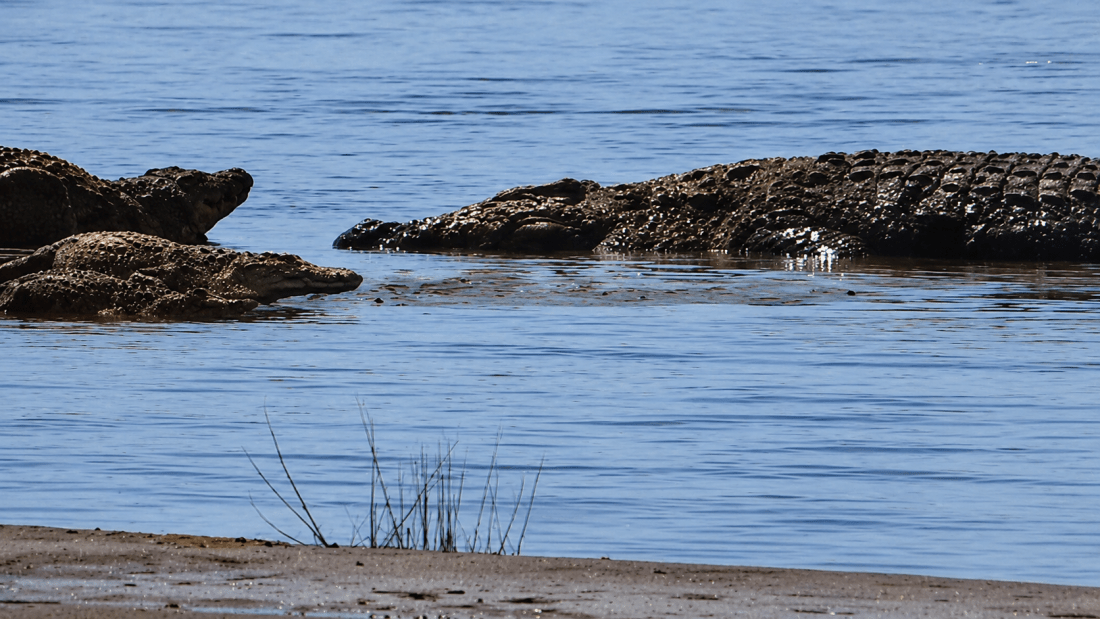
Last week, I happened to be in Oxford on a rainy day, and so, found myself at the UK’s only crocodile zoo – Crocodiles of the World, near Brize Norton. And one of the showpiece spectacles is their feeding of the 26 Nile crocodiles they have in the collection.
It was quite something to behold. But despite the many snapping jaws, and many being over two metres or more in length, they were still diminutive compared to a certain legendary Nile.
One named Gustave.
The Animal
Gustave is — or was — a Nile crocodile of extraordinary size. Estimates put him at somewhere between five and a half and six metres in length, making him one of the largest crocodiles ever reliably documented. His weight has been guessed at over nine hundred kilograms. These figures carry the usual caveats: he was never captured and therefore never officially measured. But even accounting for a little over estimation, Gustave appears to have been a genuinely massive animal, an outlier among outliers, operating in the Ruzizi River delta and along the northern shores of Lake Tanganyika near Bujumbura.
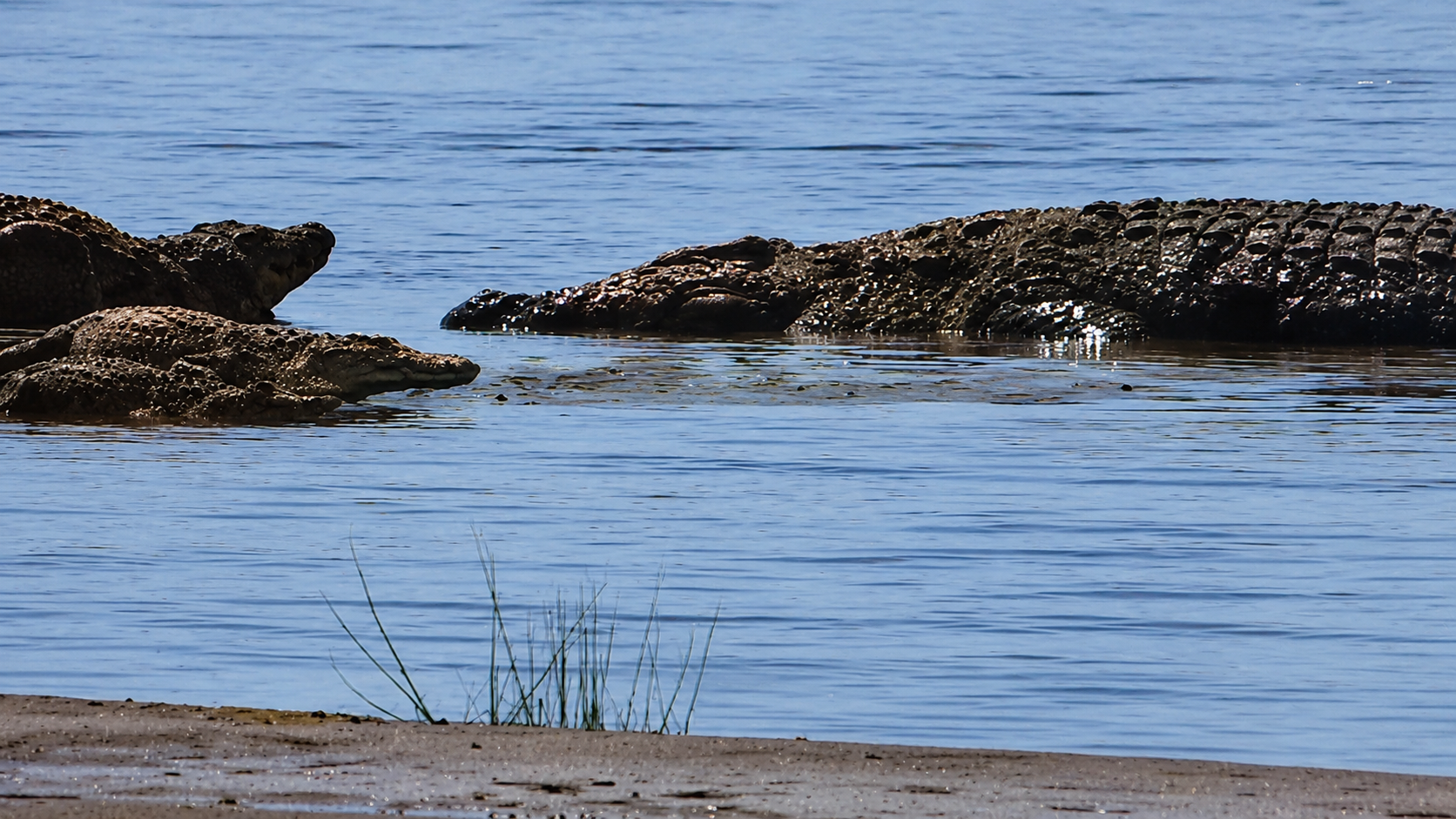
It wasn’t just Gustave’s size that made him easy to identify at a distance. He had a grouping of scars along his right rear flank put there by machine gun fire and another visible patch of pink scarring on his right shoulder from either a spear or homemade harpoon. These and other marks were accumulated through decades of encounters he walked, swam, or slithered away from.
He also had two large bony projections on top of his head that seemed to have fused at the rear, something noticed and commented on in the 2004 documentary Capturing the Killer Croc.
And he was old. Dr Alison Leslie, who observed Gustave in the early 2000s first thought he was maybe 100 years old due to his size. But his excellent and full set of dentition meant he was more likely around the age of 60, and still growing. Niles have a typical optimal lifespan of around 70 years in the wild.
Either way, his size and age, if reliably estimated, combined to produce an animal that operated by slightly different rules. For instance, in 2003, a park ranger observed Gustave stalk, kill, and devour an adult hippopotamus – something unheard of.
Another of those differences was something that researchers and locals often observed about his kills. Crocodiles, like all predators, typically don’t kill more than they can eat, or close to it. Yet Gustave appeared to kill well beyond that threshold with reports of multiple victims in a single event, before disappearing for periods. One theory holds that his sheer size made conventional feeding mechanics difficult: he was perhaps too large to roll prey underwater efficiently.
The number of alleged human fatalities, between 60 and 300, tells you everything about the problem of documenting Gustave’s victims. Attacks along the Ruzizi and the Tanganyika shore were rarely reported to any central authority. Many victims were fishermen, or people collecting water, in communities with limited access to formal record-keeping. The lower figure probably reflects confirmed attributions; the upper figure is folk accounting and accumulation, the number that feels true even if it can’t be proven. The real figure is somewhere in there, which is its own kind of horror.
My own observation is that Gustave was clearly capable of taking large prey, having been documented attacking the hippopotamus mentioned earlier, other crocodiles, and a mature cow – which was caught on camera. Many of his human victims were found drowned and not devoured (but not all by any means). I think its likely that these kills were either territorial or perhaps those discovered before Gustave could return to them: although the idea of crocodiles storing meat underwater to tenderise the meat is something of a myth (they prefer fresh meat almost always), they have been observed caching larger prey and leftovers in places where the carcass won’t be swept away by strong currents. However, the kills may have also been instinctual: the riverbanks that Gustave called home were often popular with fishermen and their presence may have been too tempting. But perhaps afterwards, Gustave decided they didn’t meet his calorific requirements.
The Man
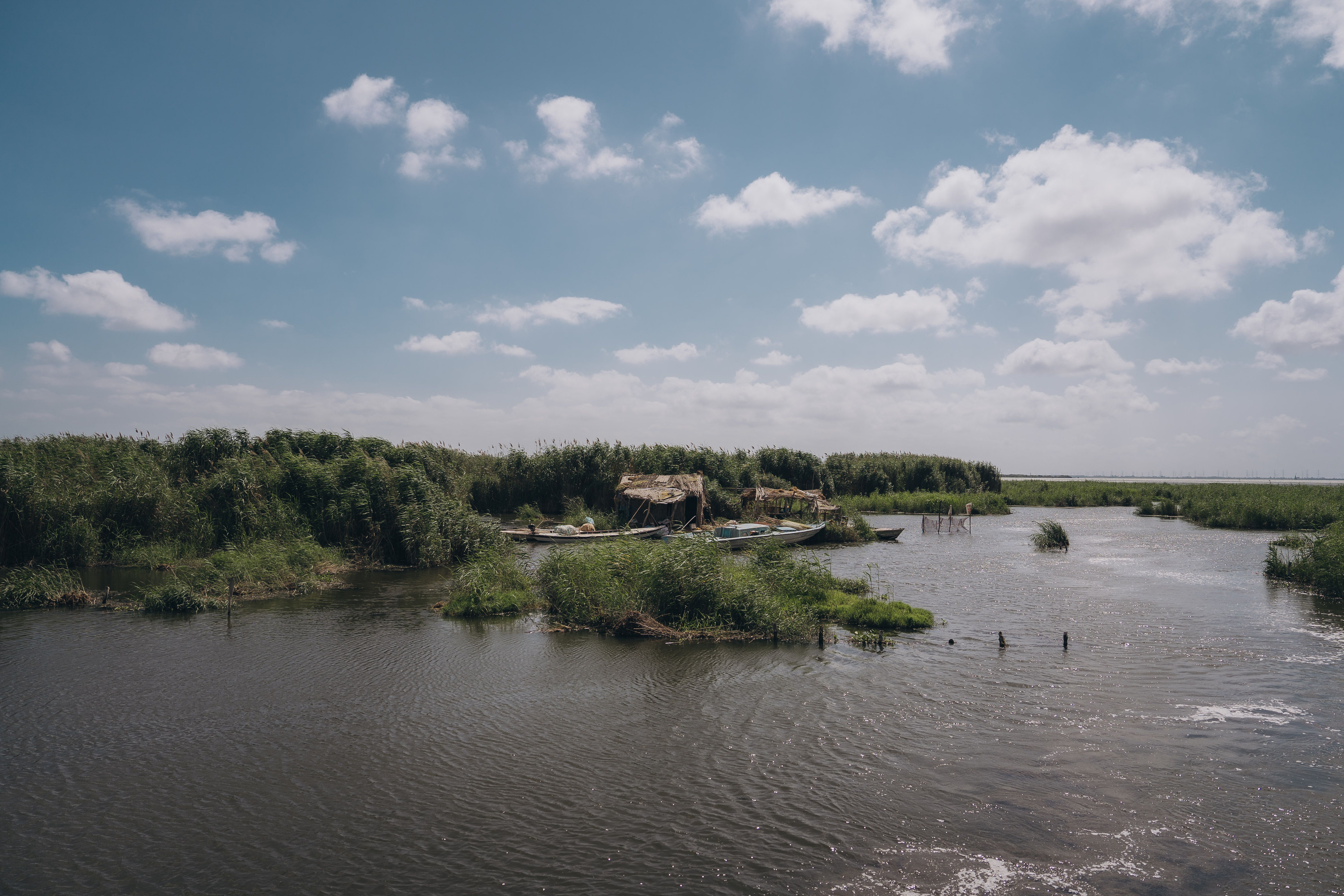
Patrice Faye arrived in Burundi as a French expatriate and became a long-term resident, which given his interest in herpetology, isn’t surprising. Burundi is an exceptional destination for herpetologists because it sits at a unique biogeographical crossroads. Bridging the Congo River Basin, the Great Rift Valley, and the East African savanna, its isolated, high-elevation montane forests, pristine rivers, and protected nature reserves are a goldmine for discovering endemic and rediscovered reptiles and amphibians. And due to decades of political turmoil, much of the country remains under-surveyed compared to neighbouring East African nations. This offers huge potential for modern field researchers and taxonomists to uncover rare or presumed-extinct taxa.
However, by the 1990s, Patrice had become the foremost chronicler of one reptile in particular – Gustave — not as a scientist exactly, but something between a naturalist, a documentarian, and an obsessive. He photographed the crocodile. He collected accounts of attacks. And eventually he decided to catch Gustave alive.
Faye constructed a large trap. It was a massive, 10-metre steel device designed to hold a crocodile of Gustave’s dimensions. Deployed in the animal’s territory, the plan was to lure him in, secure him, and then keep him in an especially built enclosure, some 60 by 90 feet for study and I’m sure as a potential attraction.
We’ll never know, as after the trap was deployed. Gustave ignored it. He showed some curiosity once live bait was introduced, but never ventured into it.
The 2004 National Geographic/PBS documentary Capturing the Killer Croc followed Faye’s expedition, and what it captured — unintentionally — was the peculiar comedy and pathos of human expertise confronting an animal that didn’t know it was supposed to be catchable. The crew waited. Gustave circled. On several occasions he came close enough to raise heart rates, then turned away. By the end of the documentary he had not been caught and ultimately. never has been.
There is something almost classical in the shape of this. The monster that keeps proving itself uncatchable is a very old story. What’s unusual here is that it’s a true one, documented on film, with a specific man standing at the centre of it — wading into a Burundian river, looking for something he couldn’t quite reach.
The Legend
Here is the moment Gustave crossed from animal into myth: sometime in the mid-2000s, while confirmed attacks were still being reported, communities around the lake began to speak about him less as a crocodile and more as a presence. A territorial entity. Something that had claimed the water and established terms. Fishermen avoided certain areas not merely out of caution but out of something closer to acknowledgement that they were operating in Gustave’s space, and that he might enforce that.
His own skin was a pockmarked testimony of his un-killable nature. And his intelligence was almost supernatural. Faye and other scientists often felt outwitted and out manoeuvred by Gustave – that he was always somehow one step ahead. Even the trap intended for his capture was somehow dislodged. Some say it was by heavy rains. But others say Gustave walked around the cage, took the goat, and dislodged it that way.
This is how living legends get made. Not through any single dramatic act, but through the accumulation of attacks that defy logic, combined with evasions and failed attempts at capture, until the animal stops being an animal and becomes an idea. Gustave’s unusual size also certainly added to his legendary status.
But here is something Burundi’s killer croc has probably never been told: he is very probably now dead.
The rumours have circulated since around 2019 — that Gustave, the most feared predator in Burundi, the Nile crocodile estimated to have killed somewhere between sixty and three hundred people, died quietly somewhere in the reed beds along Lake Tanganyika. No body. No confirmed sighting in years. Just the slow absence of a presence.
The probable death, if the 2019 rumours are true, is interesting precisely because of how little it has settled. There was no body. No confirmed final sighting. No Faye standing over something conclusive. The absence of evidence is indistinguishable, at this distance, from a six-metre crocodile lying low in deep water. And so Gustave continues to circulate — in articles, in forums, in conversations. Here, now, in this one.
It should be noted that Faye was arrested and imprisoned in Burundi in 2011, on five charges of rape, serving a 25-year sentence. Although the case must be taken seriously for obvious reasons, it is marred by possible corruption and questionable proceedings. However, the point is that since 2011, Gustave’s main documenter has been out of the game. So maybe, just maybe, Gustave still stalks the riverbanks of the Ruzizi River delta and the northern shores of Lake Tanganyika
The Honest Admission
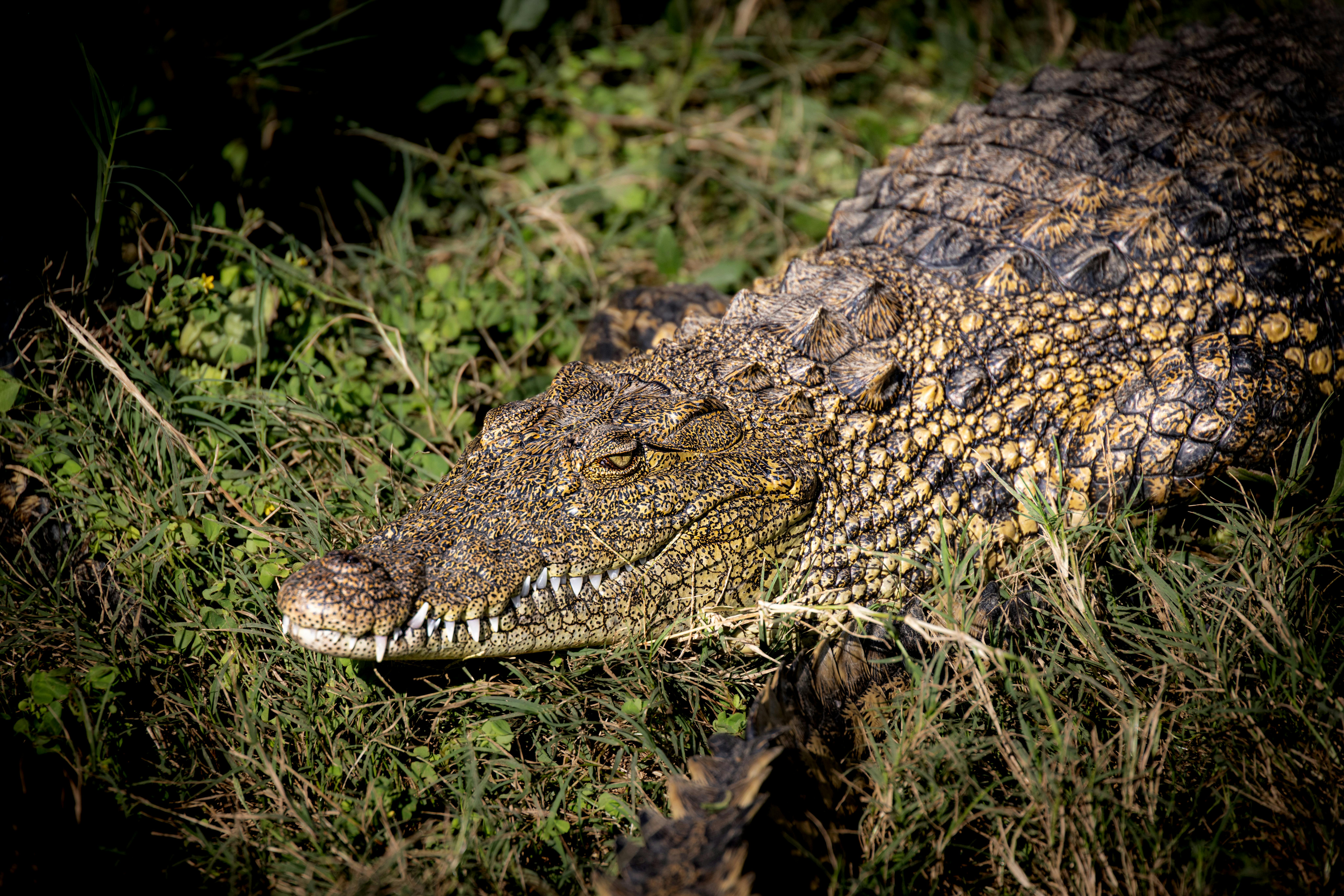
There is something worth acknowledging about the fact that the people most fascinated by Gustave — researchers, filmmakers, writers, readers of blogs like this one — are, on some level, rooting for him. Not for the attacks. Not for the deaths, which were real and brutal and happened mostly to people living modest lives beside a beautiful lake. But for the persistence of the animal itself.
It is difficult to explain this without sounding callous, so let’s try to be precise: what people are rooting for is the idea that something this large, this old, this impervious, is still out there. That the world is still a place where a creature can operate entirely on its own terms, evading every trap, outlasting every pursuit, accumulating a toll that becomes legend — and then disappearing, silently, on its own schedule.
We built our categories — man-eater, monster, legend — and Gustave filled them all without ever being asked.
And ultimately, we must consider the part humans played in creating the circumstances that enabled or even drove Gustave towards becoming a man-eater. In the 1950s, when Gustave was less than two metres long and barely ten years old, Burundi’s deltas were home to buffalo, elephant, warthog, and wild herds of numerous antelope. But each was made geographically extinct in a few short years. The only wild large mammal to survive was the hippo.
It’s not hard to imagine as livestock were introduced and brought to the water’s edge that Gustave became acclimated to the presence of humans. And then, one day, after growing used to taking the cows, he missed or opportunistically targeted their human companion. And a legend was born – perhaps one that will never truly die.

