
There is a tidy version of this story that gets told every summer, usually around the time someone re-airs Jaws on a bank holiday. It goes: Spielberg made a film about a shark, the film made an obscene amount of money, and every producer with a chequebook and a rubber animal spent the next decade trying to do it again. Tidy, and not exactly wrong. But it skips the most interesting part, which is that Jaws lit the fuse on a genre it didn’t actually belong to.
Look closely at the 1975 original and you’ll notice something the imitators all felt obliged to fix: the shark has no reason. It isn’t avenging anything (we’re ignoring the fourth instalment at this moment in time). It hasn’t been mutated, provoked, or wronged. It is simply a large apex predator doing what large apex predators occasionally do, and the film is far more interested in the three men in the boat than in any quarrel between humanity and the sea. There’s a lovely irony buried in this. Even the picture’s own origins are slippery — the 1916 Jersey Shore attacks are widely cited as the seed of Peter Benchley’s novel, and Benchley went to the trouble of issuing a correction to The New York Times in 2001 to deny it. The film references 1916 in its own dialogue. Make of that what you will. The point is that Jaws arrived without a thesis about nature, and the films that chased it spent a decade supplying one.
The bloodline before the shark
The idea of nature turning on us was hardly new. Hitchcock had done it in 1963 with The Birds, in which gulls and crows lay siege to a California town for no stated reason at all — arguably the purest expression of the whole notion. The early 1970s kept the thread going: Willard (1971) and its army of rats, Night of the Lepus (1972) and its giant rabbits filmed in slow motion across miniature sets (a sentence that explains the film’s reputation rather efficiently), and Frogs (1972), in which an assortment of swamp life conspires to remove a polluting Florida patriarch from the gene pool. The amphibians mostly sit and watch, which is somehow more unnerving than if they did the work themselves.
So the appetite was there. What Jaws added wasn’t the concept but the commercial proof — that an animal-attack picture could be the biggest thing in the country. The rest was arithmetic.
Silent Spring with teeth
Here’s the engine that the tidy version leaves out. The decade that produced these films was also the decade that produced modern environmentalism. Rachel Carson’s Silent Spring had landed in 1962, the first Earth Day was held in April 1970, and the air was thick with genuine anxiety about pesticides, pollution, the ozone layer and what exactly we were doing to the world. The drive-in took that anxiety and gave it fangs. Where Jaws offered a predator without motive, its descendants offered defendants. The animals weren’t just hungry — they were owed.
You can read the era’s whole guilty conscience in the premises. Day of the Animals (1977) blames a damaged ozone layer for sending wildlife collectively berserk. Prophecy (1979) hands us a bear mutated by mercury from a paper mill, lurching through the Maine woods as a sort of furry environmental impact statement. Kingdom of the Spiders (1977) sics pesticide-starved tarantulas on William Shatner. The monster, increasingly, was us — and the films knew it.
The American core
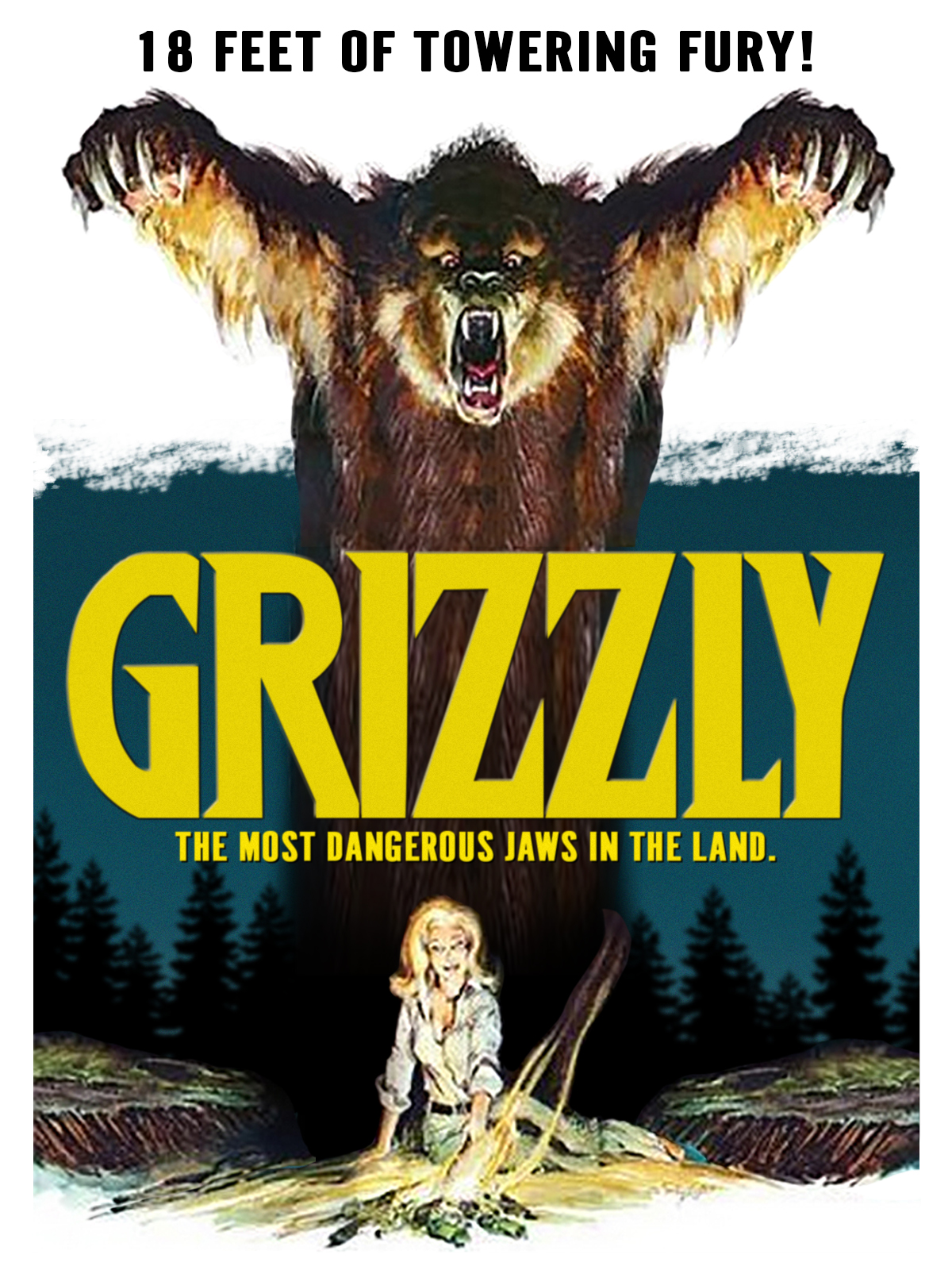
The film that turned the key was Grizzly (1976), directed by the prolific William Girdler and marketed, with admirable honesty, as the most dangerous jaws on land and at least one tagline cited “Jaws with claws“. And it is Jaws transposed to a national park almost beat for beat: the denied threat, the obstructive official, the climactic showdown (here the bear is dispatched with a bazooka, because of course it is). Critics were unkind. Audiences were not — it became the highest-grossing independent film of 1976, earning somewhere near $38 million against a budget under a million, a record it held until Halloween two years later. There is a grim coda to that success: distributor Edward L. Montoro allegedly kept the profits, leaving Girdler and his writers to sue, was later pursued by Universal over a different rip-off entirely, and in 1984 simply vanished with the company’s money, never to be seen again. A man-eating producer to bracket the man-eating bear.
The cycle that followed had range. Piranha (1978), directed by Joe Dante from a John Sayles script, was the clever one — a film that grasped the joke and told it on purpose, which is precisely why it endures. Alligator (1980), Sayles again, took the old urban legend of the flushed pet reptile and fed it discarded growth hormone until it burst out of the sewers; it remains, for my money, one of the era’s genuine guilty pleasures, smarter and funnier than it needed to be. And then Prophecy, which is a real curio — a John Frankenheimer film, properly mounted and beautifully shot, that lapses into pure camp the moment the mutant bear appears. The gap between its ambitions and its monster is where a lot of its charm lives.
The prestige peak: Orca
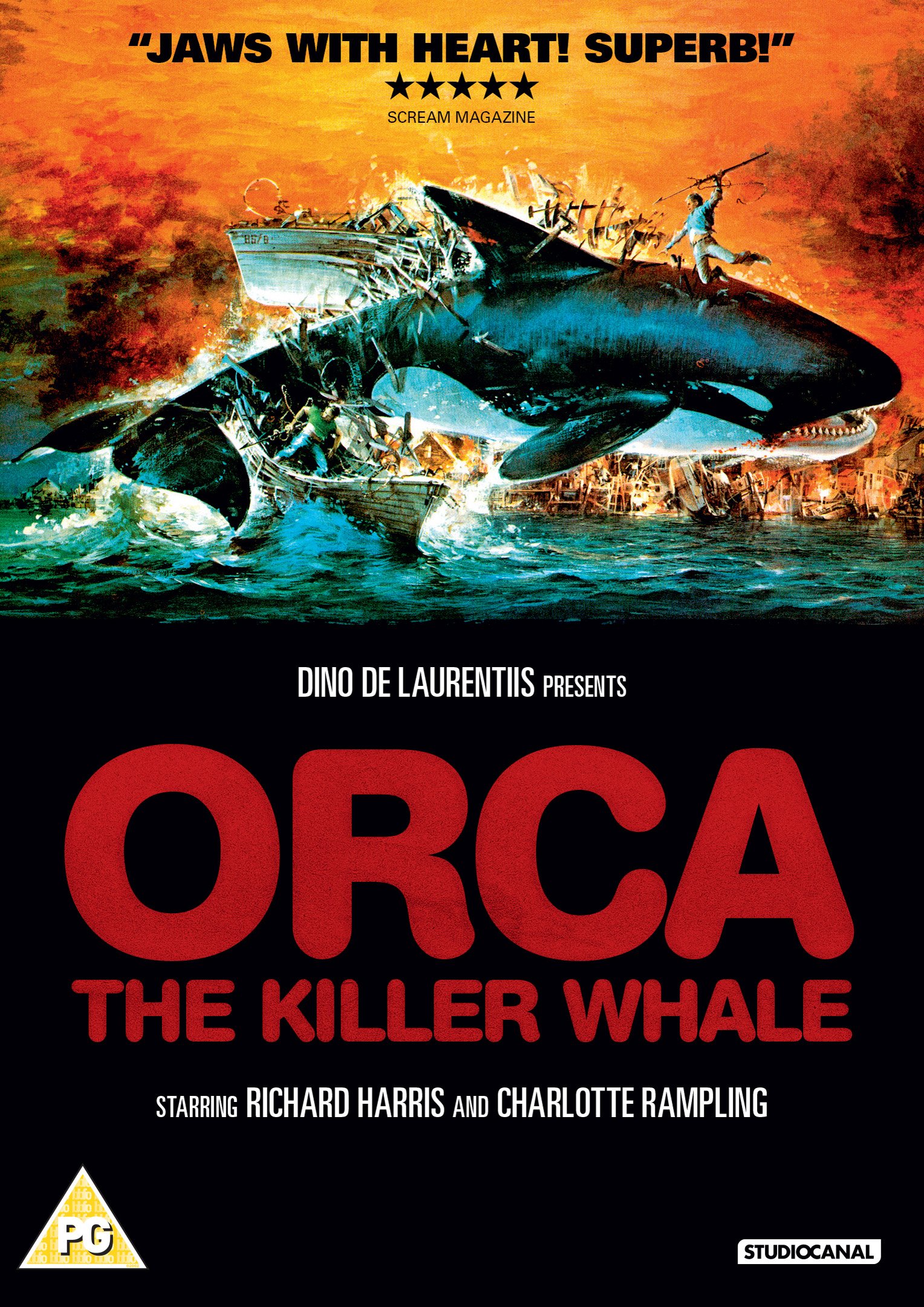
If Grizzly was the cycle’s reliable workhorse, Orca (1977) was its swing for the fences. Dino De Laurentiis commissioned it to outdo Spielberg outright. The legend has him phoning his writer in the night demanding a “fish” tougher and more terrible than the great white, and threw real money at it: Richard Harris, Charlotte Rampling, and a Morricone score. What makes Orca fascinating isn’t its budget but its morality. It flips the polarity completely. The whale isn’t a monster; it’s bereaved, hunting the captain who killed its mate and calf. It’s less Jaws than Moby-Dick reversed, or Death Wish with a dorsal fin — the animal as wronged party, the human as the one with the reckoning coming. That inversion, the audience quietly rooting for the creature, became the cycle’s true signature.
The cash-ins and the artful outliers
Inevitably, the imitation curdled into outright theft. The Italian industry, never shy, produced Cruel Jaws and Enzo Castellari’s The Last Shark (released abroad as Great White) — films so close to the source that Universal had their American releases halted in court. The genre had begun eating itself.
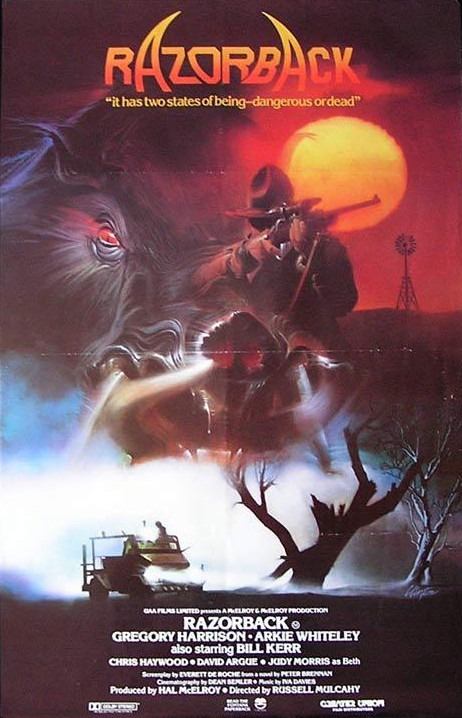
Australia, meanwhile, did something more interesting with the same materials. Long Weekend (1978) is the era’s most artful entry, a slow, dread-soaked story of a bickering couple whose casual cruelties to the bush — litter, a rifle, a smashed egg — are answered by a landscape that turns sentient and patient. And then there’s Razorback (1984), Russell Mulcahy’s giant-feral-boar picture, which has no business looking as good as it does. Mulcahy came from music videos, and it shows in the best way: the outback set-pieces, especially the desert sequences, are extraordinary — bleached, surreal, lit like a nightmare. It’s a B-movie with the visual imagination of something far grander. I also especially liked the tagline: it has two states of being – dangerous or dead. The film also featured a young Arkie Whiteley, the London-born, Sydney-raised daughter of the painter Brett Whiteley, in one of her early roles. She died in 2001 at just 37, of adrenal cancer — a genuine loss, and worth a moment’s pause amid the killer pigs.
The bill comes due again
By the early 1980s the cycle had run its course. Cultural dread migrated to the nuclear and the dystopian — the wasteland replaced the wilderness — and the notion of a vengeful animal started to feel quaint. But it never quite died, and lately it’s been stirring, fed by the same anxieties that powered the original wave, now updated. Shark cinema, frankly, never stopped at all (that will get its own blog). The bear got its absurdist revival in Cocaine Bear (2023). And the moral inversion Orca pioneered has come fully back into fashion: Killer Whale (2026) builds its whole story on an orca driven to kill by twenty years of captivity, with the humans cast firmly as the villains — an animal-welfare parable in a creature-feature costume.
What’s telling is that even a film made to condemn captivity caught flak for doing the one thing the genre always does: turning the species into a monster to sell tickets. Which brings us neatly back to the patriarch. Both Benchley and Spielberg lived to regret what Jaws did to the great white’s reputation — Spielberg has said as much, plainly. Half a century on, the nature-strikes-back film has become self-conscious about the very fear it trades in. The animals are still sending us the bill. We’ve just started to suspect we had it coming.