“A fish tougher and more terrible.”
At a quarter past twelve on 9 March 1976, some 560 miles north of the equator and a very long way from anyone, something hit the bow of the yacht Guia III hard enough to shift it three metres sideways.
Claudio Cuoghi was at the helm and had felt nothing coming. By the time Giorgio Di Mola got below, the forward compartment was already full. The breach was well beneath the waterline and far too large to plug; two spinnaker bags stuffed into it were sucked straight back out, taking a crewman’s arm most of the way with them. Sails passed under the hull were torn away. The batteries went under before a proper mayday could get out. Jérôme Poncet, skippering that leg of the Atlantic Triangle, said afterwards that not even God could have saved her.
She sank bow-first. The crew got into an inflatable with fourteen litres of water between them and were picked up around midnight the following day, having fired flares at a passing ship. Within the week they were at the Waldorf Astoria as guests of Whitbread, which was rather the point of the race in the first place.
There were five orcas around the boat while she went down. One of them lay against the hull, entirely still, in a posture that Francesco Longanesi Cattani could only describe as the animal trying to work out what sort of creature Guia was. On deck, another crewman was shouting that the whale had come to murder them. When the yacht finally went under, the orcas left.
Two readings of the same animal, in the same four minutes, from men standing five feet apart. One of them describes an intelligent predator investigating an unfamiliar object. The other describes a monster. Fifty years on we are still choosing between them, and the record of which one we picked, and when, and why, is largely a record of what was showing at the cinema.
The killer, dismissed
Before the orca could be a monster, it had to be worth noticing, and for most of the written record it was not.
The sixteenth-century naturalists were happy enough with sea monsters in the abstract — Konrad von Gesner and Ulisse Aldrovandi both produced cetaceans of extravagant proportions, ship-devouring things with fountains erupting from their skulls — but these were whales in general, monstrous by category rather than by species. The orca had no particular billing.
Melville, three centuries later, gives it a paragraph and a shrug. In the Cetology chapter of Moby-Dick, Ishmael admits that the Nantucketer knows little of this whale and the naturalist nothing at all. He allows that it is savage, that it will fasten onto the lip of a larger whale and hang there like a leech until the bigger animal is worried to death. Then he loses interest. The killer is never hunted, he notes, and he has no idea what sort of oil it yields. He objects to the name on grounds of imprecision, and delivers the line that has outlived the rest of the passage by a comfortable margin: For we are all killers, on land and on sea; Bonapartes and sharks included.
There is something almost funny about this. The monster slot in the greatest whaling novel ever written goes to the sperm whale — an animal that mostly wants to be left alone in the dark eating squid — while the actual apex predator of the world ocean gets four sentences and a note that nobody bothers with it.
What did exist was testimony, and the testimony has always been more interesting than the fiction.
Two Inuit elders in the Foxe Basin passed on an account of a young man in 1955 who ignored advice about the thinness of the ice over Grand Suttie Bay, walked out over a polynya where orcas were trapped, and was taken when the whales deliberately broke the ice beneath him. It is oral history, it cannot be verified, and it is entirely possible that it is a cautionary tale about listening to your elders wearing a whale as a costume. But it should not be waved away either. It comes from people who lived and hunted alongside these animals in conditions no marine biologist has ever worked in, and it describes something behaviourally coherent — orcas breaking ice from below is documented hunting behaviour, not invention.
We have a photograph of very nearly the same thing. In the early 1910s, during the Terra Nova expedition, a pod of Antarctic pack-ice orcas made a determined attempt to wave-wash a photographer and a team of sledge dogs off an ice floe. Pack-ice orcas specialise in washing seals off floes. The dogs were barking. Nobody was hurt, and the modern reading is that the whales were doing exactly what they always do, to what they reasonably believed were seals.
And then, in the space of four months in 1972, the two incidents that ought to have given anyone writing a killer whale film all the material they needed.
In June, Dougal Robertson’s forty-three-foot schooner Lucette was struck by orcas 200 miles west of the Galápagos and sank in about a minute, putting his family into a raft and a dinghy for thirty-seven days before a Japanese fishing boat found them. In September, an eighteen-year-old surfer named Hans Kretschmer was bitten on the leg at Point Sur in California, taking something close to a hundred stitches. His doctor reportedly said it looked as though somebody had gone at his thigh with an axe.
Kretschmer’s case is the only documented instance of a wild orca injuring a human being. It is also, on inspection, the case for the defence. There were sea lions in the water. He punched the animal’s head, and it let go. He then bodysurfed to shore expecting a second strike that never came. The pattern — a single investigative bite followed by immediate release — is far more legible now than it was in 1972. The one time an orca ever laid teeth on a human in the wild, it appears to have realised its mistake and spat him out.
That is the whole evidentiary record, more or less, as it stood in the mid-1970s. A sunken schooner. A bitten surfer. Some Edwardians on an ice floe. An unverifiable story from the Canadian Arctic. Against it: an animal that had, by then, been netted, sold, towed, penned and taught to jump through hoops for the better part of a decade, and had done almost nothing about it.
Hollywood was about to fix that.
The gentle giant, and what he built
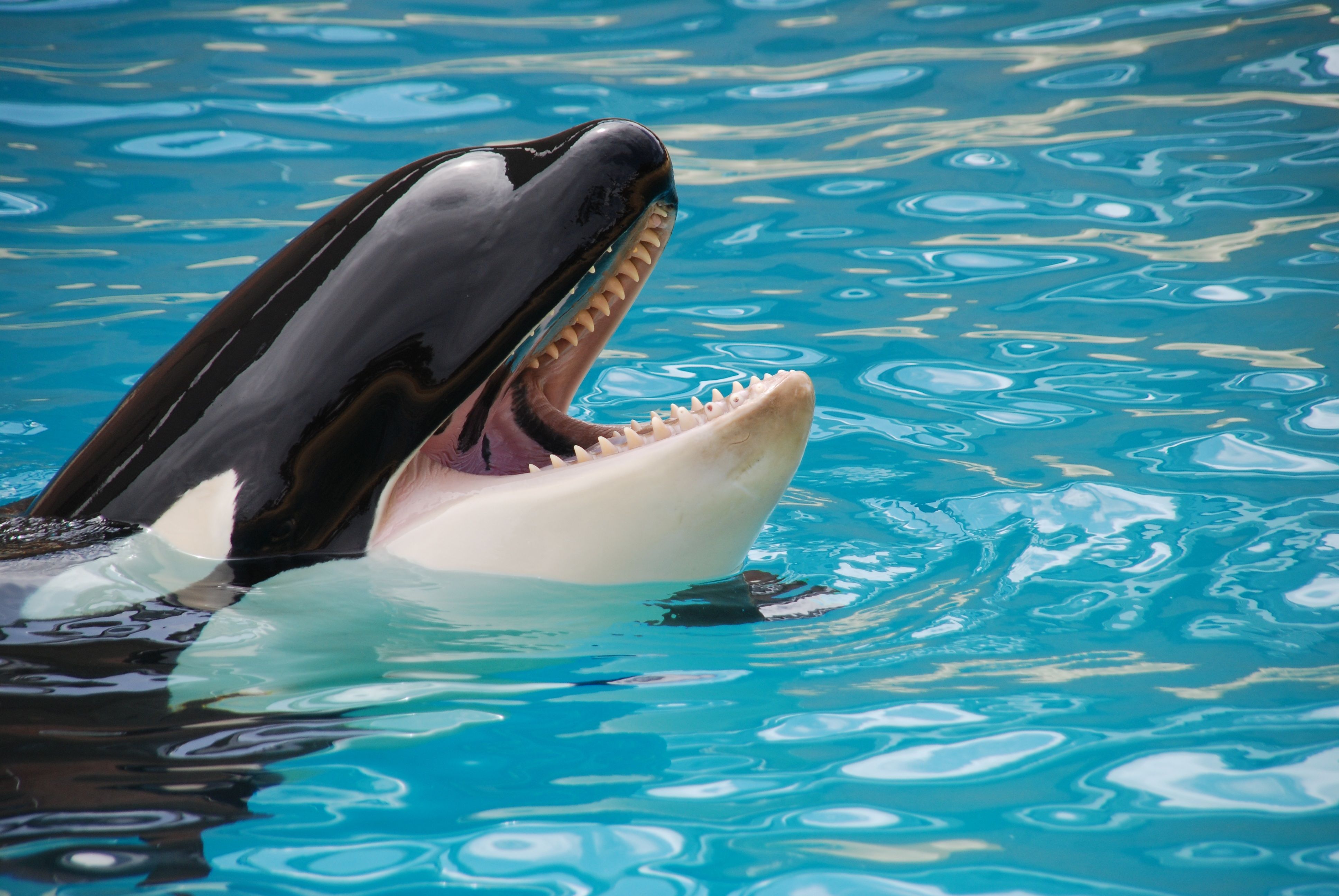
In June 1965, a young male orca drifted into a salmon net near the village of Namu in British Columbia. The fisherman who found him rang Ted Griffin, who owned the Seattle Marine Aquarium, and Griffin bought the whale for eight thousand dollars, which turned out to be the cheapest part of the exercise. Namu was towed 450 miles south in a floating pen. Crowds lined the Seattle waterfront. Aircraft circled.
Namu became the first captive orca to perform in the water with a person, and Griffin — riding him in front of paying audiences — became a local hero. There was a film, Namu, the Killer Whale, made by United Artists in 1966, in which a marine biologist befriends a misunderstood whale and must persuade frightened fishermen that the animal is gentle. There was a theme song. There was, in the space of about eighteen months, a wholesale reversal of the killer whale’s public reputation from oceanic vermin to enormous friendly dog.
Namu died on 9 July 1966, having survived just over a year. He had picked up a bacterial infection from the polluted water of his pen; weakened, he became entangled in the cables of his enclosure and drowned. Griffin later said he wished the whale had succeeded in what he chose to describe as a break for freedom.
Here is the fact around which everything else in this essay orbits. The film that taught the world to love orcas is the film that built the industry that killed them. Demand for a Namu of one’s own was immediate and enormous. Griffin founded a whale-catching company to supply the marine parks; his best customer was SeaWorld. He took the calf who became the original Shamu, having harpooned her mother. By 1970 the Penn Cove captures were using boats, aircraft and explosives to round up young whales in Puget Sound, and four calves drowned in the nets. The bodies were weighted and sunk. They were found the next day.
None of this was a betrayal of the gentle-giant story. It was the direct commercial consequence of it. You cannot sell tickets to see a monster up close. You can sell an enormous number of tickets to see a friend.
Find me a fish
In the middle of the night in 1975, Dino De Laurentiis telephoned the screenwriter Luciano Vincenzoni. Vincenzoni admitted to having seen Jaws. De Laurentiis instructed him to go and find a fish tougher and more terrible than the great white.
Vincenzoni, by his own account, had no interest in marine life whatsoever. His brother Adriano, who did, pointed him towards killer whales. The orca is not a fish, but that has never been the sort of objection that slows a producer down.
What emerged was Orca, directed by Michael Anderson, shot largely around Petty Harbour in Newfoundland, released by Paramount in July 1977 on a budget of six or seven and a half million dollars, depending on whose accounting you trust, and taking $14.7 million. Ennio Morricone wrote the score, which is far better than the film deserves. Richard Harris plays the fisherman with the full-throated commitment of a man who has decided that if he is going to be in this, he is going to be in this. Charlotte Rampling is the marine biologist. Will Sampson, two years on from One Flew Over the Cuckoo’s Nest, is the Indigenous man who understands what the whale is doing. Bo Derek loses a leg, in case anyone had failed to spot which film was being remade.
The plot: Harris’s character harpoons a pregnant female orca. She miscarries on his deck, in a sequence still capable of clearing a room. Her mate then works through his boat, his livelihood and his town until the two of them can settle it on open water.
It is, of course, Moby-Dick turned inside out. Melville’s whale is a blank onto which Ahab projects everything; the horror is that we cannot know whether there is anything behind it. Vincenzoni’s whale has motive, grief, a plan, and something close to a legal case. The animal Melville could not be bothered to describe has become the only character in the film with a coherent inner life.
The phone call
Which brings us back to Guia III, and to the strangest document in this whole story.
In the weeks after the sinking, Giorgio Falck received a telephone call from Los Angeles. The caller introduced himself as a friend of Falck’s brother-in-law. He gave his name as Vincenzoni. He said he had been studying killer whales for three years and was writing a book about them.
He then told Falck a story. In New Zealand, a fishing boat had injured a female orca with its propeller. The male had sunk the boat — and he was careful with the detail, noting the vessel’s seventy-millimetre planking against Guia‘s thirty-five. A month later, in the same place, the same animal had killed a crew of six.
That is the plot of Orca, related as established fact, to a man who had just lost his boat, sixteen months before Paramount put it in cinemas.
I cannot prove that this was Luciano Vincenzoni, and I am not going to pretend otherwise. The claim of three years’ study sits awkwardly against a brief handed down in 1975, and it is at least possible that the caller was his brother Adriano, the one with the zoological interest. But the call came from Los Angeles. The surname is not common. The timing lands precisely inside the film’s development. And the anecdote is not merely similar to Orca‘s premise; it is Orca‘s premise, with the numbers filed off. On the balance of everything we know, this is the film being written, out loud, down a transatlantic line, to a survivor.
It is worth pausing on what that story actually asserts. Six people killed by a single orca would be, by a wide margin, the worst loss of human life to a killer whale ever recorded anywhere. It appears in no register, no report, no scientific literature. Somebody in Los Angeles in 1976 was collecting atrocity stories about killer whales, and either could not tell or did not care which of them were true.
And then Falck — who had every reason on earth to want a monster, who had just watched a boat he loved go down and who describes the orca as a hateful animal — refuses the story flat. He tells the caller he is perfectly aware sea monsters are in vogue since Jaws. He is aware that Guia‘s sinking is of interest chiefly because it happens to involve a topical one. But he is interested in boats and in racing, not in orcas and not in violence.
The man with the strongest possible claim on the revenge narrative would not take it. It was offered to him by a screenwriter, and he handed it back.
Yaka, Nepo, and the whales in the lorries
Orca was made with real whales, and this is where the film stops being merely silly and becomes something closer to evidence.
The two animals identified as the film’s leads are Yaka and Nepo. They were captured together on 11 December 1969 at Pender Harbour in British Columbia, when a group of twelve orcas — Northern Residents, a fish-eating population — was surrounded in a storm and six young animals taken. Yaka was around a year old. Nepo was around two. They were podmates. They were sold together, moved to Marine World in California on 28 December, and put in a tank with an older female called Kianu.
For a few years the three of them did well enough. Kianu grew possessive of Nepo and aggressive towards Yaka, and was sold to Japan in April 1978, which left the two survivors of the Pender Harbour capture alone together. The park hoped Yaka would breed. She never did.
Nepo died on 10 July 1980, of acute bronchopneumonia and kidney disease, at roughly twelve or thirteen years old. Yaka was beside his body and reportedly would not leave it, and afterwards stopped eating and stopped engaging with her trainers. A companion was brought in, an Icelandic female called Vigga, and the two of them performed together for over a decade. Yaka died on 29 October 1997 of a respiratory infection, having spent nearly twenty-eight years in tanks. She had been taken from the sea before she was old enough to have learned to hunt in it.
Marineland of the Pacific also supplied whales to the production, and the likeliest candidate there is Corky II, taken in the same 1969 round-up, though the crediting on this has been muddled for decades and I would not swear to the detail.
They are, by any reasonable measure, wonderful in the film. They are also, by any reasonable measure, giving away the entire game, because their dorsal fins have collapsed. It is a condition essentially unknown in wild males and rare in wild females, and near-universal in animals held long-term in tanks. It is on screen. In a film about a wild orca’s stolen family. In 1977. Nobody in the production appears to have thought it worth a comment.
Because the whales could obviously not be made to bite off Bo Derek’s leg or carry a corpse across a harbour, the effects team also built animatronic orcas out of rubber. These were good. They were good enough that when they were driven to set, animal rights activists blocked the lorries, believing there were live whales inside.
Sit with the shape of that for a moment. Protestors on a road in the mid-seventies, correctly identifying the crime, correctly identifying that whales were being trucked about for entertainment, and stopping entirely the wrong vehicle. The animals they were trying to save were not in the lorries. They were already at the park, already performing twice a day, and had been for six years. They would go on doing it for another twenty.
The door closes
Free Willy arrived in 1993 with a plot about a boy liberating a captive orca, and had the singular distinction of generating a real liberation campaign for its own star. Keiko had been captured off Iceland and was living in a small tank in Mexico City. Public pressure moved him to Oregon, then to Iceland, then to a sea pen; he eventually swam to Norway, where he died in 2003. Whether it worked depends entirely on what you thought it was for. He never rejoined a pod. He also spent his last years in the sea.
Then 2013, and Blackfish, and the argument was effectively over. What the film did was not reveal that captivity was cruel — people had been saying so since Namu — but connect the cruelty to the deaths of specific named human beings, and make the connection impossible to un-see. Every human being ever killed by an orca has been killed by a captive one. There is no confirmed fatal attack by a wild killer whale anywhere in the record, ever. The animal only becomes a man-killer inside a tank.
That is a devastating fact for a monster movie. It means the horror cannot be located in the animal. It can only be located in us.
The film that argues itself out of existence
Killer Whale arrived in January 2026, directed by Jo-Anne Brechin and co-written with Katharine E. McPhee, distributed by Lionsgate. Ceto is an orca held in a Thai marine park; after she kills a janitor, the management dumps her into the open sea. Two friends on holiday end up trapped in a lagoon with her.
On paper this should work. The premise carries genuine moral charge, the animal has a real grievance, and the audience arrives pre-loaded with everything Blackfish taught them. The film reviewed catastrophically — twenty per cent on the Tomatometer, and, more tellingly, twenty-one per cent with audiences.
The reviews are unusually consistent about why. Screen Rant found it succeeded as a sombre meditation on captivity and failed as a survival film, and concluded that the director was less interested in making something vicious than in condemning what had been done to the whale. Rue Morgue put its finger on the structural problem: the film cannot decide whether Ceto is an object of fear or of sympathy, and so makes the woman who cares most about her into her principal victim. The film even puts the argument for the defence into its own dialogue, noting that the only recorded fatalities have involved captive animals — a point one reviewer observed, drily, that nobody watching was going to care about.
So the received wisdom is that the captivity angle should have given the film an edge, and the evidence is that it did precisely the opposite. It disarmed it. You cannot frighten an audience with an animal they have already acquitted. The moment you explain why she is angry, you have converted your monster into a plaintiff, and the remaining eighty minutes become a courtroom drama in which everybody has already agreed on the verdict.
The orca is, I think, the only screen monster we have successfully talked ourselves out of. We know perfectly well that sharks are misrepresented and ecologically vital, and The Meg still took a billion dollars. We know bears are not malevolent and we still watch films about them eating people. But the orca’s rehabilitation was so recent, so total, and so specifically bound up in the story of its captivity that the monster no longer fits inside the animal. There is nowhere left to put it.
The revenge was always ours
And then, in May 2020, the whales started sinking boats.
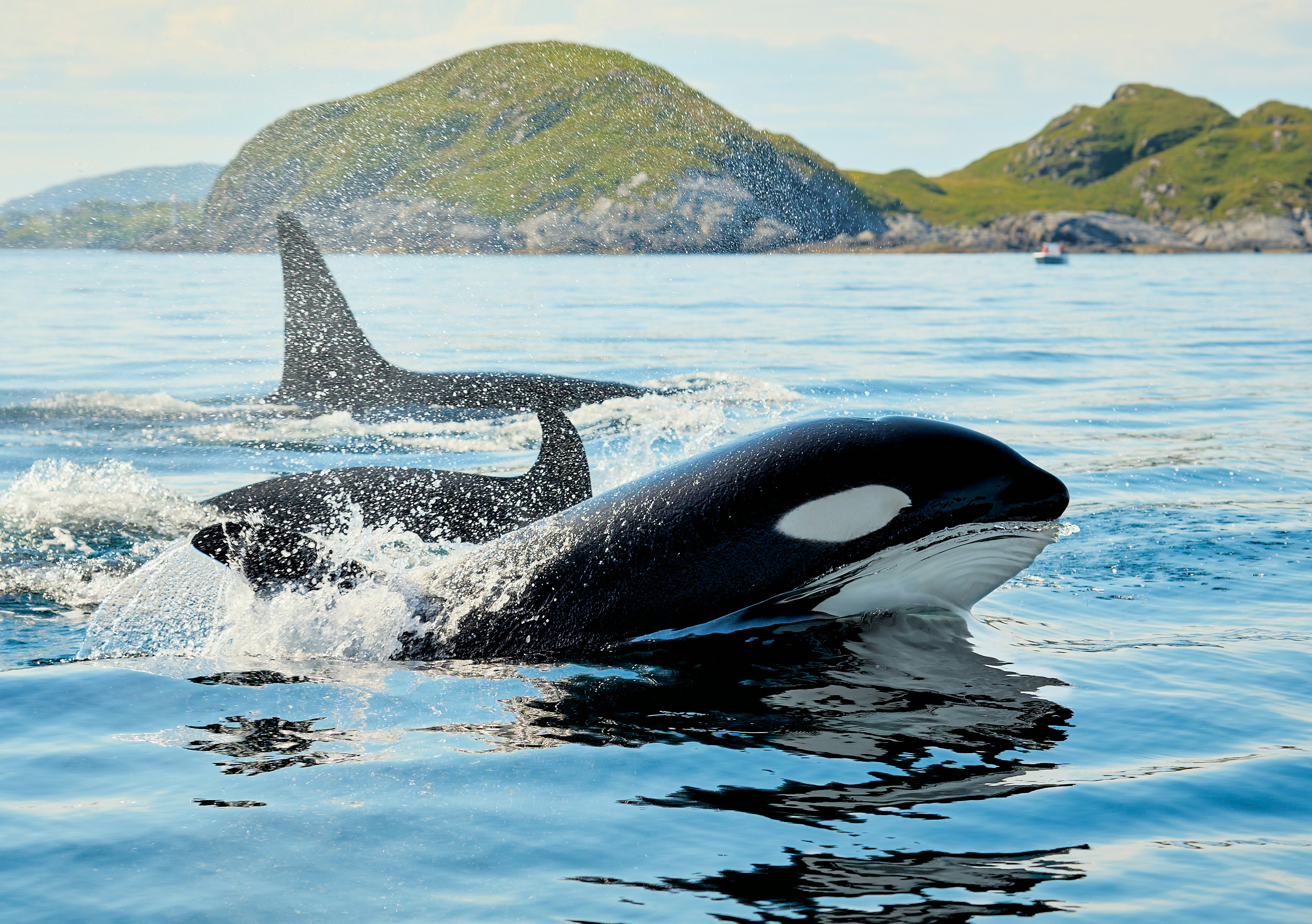
Off the Iberian Peninsula, orcas began ramming vessels and biting the rudders off sailing yachts. By the middle of 2025 there had been more than 750 recorded encounters, over 250 boats damaged, and at least six sunk. The behaviour spread. The press adored it. The animals were assigned the collective designation “Gladis”, after Orcinus gladiator — whale-fighter — and the internet did what the internet does. They were called comrades by a labour organiser and by a newspaper columnist. Merriam-Webster announced that it welcomed its new Delphinidae overlords. A revenge fantasy that Paramount could not sell in 1977 was, in 2023, the most popular story in the world.
Except that it is not a revenge fantasy. It is fifteen animals.
The Iberian orcas are a genetically and culturally distinct subpopulation, listed by the IUCN as Critically Endangered since 2019, numbering fewer than forty individuals in total, and dependent on Atlantic bluefin tuna, which has its own problems. Around fifteen of them have taken part in the boat interactions: eleven juveniles and four adult females, with no identifiable ringleader. The rate is falling — 207 interactions in 2023, 136 in 2024, 125 the year after. Nobody has been hurt. Not once, in over 750 encounters. As GTOA’s Alfredo López has pointed out, they do not come in hard and sink the boat, which they could do easily if that were the objective.
Fifteen adolescent whales from a population smaller than a decent pub quiz turnout, most of them apparently playing, against which we have constructed an international narrative of maritime vengeance.
And here is the fact that ought to end the argument. Through the 1960s and 1970s, while Pacific orcas were being chased by aircraft, herded with explosives, netted, and stripped of their young — while Yaka and Nepo were being taken, sold, and put to work — those whales did not attack boats. Not one. There is almost no evidence that wild killer whales seek revenge at all. A chimpanzee robbed of food will retaliate. An aggrieved macaque will settle the score, sometimes against a relative of the offender. Orcas do not do this. The trainers killed in the parks were killed by animals that researchers believe were psychologically wrecked by the conditions they were kept in, which is not revenge either. It is something worse and much sadder.
The revenge was never theirs. We wrote it. We filmed it, using the actual victims as extras, in a park, for money. And half a century later, when a handful of bored teenagers off Cádiz started snapping rudders for reasons no one can establish, we recognised our own script and gave it a standing ovation.
The coda is uglier. Sailors are now carrying illegal firecrackers to throw at a critically endangered species. Some play death metal through speakers. Others bang steel bars against the hull. Marine mammal biologists are openly braced for someone to shoot one. The single population that has ever cost us anything is the one we are arming against, while the whales who genuinely had cause never lifted a fluke.
One of the six young orcas taken at Pender Harbour on that December night in 1969 is still alive. Corky II went to Marineland of the Pacific rather than Marine World, and to SeaWorld San Diego in 1987 when Marineland was bought and closed. She is around sixty-one. She has been in tanks for fifty-six years, longer than any orca in history. She was pregnant seven times and none of her calves lived past seven weeks. She has cataracts. She still performs.
Her siblings are alive in the water off British Columbia. When researchers played her family’s calls to her in 1993, after twenty-four years of captivity, she reacted so strongly that she was seen to shudder.
Melville thought the killer whale was hardly worth the ink. Namu made it loveable, and the loveliness built the tanks. De Laurentiis wanted a fish tougher and more terrible than the great white, and got a mammal that has never knowingly killed anybody. Killer Whale discovered in 2026 that you cannot run a monster movie on an animal the audience has already forgiven.
And a whale who is very probably in Orca is still swimming in circles in San Diego, forty-nine years after the film came out, having been cast as the monster in a story about her own abduction, and having never in fifty-six years done a single thing to deserve the part.