

I’ve just come back from the Lyme Regis Fossil Festival, where I attended a talk by palaeozoologist Darren Naish on sea monsters past and present. Standing in the Etches Collection a few hours beforehand, staring up at the fossilised remains of a pliosaur — one of the genuine, historically verified sea monsters that once ruled the world’s oceans — I found myself doing what I suspect most visitors do: imagining it alive. Imagining the water disturbed.
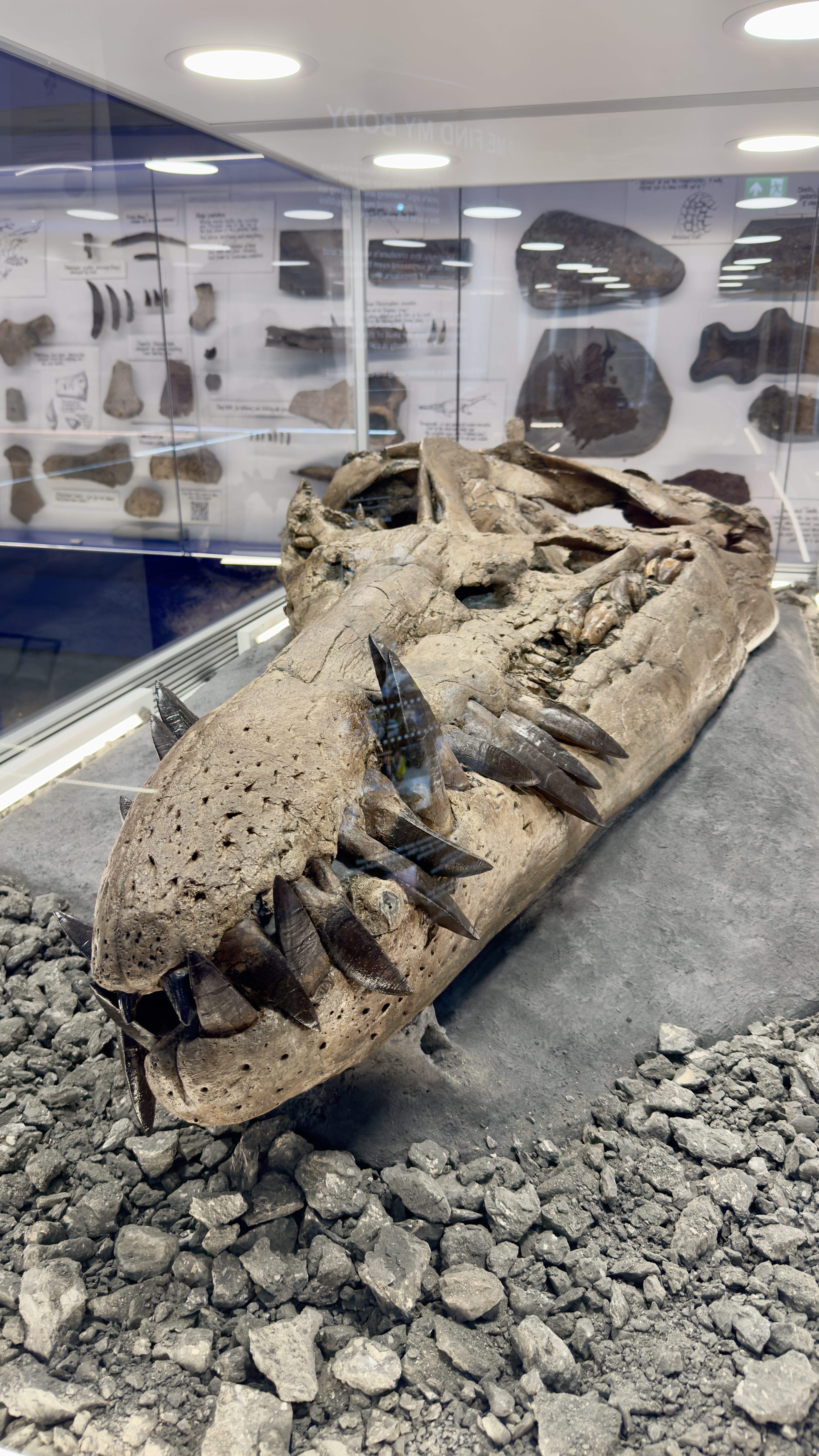
The rational case against lake monsters is well-rehearsed, and Naish is one of its most eloquent advocates. The breeding population problem alone is formidable — a single animal isn’t a species, it’s an anecdote. And Naish has also noted, in published research with Charles Paxton, something fascinating: the rise of fossil plesiosaur discoveries in the 19th century demonstrably changed the shape of sea monster reports. Before plesiosaurs became culturally embedded, people reported sea serpents. Afterwards, they increasingly reported things with long necks, paddles, and large rounded bodies. The monster template updated itself. We see what we’ve been taught to imagine. And that’s before we get to misidentification and everyday animals and objects reported as monsters.
I’m not saying there’s nothing in any lake. I would love there to be. But it’s worth keeping that thought in mind as we travel several thousand miles east to one of the coldest places on earth. And as Naish said in his talk, no argument against potential existence is the same as saying people aren’t having experiences. Furthermore, we should be open to the possibility that science can make the logical argument why something can’t exist, but can’t account for the supernatural or other explanations. And ultimately, absence of evidence is never evidence of absence.
The Pole of Cold
Lake Labynkyr sits in the Oymyakon region of Yakutia, deep in Russia’s Far East — the same district that lays claim to being the coldest permanently inhabited place on the planet. Temperatures here have been recorded as low as -67°C. The lake itself is roughly 9 miles long, 2.5 miles wide, and plunges to around 260 feet at its deepest point. It sits at over 1,000 metres above sea level, and is ordinarily frozen from October to June. Wikipedia
Ordinarily, that is, because here Labynkyr starts to get interesting. Unlike other lakes in the region, which freeze solid during the long Siberian winter, Labynkyr doesn’t — it maintains a near-constant surface temperature of 2°C. One theory is that Labynkyr, where much of the underlying rock is volcanic, is warmed slightly from below by a fissure in the Earth’s crust. Whatever the cause, the result is a body of water sitting open and dark in the middle of one of the most hostile landscapes on the planet, surrounded by ice — and on its surface, according to those who have ventured close enough to look, large holes that locals call “devil windows” appear on the ice, with traces of large animals beside them. Fandom + 2
The nearest settlement is about 150 kilometres away. Local people, the Yakuts and Evenks, have kept their distance from the lake for generations.
What They Say Is in the Water
The creature is described as a huge, aggressive monster with a big mouth full of sharp teeth. Witnesses across different generations and different communities have given strikingly consistent accounts: a large animal with a flattened dark-grey body and a big head with a mouth like a bird’s beak with enormous teeth. Estimates put it at around 30 feet in length. The distance between its eyes, according to some accounts, is no less than the span of a traditional local raft made from ten logs. Russia Beyond + 2
The stories that have accumulated around the creature are the kind that travel. On one occasion, an unknown creature is said to have come ashore and chased a local fisherman until he died of fright. On another, the devil surfaced in front of villagers and swallowed a floating dog in a single movement. Other accounts describe hunters’ dogs leaping into the lake to retrieve shot ducks and simply disappearing. MYSTICAL RUSSIAgoodreads
The accounts predate the Loch Ness Monster — to whom Labynkyr’s creature is inevitably compared — by decades, with the earliest written records reaching back to the late 19th century. Scotland’s monster only became a media sensation in the 1930s. Labynkyr’s devil had been quietly eating dogs for at least fifty years before that. Blogger
The Geologist’s Diary
The creature might have remained a piece of remote folklore, absorbed and forgotten, were it not for Viktor Tverdokhlebov. In July 1953, just a few months after Stalin’s death, Tverdokhlebov — a geologist with the East Siberian branch of the Soviet Academy of Sciences, not a man professionally inclined to whimsy — was on expedition with a colleague named Boris Bashkatov near the shore of Lake Vorota, roughly 20 kilometres from Labynkyr. What he recorded in his diary is among the more compelling pieces of eyewitness testimony in the annals of cryptozoology, precisely because of how clearly it resists embellishment.
In his own words: “It moved in an arc: first along the lake, then straight toward us. As it approached, I was seized by a strange numbness that chilled my bones. The dark grey creature rose slightly above the water, with animal eyes and something like a stick protruding from the body.” Russia Beyond
The two scientists noted it was visible by the way it moved — rising slightly above the water and throwing its torso forward. Above the surface they could make out a large dark-grey mass, and two bright symmetrical spots that resembled eyes. From the back of the creature, something protruded like a stick or a bony growth. Garynevillegasm
The diaries were published in 1961 and triggered the first formal scientific expedition to the area. It found nothing. In the following decades, several divers made attempts, during which some reported seeing something in the murky water — but nothing that could be identified or verified. Delachieve
The Remoteness Problem
There’s a pattern worth pausing on here. The Loch Ness Monster is probably the most famous cryptid in the world, and part of what made it famous is the road. The A82 runs the entire length of Loch Ness’s western shore, and has since 1833 — which means that from the moment Nessie became a media story in the 1930s, there were hundreds of daily witnesses in position to see something, and hundreds more who could arrive quickly to look. The sightings multiplied. So did the hoaxes, the misidentifications, and the tourism industry.
Loch Morar, about 70 miles to the southwest of Loch Ness, tells a different story. Its southern shore and much of its northern shore are accessible only by foot, boat, or bicycle. It is deeper than Loch Ness — the deepest inland loch in the UK at 310 metres — and it has its own monster, known as Morag, with its own sighting history stretching back to 1887. There are over thirty known recorded sightings — and given the loch’s remoteness and complete absence of tourist infrastructure, that number is arguably more striking than Nessie’s catalogue, not less. The witnesses tend to be ordinary Highland residents — fishermen, stalkers, community members — with no record of sensationalism or publicity-seeking. Morag simply isn’t famous, because almost nobody goes there. Scottish-at-Heart + 3
Labynkyr operates at a similar remove, multiplied by several orders of magnitude. It is not 70 miles from a famous loch with a visitor centre. It is 150 kilometres from the nearest settlement, in a region where the annual temperature swing can exceed 100 degrees Celsius. The handful of serious researchers who have made the journey have done so at genuine physical risk. There is no incentive to perform a sighting at Labynkyr. There is barely any incentive to go at all.
This doesn’t prove there is something in the water. But it does change the texture of the testimony — the same way Morag’s witnesses carry a different quality of credibility than a tourist snapping a photo from a car park at Drumnadrochit.
The Sonar and the Skeleton
The thread didn’t die. In 2012, Moscow State University associate professor of biogeography Ludmila Emeliyanova used sonar readings to record several large, underwater objects in Lake Labynkyr. She was careful with her language — she didn’t claim to have found a monster — but the readings were of objects larger than any fish or shoal of fish the equipment would normally register. Live Science
The following year, a team from the Russian Geographical Society dove to the lake bottom during winter conditions, in temperatures that were hitting -45°C outside. They recovered what appeared to be the remains of jaws and skeleton of an animal. The expedition’s geologist gave a quote that has the quality of the best kind of open verdict: “There have been all sorts of hypotheses about what kind of creature it could be: a giant pike, a relic reptile or an amphibian. We didn’t manage to prove or to disprove these versions… we managed to find remains of jaws and skeleton of some animal.” Live Science
Some animal. After sixty years of searching, that’s the most the evidence has yielded.
What It Probably Is (and Why That’s Still Interesting)
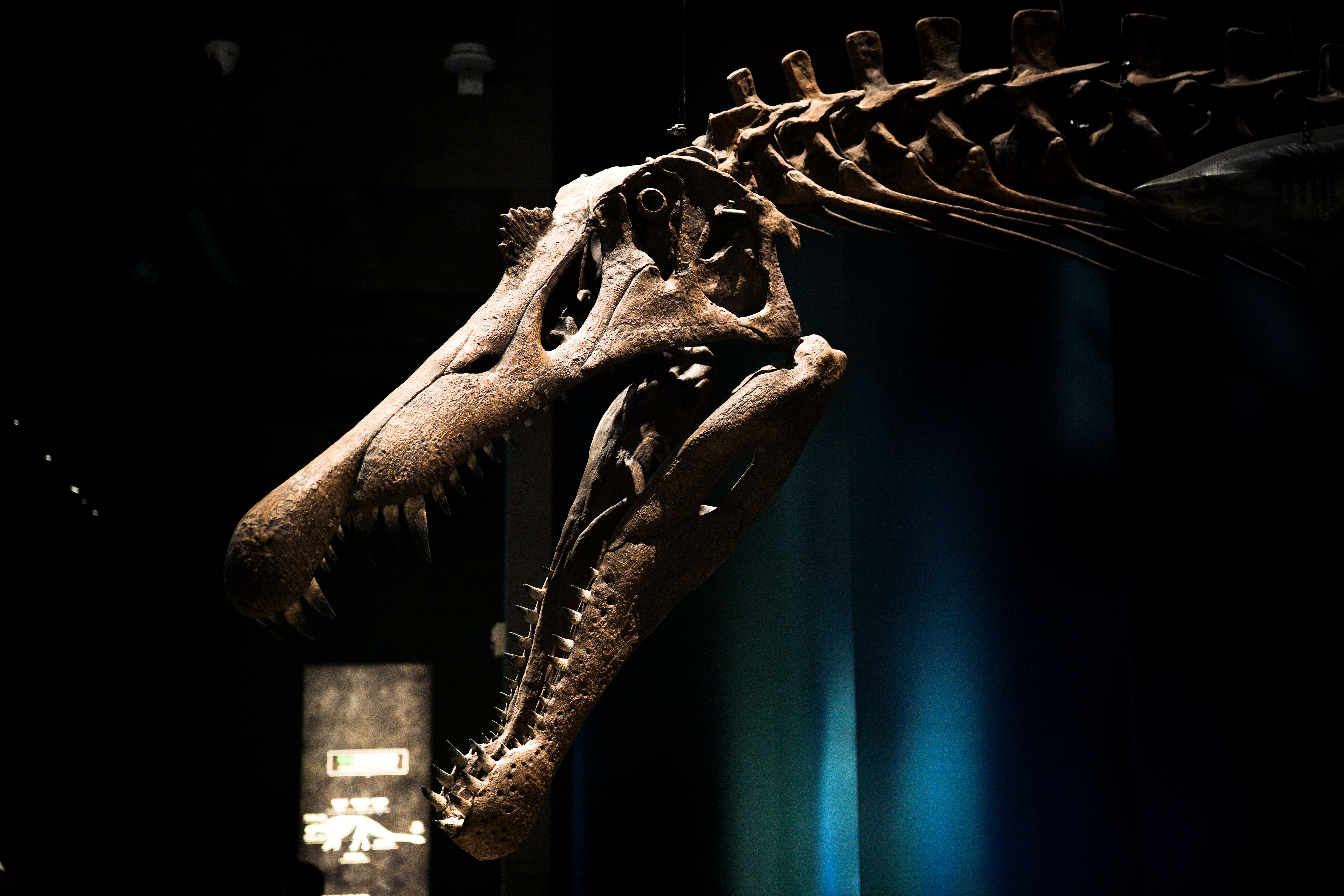
Sceptics at the Russian Academy of Sciences have done the maths on the creature’s supposed dimensions. If the distance between its eyes is really 1.5 metres, as some accounts suggest, then the body must be somewhere between 7 and 8 metres long. That’s not impossible for a large aquatic animal — but it rules out most of what actually lives in the lake. Pike don’t grow that large or live long enough to reach such a size, though they remain the most popular rational candidate. Cryptozoologist Karl Shuker has proposed the burbot — an unusual, deep-water fish with a loose body and a large, rather unlovely head — as an alternative candidate, arguing that in the cold of Labynkyr, undisturbed by predators or human interference, a burbot could theoretically attain a genuinely extraordinary size. Live Science + 2
There is also the mirage factor to consider. One diver who made multiple descents into the lake saw nothing but large dogfish, and noted that the area produced visual mirages — something like moving islands — that are common throughout northern regions with significant ice and snow cover. A mirage of an ice feature, glimpsed briefly across 200 metres of open lake in conditions of extreme cold, could very reasonably become a dark-grey rising hump in the telling. Wikipedia
And yet. The consistency of the descriptions across cultures and centuries is hard to entirely dismiss. The lake’s anomalous thermal properties remain partially unexplained. The underwater trench — deeper than most of the lake and, as of the last serious attempt, still not fully explored — is a blank space on the map. There are also theories that Labynkyr is connected by underwater channels to Lake Vorota, 20 kilometres away, where Tverdokhlebov made his original sighting — which would at least account for why the creature seems to appear at both locations. The Watchers
The Cover That Started in Italy
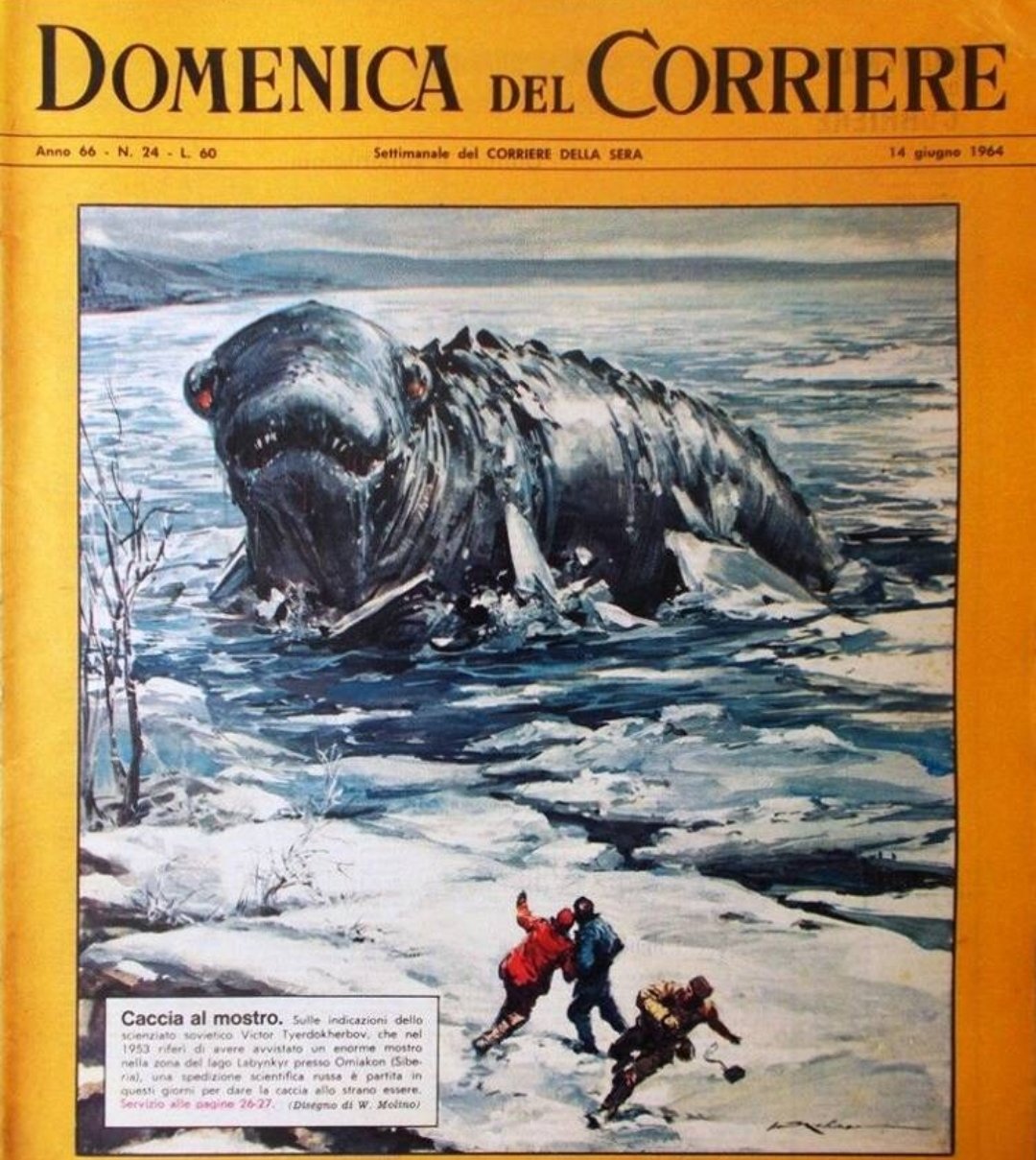
The Domenica del Corriere illustration that opens this article — that hulking, grey, thick-bodied mass rising from icy water, tiny human figures fleeing in the foreground — was published in June 1964, when the legend had been circulating in the Western press for a few years following Tverdokhlebov’s published diaries. It looks like a plesiosaur, roughly. It also looks like an enormous seal, or a boulder, or a trick of the light in one of the coldest places on Earth.
I stood in front of a genuine sea reptile fossil last week and felt the pull regardless. There’s something in us that wants the monsters to be real — and standing at the shores of a lake that refuses to freeze in -60°C weather, in a wilderness where no one lives for 150 kilometres in any direction, hearing stories that have been told in the same terms for over a century, it would be hard not to look out at the water and wonder.
The Labynkyr Devil may be a giant burbot. It may be a mirage. It may be a legend that filled a void left by a place too remote and too hostile to allow easy explanation. But until someone gets back down into that unexplored trench and comes up with something definitive, the lake keeps its secret — and in the meantime, the devil windows keep appearing in the winter ice, and no one seems particularly eager to find out who’s making them.
If you’re interested in Sea Monsters both past and present, real and imagined – you might find some in my upcoming book, Dark Tides. The Kindle version is available to pre-order now here.

