Monster Monday: The Flathead Lake Monster

In 1889, the year Montana became a state, a steamboat called the U.S. Grant was working its way down Flathead Lake with something over a hundred passengers aboard. Her captain, James C. Kerr, saw a log in the water ahead.

Then the log started moving.

What Kerr and his passengers reported was an object of perhaps twenty feet, whale-like, coming towards the boat. One passenger — and here the nineteenth century announces itself — produced a rifle and fired at it. The thing went down. Everybody got home. And the Flathead Lake Monster, in the form we still argue about, was born on that afternoon.

It has been argued about ever since. More than a hundred sightings have been logged in the years since Kerr, most of them between April and September, which is either evidence of a creature’s seasonal habits or evidence of when people are on the water with a drink in their hand. Locals call it Flessie, in tribute to a more famous Scottish resident. Two explanations dominate: a sturgeon, or a giant eel.

Both of those explanations are worth taking seriously. Neither of them, it turns out, came from the lake.

The lake’s case for itself

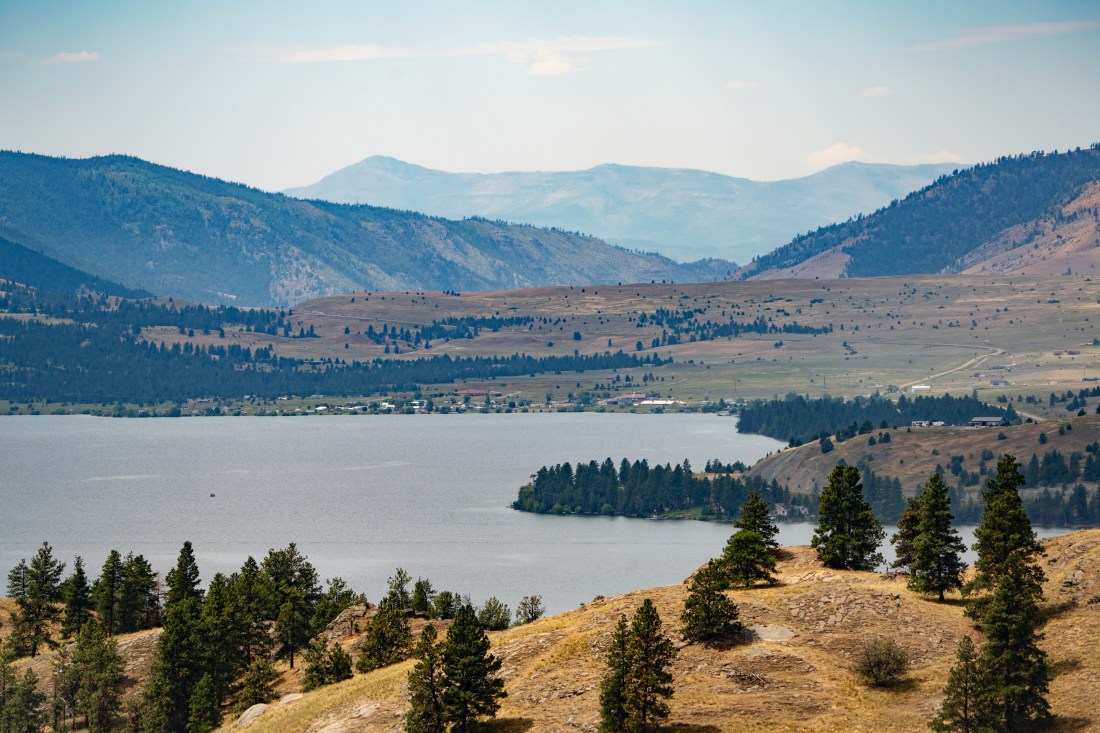
Flathead is not a pond. It covers close to two hundred square miles, runs to a maximum depth of 370 feet, and is the largest natural freshwater lake west of the Mississippi. Tom Bansak of the Flathead Lake Biological Station describes it as a geological remnant of Glacial Lake Missoula, that vast ice-dammed body whose repeated collapses scoured the Pacific Northwest.

So the concealment argument has legs. There is genuinely a great deal of cold, dark water here, and a fish with any sense would spend most of its life at the bottom of it.

The sturgeon, taken seriously

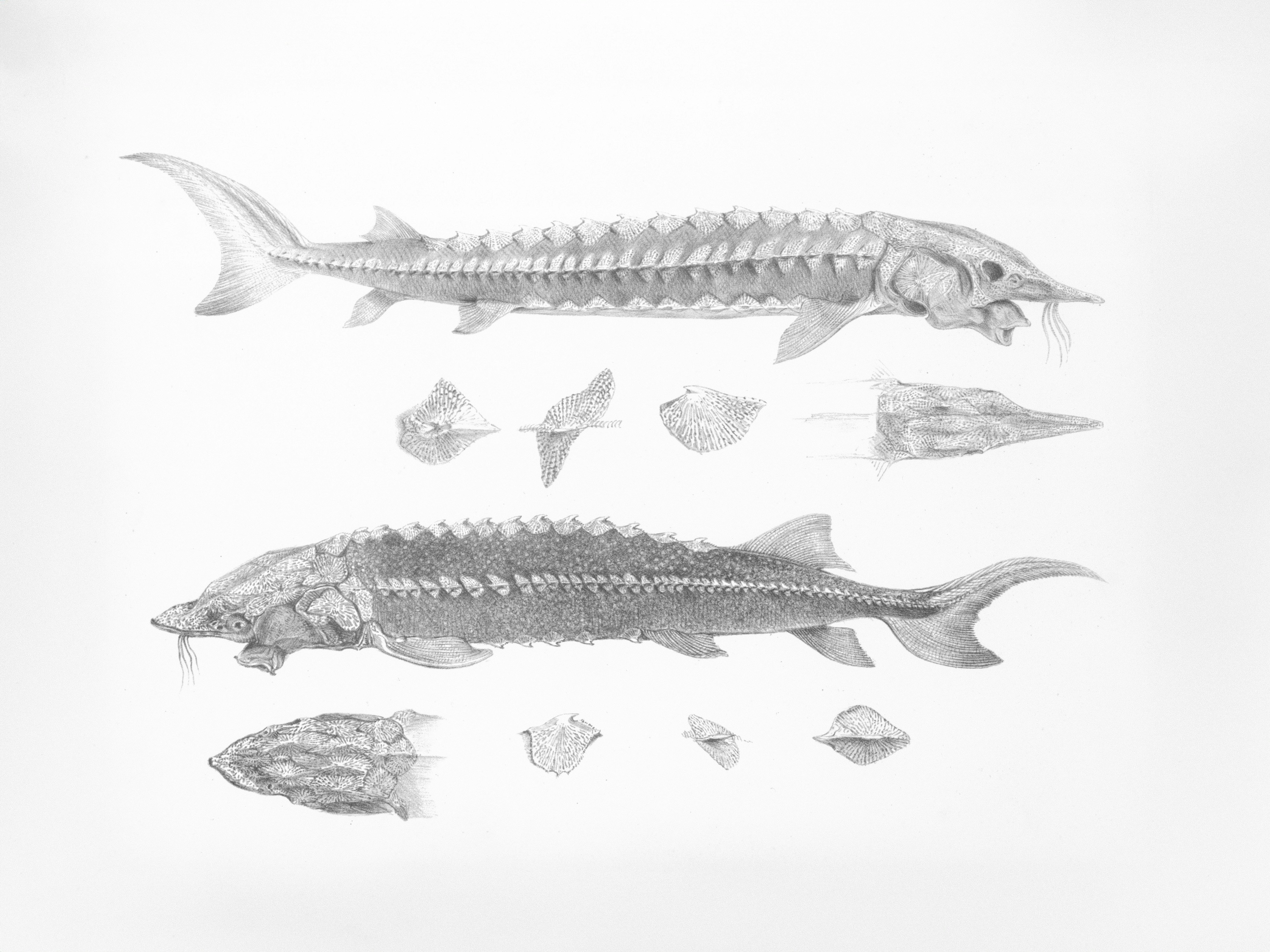
The white sturgeon is the largest freshwater fish in North America, can live the better part of a century, and looks — with its ridged back and long tapering snout — convincingly prehistoric. It is not a mad suggestion. Flathead drains into the Clark Fork, the Clark Fork into the Pend Oreille, and onwards into the Columbia system, so we are at least in the right plumbing.

Bansak is admirably straight about it: he thinks it highly likely that sturgeon lived in Flathead Lake or its predecessors, and says the real question is whether they persist and whether anyone can prove it. That is the honest scientific position, which I have little ability or interest in discrediting.

The difficulty is everything after that. The nearest white sturgeon are in a different drainage — the Kootenai River below Kootenai Falls, and Kootenay Lake up in British Columbia — and biologists cite waterfalls, and later dams, are precisely what fixed those limits. Flathead has been netted, electro-shocked, and visited by small submarines. Nothing out of the ordinary or monstrous has been officially recorded. Brian Marotz, then of Montana Fish, Wildlife and Parks, made the point that with a popular deep-water lake trout fishery operating year after year, somebody should long ago have pulled up at least a small or juvenile monster by accident.

And there is an arithmetic problem nobody likes to dwell on. The creature of the sighting record is thirty to forty feet long, undulates like a snake, and has black eyes. Even the most magnificent of sturgeons does not match that description.
The sturgeon, and where it actually came from

Here is the part that reframes the whole business.

In the 1950s, a group of Polson residents formed an organisation called Big Fish Unlimited. Its stated purpose was not zoological. It existed to generate publicity of the economically beneficial kind for the town at the south end of the lake. To that end it offered money: five hundred dollars for a sturgeon over nine feet, a thousand for one over fourteen.

Enter C. Leslie Griffith, aged sixty-three, described as a freelance fisherman, and who had reportedly taken a 300-pound white sturgeon out of Idaho’s Snake River. He moved to the lakeshore near Dayton and fished for the best part of three months. On a Friday evening in late May 1955, off Cromwell Island, something took his line and — by his account — towed his sixteen-foot cedar boat around the lake for five hours before he gaffed it.

The fish was seven feet six inches long and weighed 181 pounds. Within hours it was on ice in the Salish Hotel building and views could be had at twenty-five cents a look, ten cents for children, with a competition to guess its weight thrown in. Promotional posters billed it as “our baby monster”. Some seven thousand people came. The Great Falls Tribune put it on the front page under a headline about a fisherman hooking the Flathead Lake Monster, while noting, drily, that nobody had ever caught a sturgeon in that lake before or produced good evidence there were any. The Tribune also observed that the fish subsequently swelled to 350 pounds in newsprint.

When people began asking the obvious question — had it actually come out of the lake — the promoters responded with a masterpiece of logic. They offered a thousand dollars to anyone who could prove it hadn’t. Griffith and the group’s leading light both signed notarised statements swearing it had. Two university zoologists opened the fish up and found the situation no clearer, though one of them noted a fish backbone inside it that didn’t appear to belong to anything known to live in Flathead.

Then, as these things do, it went to law. Griffith sued over ownership and money. It took until late 1959 for the Montana Supreme Court to settle it, and the court offered no opinion whatsoever on where the fish had come from.

And the fish is not in the state records. Not then, not now.

That absence deserves emphasis, because it cannot be explained away as paperwork nobody filed. The official Montana record for white sturgeon is a 96-pound fish caught in the Kootenai River in 1968. Griffith’s was 181 pounds. Had it been accepted, it would have taken the state record by nearly double and held it comfortably for the next sixty years. Fish of that size do not slip quietly past the record-keepers.

To be scrupulous: record books have eligibility rules about method of capture, witnesses and certified scales, and a man who gaffs a fish alone after a five-hour fight may simply fall outside them. Absence from the books is not proof of fraud. But it is not an oversight either, and the state of Montana has now spent seventy years declining to write down the most famous fish ever taken from its most famous lake.

The sturgeon theory, in other words, does not rest on a fish. It rests on a bounty.

The eel, and the map

The eel is the other favourite, and it dies faster.

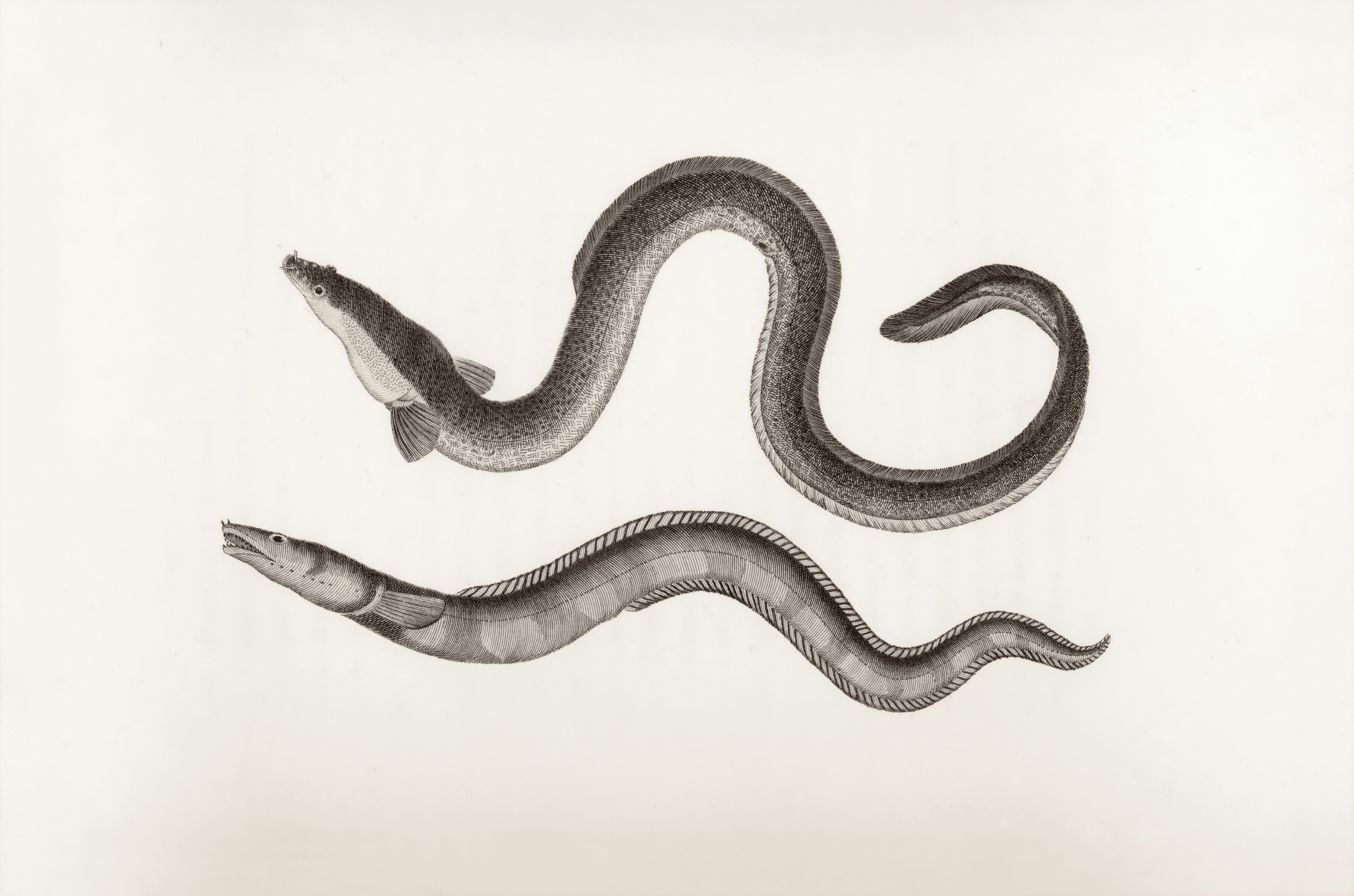
There are no freshwater eels in any Pacific drainage of North America. None. The American eel is an Atlantic animal that spawns in the Sargasso Sea, and there is no route from there to a lake in western Montana that does not involve a lorry, or truck in American parlance. The nearest eel-shaped candidate is the burbot — a freshwater cod, elongate, nocturnal, deep-dwelling — and even the burbot is native to the Kootenai drainage rather than the Flathead, turning up in the lower Clark Fork only as an introduction. Wrong system, wrong size, wrong animal.

Which tells us what “eel” is doing in these accounts. It isn’t a taxonomic proposal. It is a word people reach for when they have seen something long moving through water, because English does not offer them a better one. Well, other than monster.
The thing under the ice

Long before any of this, the Ktunaxa told a story about the lake.

In the version recorded by Ella E. Clark in Indian Legends from the Northern Rockies, the people once lived on an island in the middle of Flathead. Crossing the frozen lake one winter, two girls found antlers about two feet long standing up through the ice. Taking them for a dead animal’s, the girls set about cutting them free with sharp stones. The antlers began to shake. The ice split open, and a head came up through it. The girls escaped by transforming themselves, but half the people drowned — which is why, the story holds, there are so few Ktunaxa, and why afterwards they did not stray far from the shore.

Modern write-ups routinely cite this as proof that the monster has been seen for centuries. It is worth noticing how badly that fails.

The creature in the story is antlered. It is not a sturgeon and it is not an eel. And the story is not a sighting report — it explains why the world is as it is and warns against a particular kind of greed. Conscripting it as corroboration for Flessie is precisely the move Big Fish Unlimited made with the sturgeon: taking something that existed on its own terms and repurposing it as evidence for a claim it never made.

There is a further point, and it matters. Sturgeon fishing was part of Ktunaxa life in the Kootenay basin, where the fish genuinely occur. These were people who knew what a sturgeon was, caught them and ate them. When their tradition describes an antlered thing shaking apart the ice, it is not a confused account of a big fish. It is a different kind of statement about the world, and it earns the right to be read as one.

And no, it isn’t a wendigo

Some of you got to “antlered creature” and thought it. Or, at least I did. So, let’s deal with it, because the answer is more interesting than a connection would have been.

The wendigo belongs to Algonquian-speaking peoples of the Great Lakes and the subarctic — Cree, Ojibwe, Saulteaux, Innu. Flathead’s peoples are Salishan and Ktunaxa, the latter speaking an isolated language with no accepted relation to Algonquian or anything else. Different culture area, different language family, and a very great distance between them.

More to the point, the traditional wendigo has no antlers. It is a gaunt, ash-skinned figure with sunken eyes and a heart of ice, whose hunger grows with everything it eats, and its horror is that it still looks like a person. The antlered deer-skull creature is a twentieth-century invention, assembled out of horror fiction and finished off by video games and internet art.

So the wendigo acquired its antlers exactly the way Flessie acquired its sturgeon. Retrofitted from outside, by people telling the story for their own purposes, until the new version buried the old one. If like me you made that connection a moment ago, you weren’t making a mistake. You were demonstrating the thesis.

The trade in monsters

None of this was new in 1889, and Kerr’s generation had form.

In July 1855, fishermen on Silver Lake in western New York saw a floating log that turned out to move. The local paper reported it. More sightings followed. Visitors poured into the town of Perry, watchtowers went up, vigilance committees patrolled the water, and the Walker Hotel filled up well outside the season. In 1857 the hotel burned down, and in the wreckage somebody found a wire-and-canvas serpent with a set of bellows. The hotelier had built his monster on the bones of a Seneca story about a creature in the lake. Out-of-town papers had called it nonsense from the start, and had been right.

A log that turns out to move was, by 1889, very nearly a genre convention.

Nobody has found bellows in Flathead, and I am not accusing Captain Kerr of anything. But a lake steamer full of paying passengers in a brand-new state on the edge of a tourist boom is a particular kind of setting, and the local paper, the Flathead Courier at Polson, spent decades as the monster’s newspaper of record.

Its long-serving editor, Paul Fugleberg, kept an inventory of what sightings turned out to be. Wave action, shadows, odd light, logs. Bears, horses, deer, elk, and even dogs. There was also a dead monkey, an escaped buffalo, and a circus seal that had gotten loose. There is a whole social history of Montana in that list.

The part that should give us pause

It would be easy to finish there, and it would be too easy.

Fugleberg himself never dismissed the possibility outright. In 1962 the writer Dorothy M. Johnson, then secretary of the Montana Press Association, wrote to warn him against treating the reports with his tongue in his cheek: the witnesses had been frightened, and hadn’t found it funny. She added that she had heard of something in Flathead Lake forty years earlier, so the Polson Chamber of Commerce could not claim the credit.

Then there is Laney Hanzel, who worked the lake as a fisheries biologist for Montana Fish, Wildlife and Parks from 1960 until 1993 and became the closest thing the phenomenon had to a scholar. He compiled the sightings, interviewed the witnesses, mapped them all. He disliked the word monster and refused to use it. He called it a creature, and by every account he told the stories in a way that left you genuinely unsure what he thought, and free to decide for yourself.

Thirty years on the water, night and day, and Hanzel never saw a thing himself.

What is actually in the lake

In truth? Probably nothing out of place. A very large lake trout, a floating log at the wrong angle, an elk swimming a bay, a wind seam running across still water at dusk. The occasional person telling a story, and rather more people believing one.

But the more revealing question isn’t what’s down there. It’s what each generation put there. The Ktunaxa placed an antlered being beneath the ice and drew a hard warning from it. A steamboat captain in statehood year saw a whale. A chamber of commerce saw a sturgeon, and priced it at twenty-five cents a look. The twentieth century, once Loch Ness supplied the template, saw a long neck and an undulating body.

Flathead is 370 feet deep and takes three and a half years to change its water. It is very good at holding things. It just tends to give back exactly what was brought to it.
Monster Monday:The Devil of Lake Labynkyr

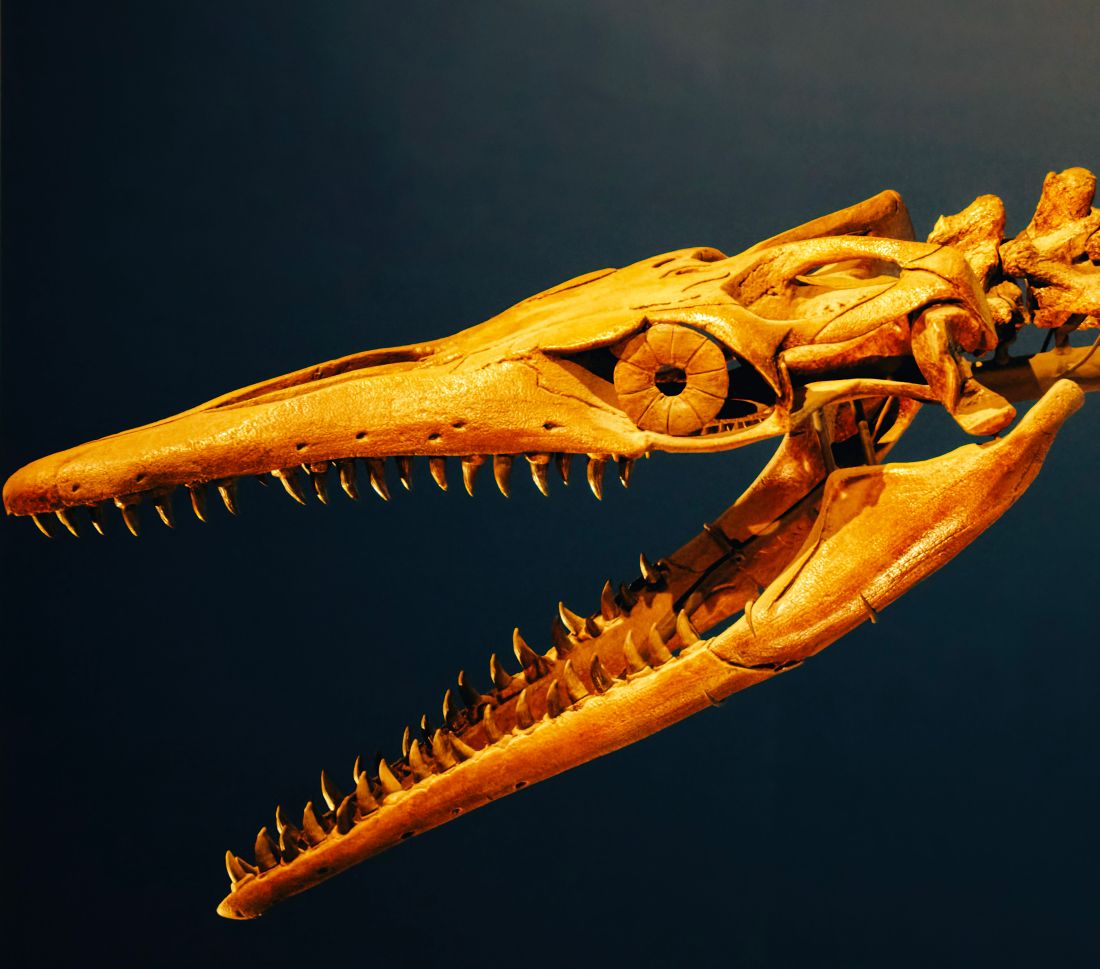
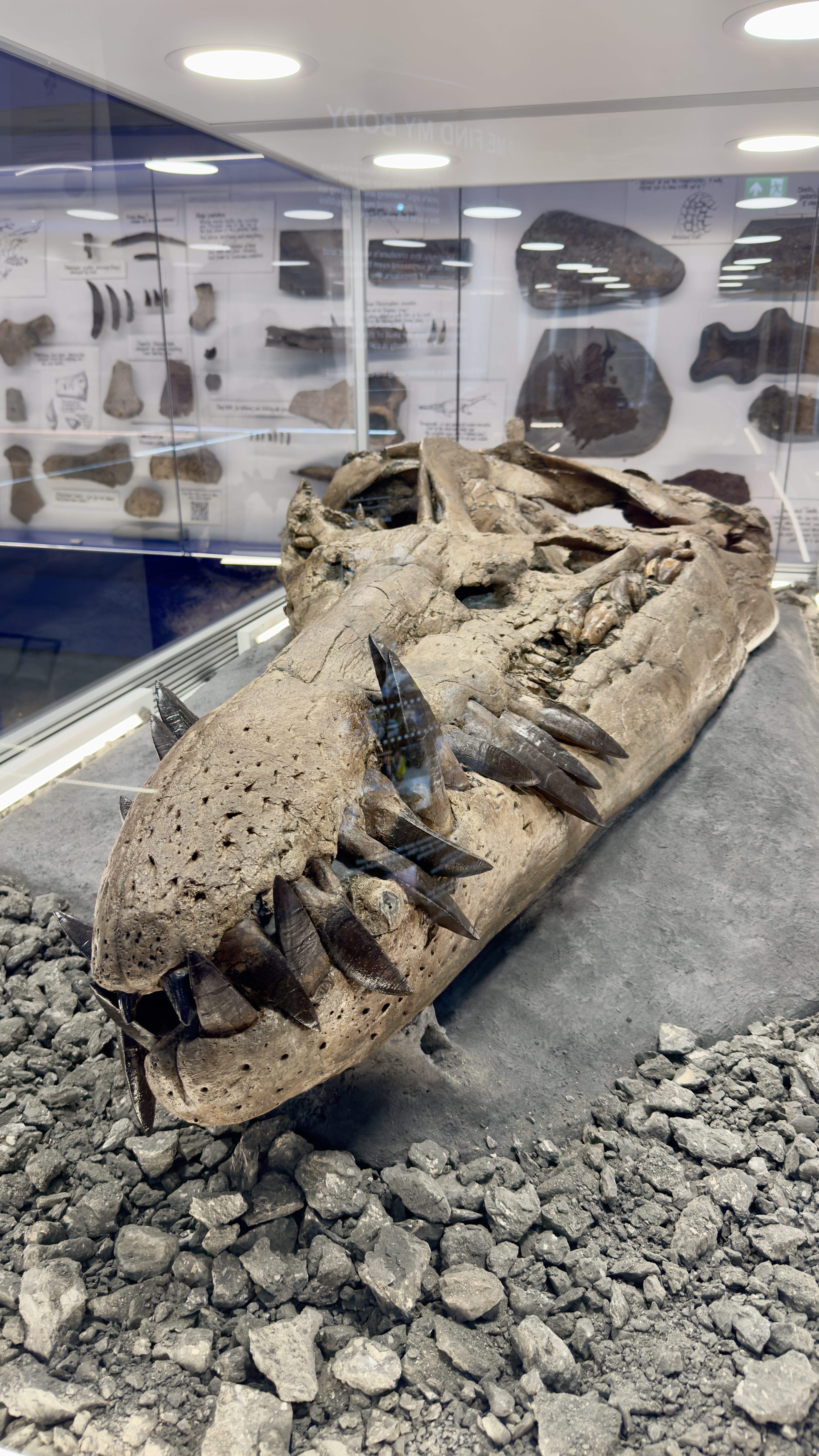
I’ve just come back from the Lyme Regis Fossil Festival, where I attended a talk by palaeozoologist Darren Naish on sea monsters past and present. Standing in the Etches Collection a few hours beforehand, staring up at the fossilised remains of a pliosaur — one of the genuine, historically verified sea monsters that once ruled the world’s oceans — I found myself doing what I suspect most visitors do: imagining it alive. Imagining the water disturbed.

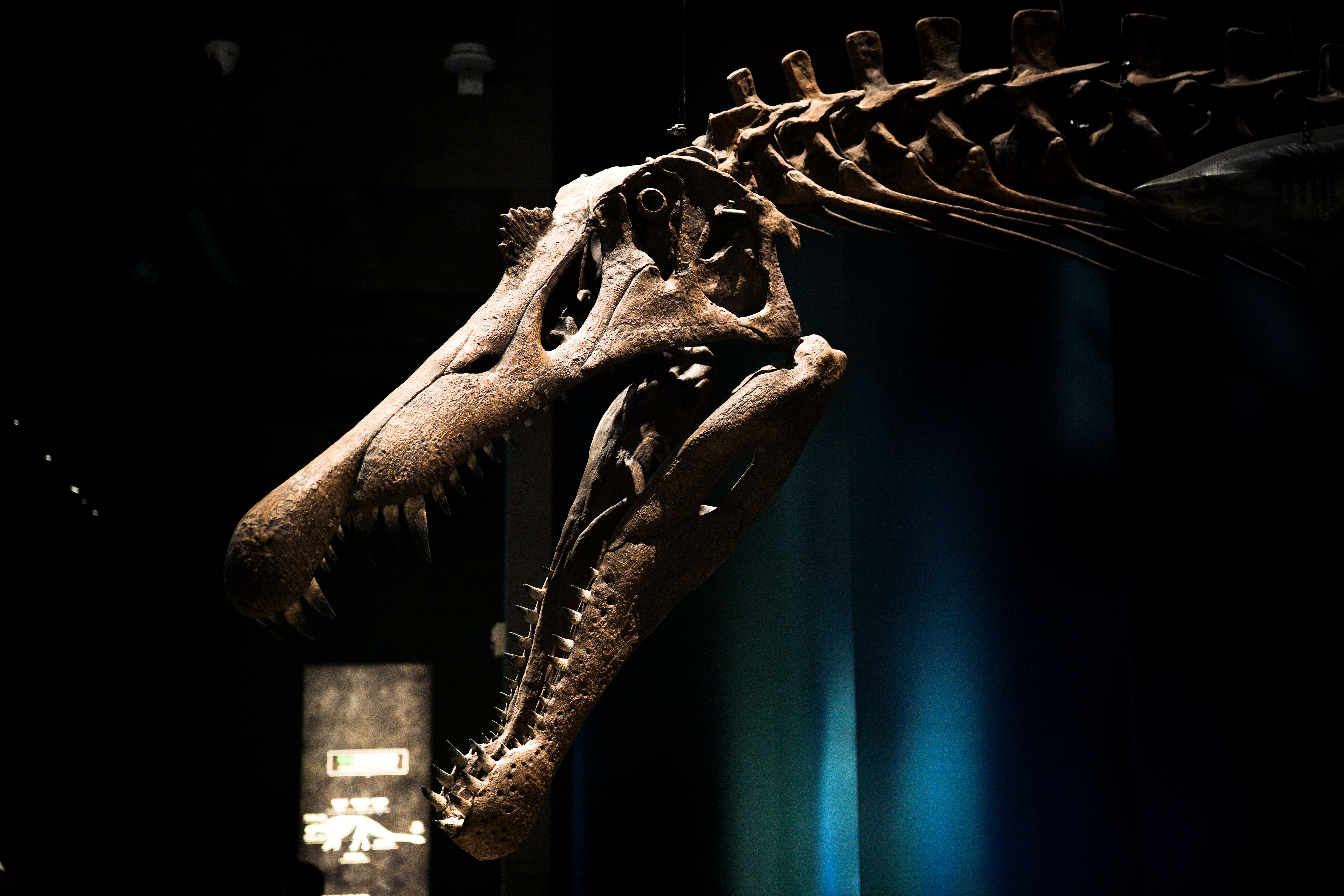
The sea rex skull at the Etches Collection.

The rational case against lake monsters is well-rehearsed, and Naish is one of its most eloquent advocates. The breeding population problem alone is formidable — a single animal isn’t a species, it’s an anecdote. And Naish has also noted, in published research with Charles Paxton, something fascinating: the rise of fossil plesiosaur discoveries in the 19th century demonstrably changed the shape of sea monster reports. Before plesiosaurs became culturally embedded, people reported sea serpents. Afterwards, they increasingly reported things with long necks, paddles, and large rounded bodies. The monster template updated itself. We see what we’ve been taught to imagine. And that’s before we get to misidentification and everyday animals and objects reported as monsters.

I’m not saying there’s nothing in any lake. I would love there to be. But it’s worth keeping that thought in mind as we travel several thousand miles east to one of the coldest places on earth. And as Naish said in his talk, no argument against potential existence is the same as saying people aren’t having experiences. Furthermore, we should be open to the possibility that science can make the logical argument why something can’t exist, but can’t account for the supernatural or other explanations. And ultimately, absence of evidence is never evidence of absence.

The Pole of Cold

Lake Labynkyr sits in the Oymyakon region of Yakutia, deep in Russia’s Far East — the same district that lays claim to being the coldest permanently inhabited place on the planet. Temperatures here have been recorded as low as -67°C. The lake itself is roughly 9 miles long, 2.5 miles wide, and plunges to around 260 feet at its deepest point. It sits at over 1,000 metres above sea level, and is ordinarily frozen from October to June. Wikipedia

Ordinarily, that is, because here Labynkyr starts to get interesting. Unlike other lakes in the region, which freeze solid during the long Siberian winter, Labynkyr doesn’t — it maintains a near-constant surface temperature of 2°C. One theory is that Labynkyr, where much of the underlying rock is volcanic, is warmed slightly from below by a fissure in the Earth’s crust. Whatever the cause, the result is a body of water sitting open and dark in the middle of one of the most hostile landscapes on the planet, surrounded by ice — and on its surface, according to those who have ventured close enough to look, large holes that locals call “devil windows” appear on the ice, with traces of large animals beside them. Fandom + 2

The nearest settlement is about 150 kilometres away. Local people, the Yakuts and Evenks, have kept their distance from the lake for generations.

What They Say Is in the Water

The creature is described as a huge, aggressive monster with a big mouth full of sharp teeth. Witnesses across different generations and different communities have given strikingly consistent accounts: a large animal with a flattened dark-grey body and a big head with a mouth like a bird’s beak with enormous teeth. Estimates put it at around 30 feet in length. The distance between its eyes, according to some accounts, is no less than the span of a traditional local raft made from ten logs. Russia Beyond + 2

The stories that have accumulated around the creature are the kind that travel. On one occasion, an unknown creature is said to have come ashore and chased a local fisherman until he died of fright. On another, the devil surfaced in front of villagers and swallowed a floating dog in a single movement. Other accounts describe hunters’ dogs leaping into the lake to retrieve shot ducks and simply disappearing. MYSTICAL RUSSIAgoodreads

The accounts predate the Loch Ness Monster — to whom Labynkyr’s creature is inevitably compared — by decades, with the earliest written records reaching back to the late 19th century. Scotland’s monster only became a media sensation in the 1930s. Labynkyr’s devil had been quietly eating dogs for at least fifty years before that. Blogger

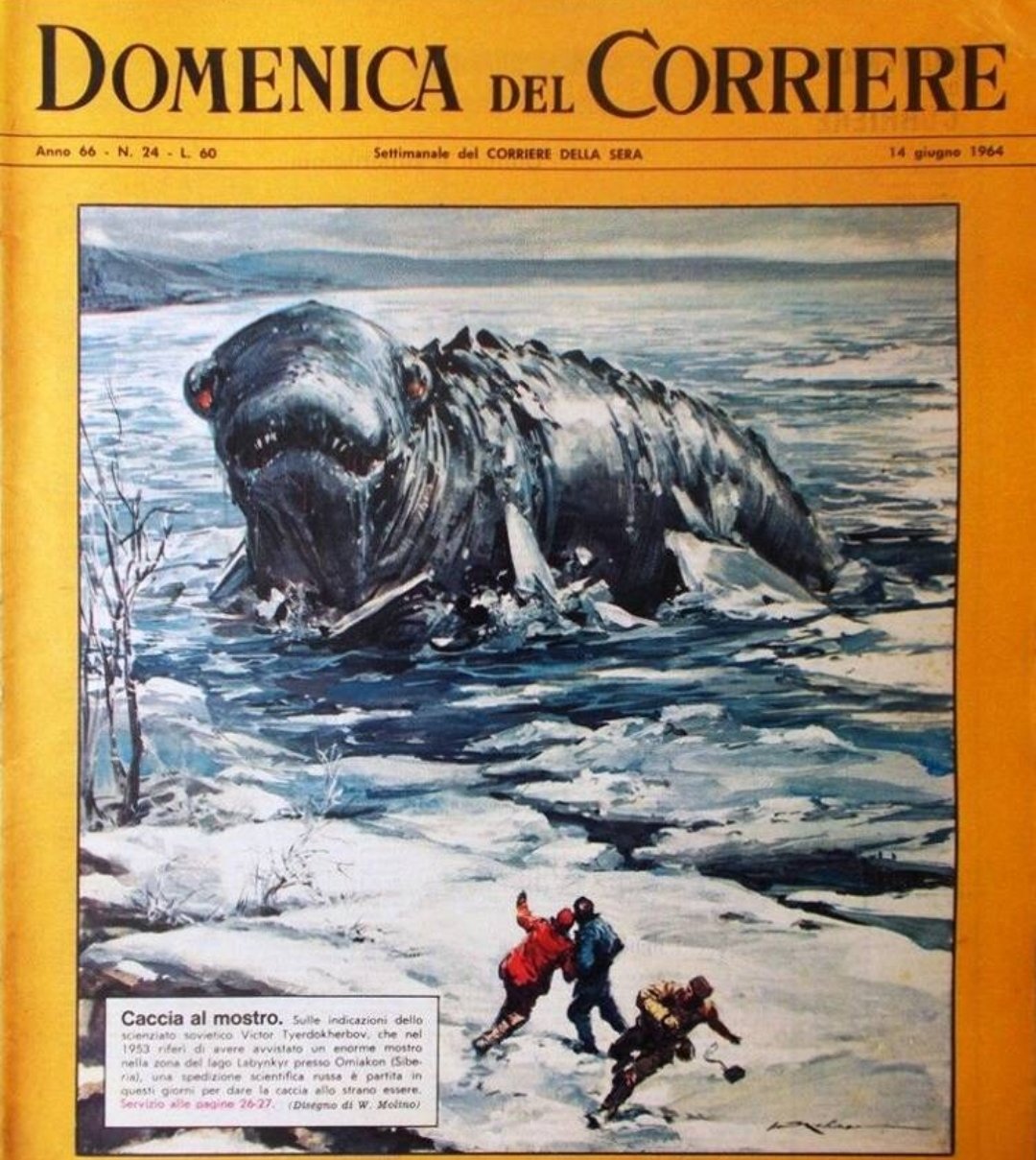
A 1964 edition of the Italian magazine Domenica del Corriere depicts the monster.

The Geologist’s Diary

The creature might have remained a piece of remote folklore, absorbed and forgotten, were it not for Viktor Tverdokhlebov. In July 1953, just a few months after Stalin’s death, Tverdokhlebov — a geologist with the East Siberian branch of the Soviet Academy of Sciences, not a man professionally inclined to whimsy — was on expedition with a colleague named Boris Bashkatov near the shore of Lake Vorota, roughly 20 kilometres from Labynkyr. What he recorded in his diary is among the more compelling pieces of eyewitness testimony in the annals of cryptozoology, precisely because of how clearly it resists embellishment.

In his own words: “It moved in an arc: first along the lake, then straight toward us. As it approached, I was seized by a strange numbness that chilled my bones. The dark grey creature rose slightly above the water, with animal eyes and something like a stick protruding from the body.” Russia Beyond

The two scientists noted it was visible by the way it moved — rising slightly above the water and throwing its torso forward. Above the surface they could make out a large dark-grey mass, and two bright symmetrical spots that resembled eyes. From the back of the creature, something protruded like a stick or a bony growth. Garynevillegasm

The diaries were published in 1961 and triggered the first formal scientific expedition to the area. It found nothing. In the following decades, several divers made attempts, during which some reported seeing something in the murky water — but nothing that could be identified or verified. Delachieve

The Remoteness Problem

There’s a pattern worth pausing on here. The Loch Ness Monster is probably the most famous cryptid in the world, and part of what made it famous is the road. The A82 runs the entire length of Loch Ness’s western shore, and has since 1833 — which means that from the moment Nessie became a media story in the 1930s, there were hundreds of daily witnesses in position to see something, and hundreds more who could arrive quickly to look. The sightings multiplied. So did the hoaxes, the misidentifications, and the tourism industry.

Loch Morar, about 70 miles to the southwest of Loch Ness, tells a different story. Its southern shore and much of its northern shore are accessible only by foot, boat, or bicycle. It is deeper than Loch Ness — the deepest inland loch in the UK at 310 metres — and it has its own monster, known as Morag, with its own sighting history stretching back to 1887. There are over thirty known recorded sightings — and given the loch’s remoteness and complete absence of tourist infrastructure, that number is arguably more striking than Nessie’s catalogue, not less. The witnesses tend to be ordinary Highland residents — fishermen, stalkers, community members — with no record of sensationalism or publicity-seeking. Morag simply isn’t famous, because almost nobody goes there. Scottish-at-Heart + 3

Labynkyr operates at a similar remove, multiplied by several orders of magnitude. It is not 70 miles from a famous loch with a visitor centre. It is 150 kilometres from the nearest settlement, in a region where the annual temperature swing can exceed 100 degrees Celsius. The handful of serious researchers who have made the journey have done so at genuine physical risk. There is no incentive to perform a sighting at Labynkyr. There is barely any incentive to go at all.

This doesn’t prove there is something in the water. But it does change the texture of the testimony — the same way Morag’s witnesses carry a different quality of credibility than a tourist snapping a photo from a car park at Drumnadrochit.

The Sonar and the Skeleton

The thread didn’t die. In 2012, Moscow State University associate professor of biogeography Ludmila Emeliyanova used sonar readings to record several large, underwater objects in Lake Labynkyr. She was careful with her language — she didn’t claim to have found a monster — but the readings were of objects larger than any fish or shoal of fish the equipment would normally register. Live Science

The following year, a team from the Russian Geographical Society dove to the lake bottom during winter conditions, in temperatures that were hitting -45°C outside. They recovered what appeared to be the remains of jaws and skeleton of an animal. The expedition’s geologist gave a quote that has the quality of the best kind of open verdict: “There have been all sorts of hypotheses about what kind of creature it could be: a giant pike, a relic reptile or an amphibian. We didn’t manage to prove or to disprove these versions… we managed to find remains of jaws and skeleton of some animal.” Live Science

Some animal. After sixty years of searching, that’s the most the evidence has yielded.

What It Probably Is (and Why That’s Still Interesting)

Sceptics at the Russian Academy of Sciences have done the maths on the creature’s supposed dimensions. If the distance between its eyes is really 1.5 metres, as some accounts suggest, then the body must be somewhere between 7 and 8 metres long. That’s not impossible for a large aquatic animal — but it rules out most of what actually lives in the lake. Pike don’t grow that large or live long enough to reach such a size, though they remain the most popular rational candidate. Cryptozoologist Karl Shuker has proposed the burbot — an unusual, deep-water fish with a loose body and a large, rather unlovely head — as an alternative candidate, arguing that in the cold of Labynkyr, undisturbed by predators or human interference, a burbot could theoretically attain a genuinely extraordinary size. Live Science + 2

There is also the mirage factor to consider. One diver who made multiple descents into the lake saw nothing but large dogfish, and noted that the area produced visual mirages — something like moving islands — that are common throughout northern regions with significant ice and snow cover. A mirage of an ice feature, glimpsed briefly across 200 metres of open lake in conditions of extreme cold, could very reasonably become a dark-grey rising hump in the telling. Wikipedia

And yet. The consistency of the descriptions across cultures and centuries is hard to entirely dismiss. The lake’s anomalous thermal properties remain partially unexplained. The underwater trench — deeper than most of the lake and, as of the last serious attempt, still not fully explored — is a blank space on the map. There are also theories that Labynkyr is connected by underwater channels to Lake Vorota, 20 kilometres away, where Tverdokhlebov made his original sighting — which would at least account for why the creature seems to appear at both locations. The Watchers

The Cover That Started in Italy

The Domenica del Corriere illustration that opens this article — that hulking, grey, thick-bodied mass rising from icy water, tiny human figures fleeing in the foreground — was published in June 1964, when the legend had been circulating in the Western press for a few years following Tverdokhlebov’s published diaries. It looks like a plesiosaur, roughly. It also looks like an enormous seal, or a boulder, or a trick of the light in one of the coldest places on Earth.

I stood in front of a genuine sea reptile fossil last week and felt the pull regardless. There’s something in us that wants the monsters to be real — and standing at the shores of a lake that refuses to freeze in -60°C weather, in a wilderness where no one lives for 150 kilometres in any direction, hearing stories that have been told in the same terms for over a century, it would be hard not to look out at the water and wonder.

The Labynkyr Devil may be a giant burbot. It may be a mirage. It may be a legend that filled a void left by a place too remote and too hostile to allow easy explanation. But until someone gets back down into that unexplored trench and comes up with something definitive, the lake keeps its secret — and in the meantime, the devil windows keep appearing in the winter ice, and no one seems particularly eager to find out who’s making them.

If you’re interested in Sea Monsters both past and present, real and imagined – you might find some in my upcoming book, Dark Tides. The Kindle version is available to pre-order now here.

X-Files: The best monsters of the week

The latest series of the X-Files is currently on UK screens (Channel 5, Mondays at 10PM), and tonight sees the arrival of the always greatly anticipated “monster of the week” episode. In season eleven’s “Ghoulie”, two teenage girls attack one another, each believing the other to be a monster. The episode plays with cultural references such as Creepy Pasta, as it explores the myth of the “screaming skull” as well as what the real definition of a monster could be.

But as we shall see, the X-Files has a long and much-loved history of flirting with cryptids and creatures. I’m going to ignore the many human (ish) monsters that have made their way into the X-Files, and just stick to those that most of us would recognise as the real deal.

S1: E19 – Shapes

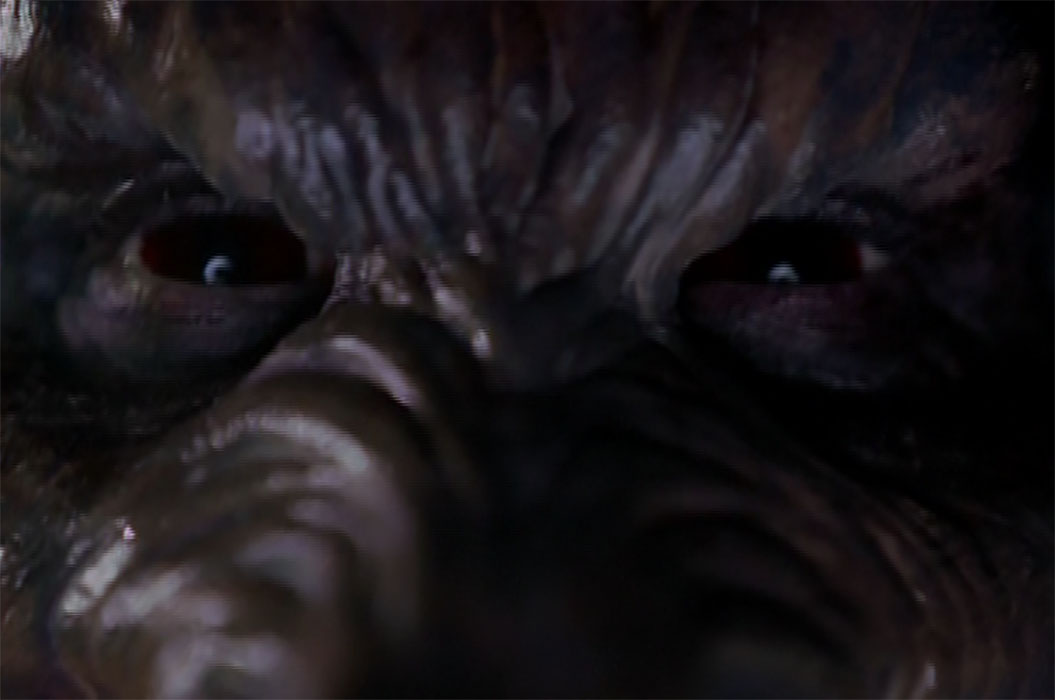
This is probably the X-Files episode that both scares me the most, and I have watched the most. Although we never really see the monster clearly, we do see it’s bulging, amber eyes and hear its panting breaths as it watches its prey from the shadows. A spate of gruesome murders brings Mulder and Scully into the jurisdiction of the Native American Tribal Police, and the legend of the Manitou – or werewolf to you and me.

In the episode, an elder explains that the curse revisits every eight years. Oh, how I wished it was a case that was returned to at a later date, but alas, it was never to be.

Shapes-X-Files-season-1-header-v1-2


S2: E2 – The Host

AKA as the flukeman, The Host sees a humanoid, parasitic organism using sewage systems to live in seclusion, away from humans. But when confronted, its predatory nature quickly comes to the surface.

S3: E22 – Quagmire

Another firm favourite, Quagmire sees our dynamic duo searching for a beast similar to the Loch Ness Monster, in a lake in Georgia. I love this episode, as it keeps you guessing all the way through, and there’s a lovely little Easter Egg right at the end too. Not an episode for dog lovers though…

Bigblue2

S5: E4 – Detour

A quintessential monster in the woods story gives Mulder the perfect excuse not to go to a team-building seminar, and instead drags Scully, and the two agents unfortunately (for them) hitching a ride, literally into the woods. Several disappearances and a boy’s tale of something invisible attacking him, leads Mulder to believe nature may be taking a vengeful turn against people.

S6: E13 – Agua Mala

As a hurricane bears down on the Florida coast, a contact asks Mulder and Scully to investigate the disappearance of two marine biologists. This episode is a controversial choice among X-Files die-hards, as it’s considered too funny to be scary – but it was great for two reasons. First, humour and the monster of the week episodes quickly became hallmarks of the series, and two, the late great Darren McGavin returns as Arthur Dales. Third, there’s a sea monster on the loose!

“Don’t sneer at the mysteries of the deep, young lady. The bottom of the ocean is as deep and dark as the imagination.”

Arthur Dales

S6: E16 – Alpha

A cryptozoologist and a canine biologist import a rare Chinese dog that kills those transporting it and seems to show supernatural cunning in its behaviour. More evil glowing eyes in this episode, and an interesting twist too.

S7: E12 – Cops

A clear example of how humour and the monster of the week episodes worked well together, the crew of hit show “Cops” follow Mulder and Scully as they investigate a neighbourhood monster.

S8: E19 – Alone

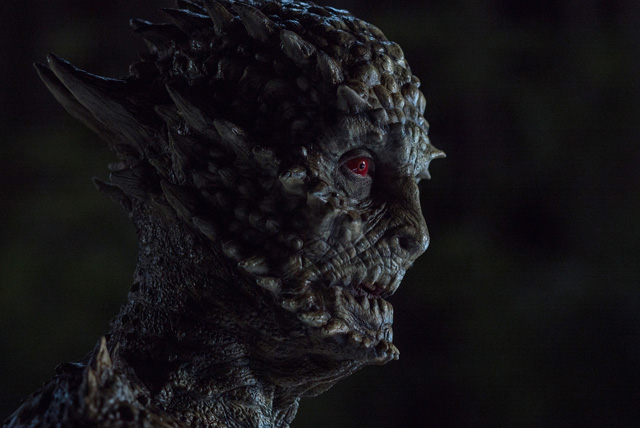
In season 8, it took a full-blown reptilian creature to drag Mulder back into the X-Files for a guest appearance. Just remember that folks, it was a monster of the week that brought Mulder back. You’d be watching Robert Patrick right now if it wasn’t for that scaly SOB.

S10: E3 – Mulder & Scully meet the Were-monster

This episode was greatly anticipated by show fans, not for just being the only monster of the week of the newly emerged season 10, but also for the return of writer Darin Morgan. The one-liners come thick and fast, and the twist is almost as funny.

xfiles12

So, although I couldn’t quite make it to ten, perhaps tonight’s “Ghoulie” will make the list. Are you sitting comfortably? Yes? Obviously, I want to believe you, but you can’t possibly be watching the X-Files then! And remember, just like the truth, the monsters are out there.