Movie Monday: Remembering Sam Neill (1947-2026)

Two weeks ago I sat in the front row of the BFI IMAX and watched a palaeontologist go weak at the knees over a brachiosaur. The film was Jurassic Park, screened for London Climate Week by The Wildlife Trusts, and before the lights dropped, Craig Bennett – Chief Executive of The Wildlife Trusts – made the point that we perhaps could never have imagined at its inception: the film is thirty-three years old, and its science fiction has quietly become science. De-extinction is no longer a plot device. It is a funding round.

I did not expect, a fortnight later, to be writing about the man who played that palaeontologist because he had gone.

Sam Neill died on Monday in Sydney, aged 78. His family called it sudden and unexpected, and were careful to say he remained cancer free — he had beaten the rare blood cancer he was diagnosed with in 2022, and announced as much only that spring. That is the cruelty of it. Many of us had let ourselves believe we would be seeing a great deal more of him.

I’d like to pay my respects the way this blog knows how: by noting that Sam Neill spent an extraordinary amount of his career standing next to monsters, and that almost nobody did it better.

Dr Alan Grant, and the wonder that curdles

Let’s start where most of us did. Every kid who grew up in the eighties had a dinosaur phase; Alan Grant showed up and quietly extended ours by another thirty-odd years. He was Indiana Jones with a rock hammer — a palaeontologist who would rather be knee-deep in a Montana dig than anywhere near people, least of all children. One can sympathise. What Neill understood about the part was that the wonder and the wariness are the same muscle. Watch the sauropod scene: the open-mouthed awe of a man who has spent his life with the dead and is suddenly handed the living. He recaptures this beautifully, despite all the danger via dinosaurs his character has been exposed to by then, when he spots the dreadnoughtus in Jurassic World: Dominion. But also watch how quickly that awe learns to be afraid. By the end he will not endorse the park, and he has become, almost against his will, the fierce protector of two frightened children.

The film’s explicit sermon on hubris belongs to Ian Malcolm — the line about scientists being so preoccupied with whether they could that they never stopped to ask whether they should, which I have leaned on myself when writing about resurrected wolves. But Grant is its conscience in a quieter register: the scientist who looks at the miracle and says, gently, that some things are not ours to command. Neill played that not as a lecture but as a kind of grief.

It’s been a while since I drew anything, but this image has been in my head all morning. Farewell Dr. Alan Grant.

When the fiction walked out of the cinema

Which brings us back to that IMAX introduction. In 2025 a Texas company, Colossal Biosciences, announced it had “brought back” the dire wolf — a claim I picked apart at length elsewhere, because what they had actually made was a gene-edited grey wolf in a very good marketing coat. The dodo, the thylacine and the mammoth are all on their stated to-do list. Grant’s fictional dilemma has become a real one, and we are all extras in it now.

The Hunter, and a guide you cannot trust

Here is where I had meant to cast Neill as the wise voice steering a hunter towards mercy — and where the film politely refuses to let me.

In The Hunter (2011), Willem Dafoe plays a mercenary sent to Tasmania by a biotech firm to find the last thylacine and take its DNA, killing any others so that no rival can have them. Neill plays Jack Mindy, the local who meets him off the plane and shows him the country — and who turns out to be a man with rather too many secrets and divided loyalties, closer to the fire that guts the film’s grieving family than to its conscience. It is Dafoe’s hunter, not Neill’s guide, who finds the moral centre, and he finds it the hard way.

I think that is the better note anyway. Mindy is a wonderfully compromised piece of work — friendly, helpful, and quietly on the wrong side — and the film’s real argument is that when the last of a kind is at stake, nobody’s hands stay clean. The thylacine Dafoe hunts was formally declared extinct in 1986; it is now, uncannily, a resurrection candidate. The monster and the man have swapped places, and Neill is right there in the middle of it.

The wider bestiary

Grant may be the headline, but Neill kept unlikely company for decades. He was the grown Antichrist in Omen III: The Final Conflict. He lost his mind aboard a very haunted spaceship in Event Horizon and inside a Lovecraftian small town in In the Mouth of Madness. He shared the sea with a killer in Dead Calm and something far worse in Possession. Time and again he was cast as the sane, civilised man at the threshold of the unspeakable — and he lent those films a gravity they had no right to expect, never once looking down his nose at the genre paying his wages.

The man himself

Neill was born in Northern Ireland in 1947 and raised in New Zealand from the age of seven, and for all the Hollywood years he never really left the land. He kept a Central Otago vineyard and a farm full of ducks, pigs and cattle that he introduced to the internet, by name, during lockdown, to the delight of several million strangers. Offered a knighthood, he waved the title away as far too grand, though he quietly accepted the honour in 2022.

And he was, by every account, a deeply kind man. In 2024 he appeared on the ABC series The Assembly, interviewed by a room of autistic journalism students, and a young woman named Abby asked him the best lesson his parents had taught him. He stopped. He teared up, admitting he could not quite say why the question had floored him, before landing on his mother’s very undramatic wisdom: that sometimes you simply have to pull yourself together. It went round the world because it was so plainly unperformed.

He spoke about his illness the same way — without self-pity, and with a line I keep coming back to. He was not frightened of dying, he said; he would just find it “very irritating”, because there were things he still wanted to do.

There were. There would have been more. Thirty-three years on from that first sauropod, the beautiful, terrible animals he stood beside are climbing out of the past and into our laboratories — and it feels right that the man who taught a generation to look at them with equal parts hunger and caution should get the last, quiet word.

Rest well, Sam. Try not to be too irritated.
Meet the Sabretooths

Warning – potential book spoilers ahead

I like to keep a lot of visual references and trinkets of inspiration around me when I write. Dotted around my workspace are various Schleich dinosaurs – Carnotaurus and T. Rex have prominent places (what can I say, I like predators!); and a selection of plush toys including a sabretooth, Nessie, and a black jaguar cub. Then, there are black jaguar and black leopard models, slightly overshadowed by the huge ‘stray cat’ Smilodon from Rebor.

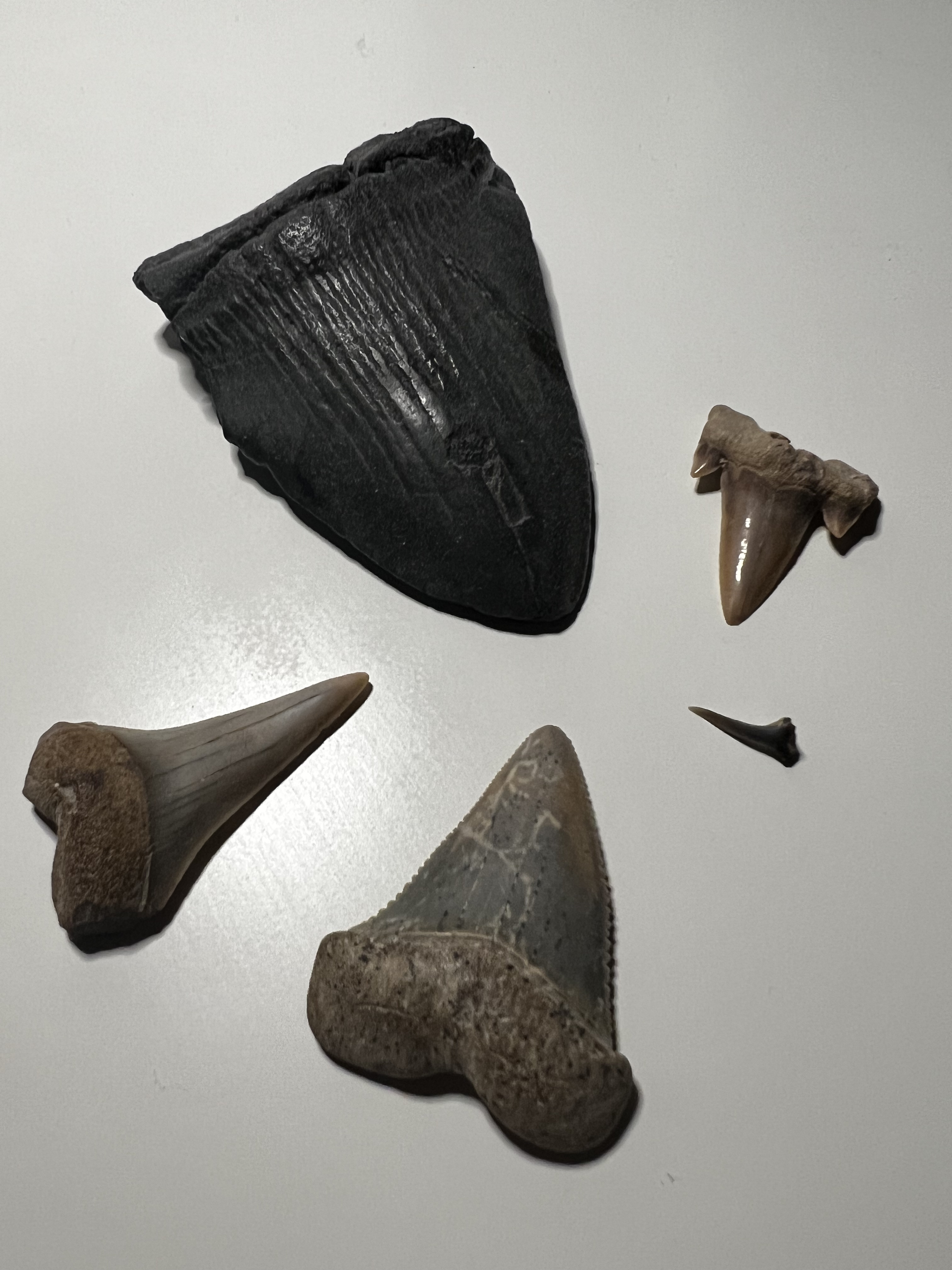
On my desk is a selection of teeth and claws. Some are real, whilst others are museum replicas. I have megalodon, great white, and mako teeth that are all the genuine article, as well as two other fossil shark teeth I’ve never been able to identify 100% (found on a beach on the Isle of Sheppey). Incidentally, the great white tooth was found on a beach in La Jolla, California.

My desk collection of modern and prehistoric shark teeth.

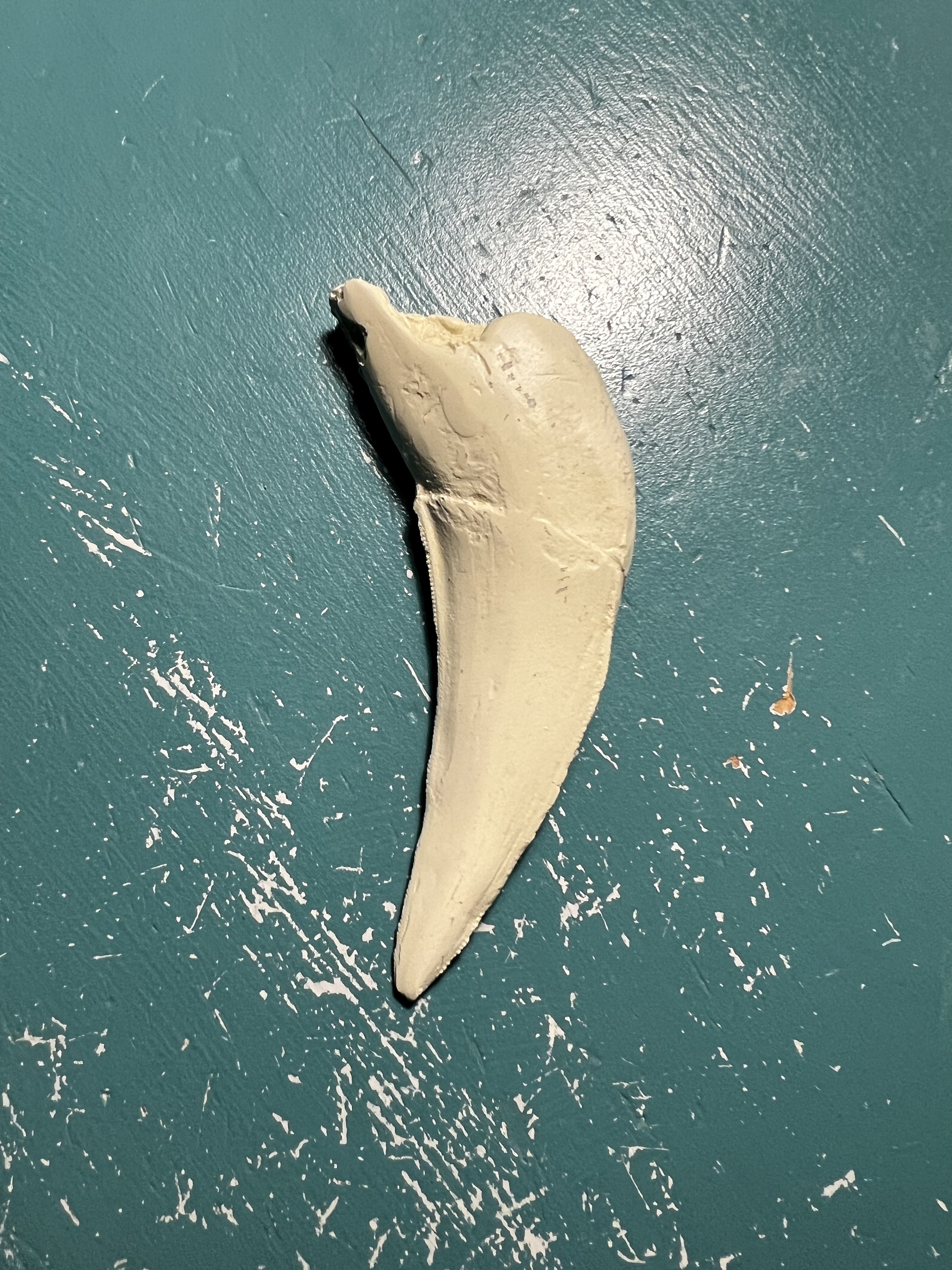
Among the replicas is the tooth you see in the picture below. It’s a cast of a canine from Homotherium. Also known as the scimitar-toothed cat, this was one of the most widely distributed sabre-toothed predators to have existed, having roamed North and South America, Eurasia, and Africa. 

Sabretooths are featured in my books, and I’m often asked why I didn’t choose Homotherium as the species that ultimately plays a major role in the ongoing storyline. There’s a couple of reasons, but first, did you know how many different sabretooths there are to (hypothetically) choose from?

Homotherium belonged to the Machairodontinae (meaning daggertooth) sub-family within the Felidae (true cat) family of mammalian carnivores. Like all in this sub-family, they are most known for their enlarged maxillary canines. In almost all cases, these protruded from the mouth on either side of the jaw and were visible even when the mouth was closed. But, in the case of Homotherium, it’s likely that despite having relatively large canines, they would have been hidden by the upper lips and lower gum tissues, just like in modern big cats. This was just one reason Homotherium didn’t make the cut. I needed a sabretooth that could be recognised for what it is – despite Homotherium’s convenient European fossil record.

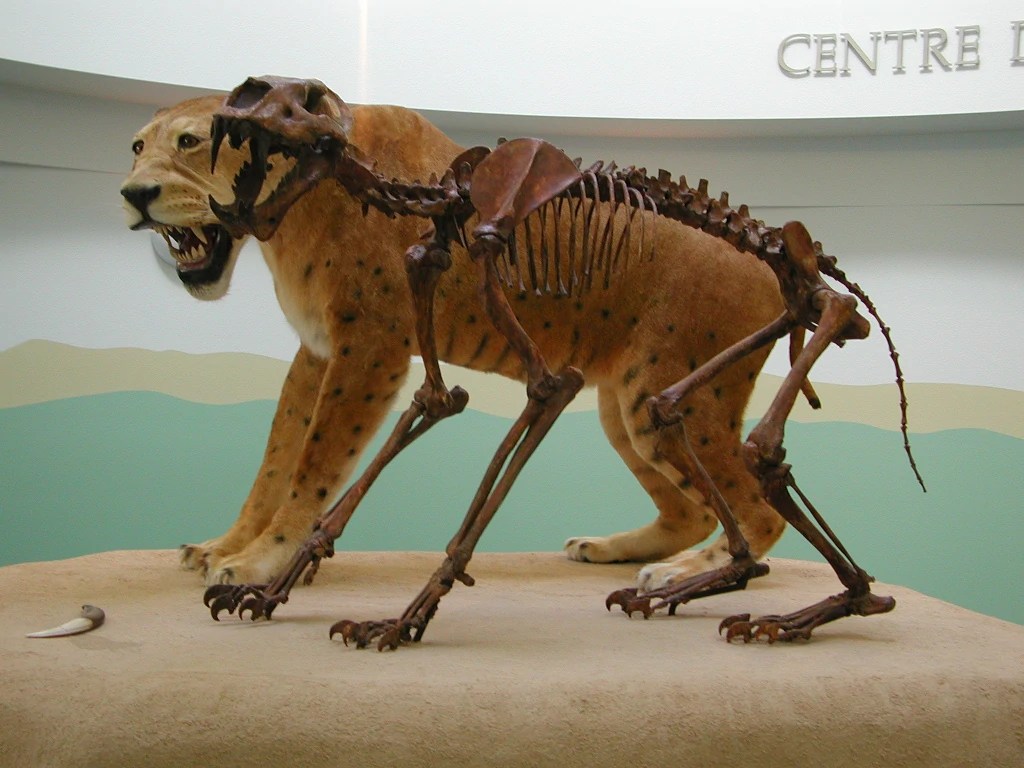
A museum replica of Homotherium, alongside a skeletal reconstruction.

Don’t be fooled into thinking Homotherium didn’t pack a punch though. They were about the size of a male African lion. And not only were its teeth designed for slashing, but also a powerful gripping bite capable of delivering deep puncture wounds.

Joining Homotherium in the Machairodontinae is also Amphimachairodus (thought to be some of the earliest sabretooths to inhabit Europe); Lokotunjailurus (think a long-legged, more gracile lioness) was known from the Miocene epoch across Kenya and Chad; Nimravides – a tiger-sized sabretooth that appeared in the late Miocene and has been found exclusively in North America; and Xenosmilus. 

If you’ve read my books, you’ll know why I’ve paused there. Xenosmilus was big, even for a sabretooth. In fact, only Smilodon (who’ll we’ll come to later) was noticeably larger in terms of mass. Yet it stands out among others in the sub-family for other reasons.

Before Xenosmilus was discovered, sabretooths fell relatively neatly into two categories. Scimitar-toothed cats, like Homotherium, had mildly elongated canines and long legs. Dirk toothed cats, like Smilodon, had long upper canines and stout legs. Xenosmilus broke the mould. It had short, muscular legs and a robust body – yet its canines weren’t as pronounced. And those teeth were different in other ways too. All of Xenosmilus’ teeth were serrated, and its top teeth aligned with the bottom in a way that enabled it to concentrate its bite force on two teeth at a time. This is where Xenosmilus gets its name – which means ‘strange smile’. The unique way that its canines and incisors operated together in biting, also led to the moniker, ‘the cookie-cutter cat’. 

The skull of Xenosmilus also features a pronounced and significant sagittal crest compared to others in the family. This meant it had phenomenal jaw strength and bite force, thanks to the muscles that would have been attached here. Together, these features have led to the theory that Xenosmilus adopted a bite and retreat hunting strategy. It would use its formidable teeth to inflict a deep wound, then wait until the prey was incapacitated. The peccary bones found close to the two type specimens indicate not only a liking for pork, but also that the species may have hunted collaboratively. 

It was these unique features that led to Xenosmilus playing the role it does in my stories. But we’re only halfway through the very top layers of the sabretooth family tree.

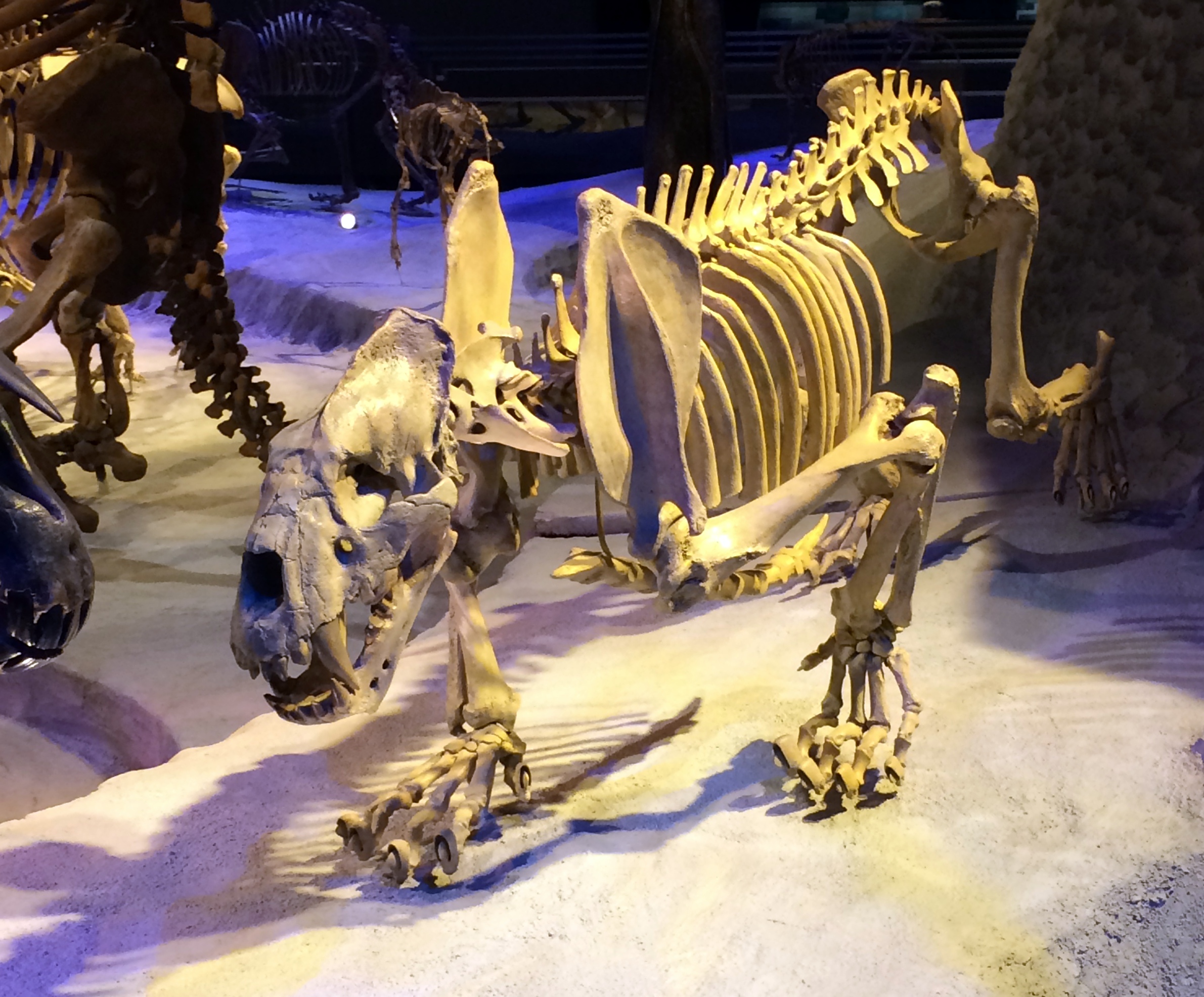
Xenosmilus skeletal reconstruction on display at the Florida Museum of Natural History.

A smaller, sub-group are the Machairodontini, made up of; Machairodus – meaning ‘knife tooth’ and who gives this little clan their name; Hemimachairodus – known from finds in Java and Indonesia; and Miomachairodus, known from finds in China and Turkey. They were large cats, similar in size to the smaller subspecies of modern-day tigers.

The Metailurini include Metailurus – a cat we know from only partial remains, but its elongated rear legs mean that it was probably an accomplished jumper. Others in the group include Adelphailurus, Stenailurus, and Yoshi – a species proposed to be quite cheetah like in behaviour. Because these species have only been identified from small finds, what we know about them is limited, but new details are being published regularly with study. 

The exception in this group is one of my favourites – Dinofelis, whose name means ‘terrible cat’. There’s some argument that Dinofelis belongs to the Smilodon sub-family, but for now, they lie here. These jaguar-sized cats were powerfully built with prominent sabres and extremely robust front limbs. They were also widespread, with fossils found across the North America, Europe, Asia, and Africa, from between 5 and 1.2 million years ago. It has also been proposed that Dinofelis preferred forest habitat and may have had a spotted or striped coat – like the modern day clouded leopard and ocelot. 

Finally, we come to the best known of the sabretooths – the Smilodontini. These include the three sub-species of Smilodon, but also the family groups of Rhizosmilodon, Promegantereon, Paramachairodus, and another favourite – Megantereon. The latter may have been a direct ancestor of Smilodon and was jaguar-sized, but even heavier set with lion-like forelimbs. Despite this, they are thought to have been able to climb relatively well and take down prey as large as a horse. And unlike its relative Smilodon, who was limited to North America, Megantereon was found in Eurasia and Africa too.

Homotherium skull

Smilodon is not only one of the most well-known sabretooths, but also one of the most easily recognised prehistoric mammals ever discovered, thanks in part to hundreds of fossils retrieved from the La Brea tar pits. Its name means scalpel, or ‘two-edged knife tooth’. Its teeth are easily the most impressive of all sabres in terms of size and were tools used for precision kills. However, these formidable upper canines were relatively weak and fragile. They had stocky, bear-like bodies and are thought to have been ambush predators that preferred thick forest and vegetation as habitat. Again, we’re not sure if they were co-operative hunters – but it is thought likely that they lived in small family groups. 

All the above sabretooths are part of the Felidae family – making them true cats. But they weren’t the only sabretooths out there. There are others, most of which fall under what are known as false sabre-toothed cats – including the nimravidae and barbourfelidae. These animals are part of the Feliformia sub-order. Again, if you’ve read my books, you’ll be familiar with that name in terms of hyenas and their fossil relatives. But it also includes animals like the Madagascan fossa, the binturong of Asia, as well as civets, mongoose, and meerkats. Cats too are part of this sub-order, and the false sabre-toothed cats are obviously more closely related than these others – but are still different from true cats.

As for sabretooths and their modern-day cat relatives, it’s thought that they shared a common ancestor from about 18 million years ago. But the family ties between the sabretooths themselves are quite strained too. For instance, Homotherium and Smilodon are probably more distantly related from each other than your typical house cat is to a tiger. But genetically, we can still forge that connection to modern day big cats like lions and tigers from studies carried out on fossil mitochondrial DNA. It’s more direct in species related to Homotherium, which is another reason Xenosmilus was a good fit on paper. It had the strength and size of Smilodon but benefited from being part of the larger sabretooth family, with more of a genetic tie (however slight) to modern big cats.

Xenosmilus skull – its name means “strange smile”.

As for would a modern-day big cat, like a jaguar, be able to breed with a sabretooth like Xenosmilus… we obviously don’t know. My conjecture is that as true cats, it’s technically possible and viable. There would no doubt be many unknown evolutionary and biological barriers to overcome, but, as a favourite fictional character facing similar concerns famously once said… “life finds a way”. 

And whereas we’ll never be able to bring back a dinosaur from its DNA to find out what it might conveniently splice with, don’t be so sure when it comes to prehistoric cats. Their DNA – from cave lions to Smilodon, has been found and identified, and in some cases, even mapped. Maybe in the near future, just like in my books, we’ll be able to visit something akin to a Pleistocene Park!

If you can’t wait until then, you can discover how these cats and others play a role in my books here.